

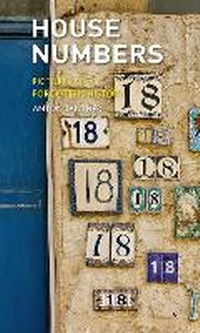
House Numbers
Pictures of a Forgotten History
Published on 1. October 2015
Book
Hardback
200 pages
978-1-78023-518-9 (ISBN)
Description
House numbers are small things that appear quietly on the walls, gates and porches of our homes and places of work. They seem to have come from nowhere and are now taken for granted in everyday life. But house numbers have their own history - one that is retrieved, assembled and presented here, for the first time, in vivid images from around the world.
House numbers started their lives in a grey area between the military, the tax authorities and early police forces. Anton Tantner's engaging, intriguingly quirky book is a chronicle of the house number, from its introduction in European towns in the eighteenth century through the spread of the numbering system in the nineteenth century to its global adoption today. It also reveals that there was often opposition to this convention - those living at their allotted addresses have not always been too happy about their houses being given numbers.
House Numbers is full of original research and is extensively illustrated, with photographs showing historic house numbers and addresses, from Nought, Strand-on-the-Green in London to 1819 Ruston, Louisiana. Its narrative will alter the way you walk around a city, as these seemingly minor, insignificant aspects of our houses and streets become links to a broad and fascinating history.
House numbers started their lives in a grey area between the military, the tax authorities and early police forces. Anton Tantner's engaging, intriguingly quirky book is a chronicle of the house number, from its introduction in European towns in the eighteenth century through the spread of the numbering system in the nineteenth century to its global adoption today. It also reveals that there was often opposition to this convention - those living at their allotted addresses have not always been too happy about their houses being given numbers.
House Numbers is full of original research and is extensively illustrated, with photographs showing historic house numbers and addresses, from Nought, Strand-on-the-Green in London to 1819 Ruston, Louisiana. Its narrative will alter the way you walk around a city, as these seemingly minor, insignificant aspects of our houses and streets become links to a broad and fascinating history.
Reviews / Votes
perhaps the most interesting thing about a system that attempted to standardise and fix house numbers is the sheer variety of their expression from Venices distinctive black charcoal numbers on whitewashed squares to the blue-and-white enamelled plaques to be found throughout the cities of the old Habsburg empire . . . Some of these myriad modes of expression are expressed in the excellent new book House Numbers. * <i> Financial Times</i> * The word enthralling isnt one to use lightly when embarking on a book review and it has probably rarely been used in connection with the prosaic matter of the numbering of houses. However, Anton Tantners book, House Numbers: Pictures of a Forgotten History fully earns the adjective . . . Rather more than half the book consists of photographs of house numbers ranging from Nought (in London) to 5,876 (in Venice) there are 14 pages of notes and suggestions for further reading on what few could have realised is such an historically rich subject. * <i>Methodist Recorder</i> * The further you look into the humble house number the more fascinating information is revealed right up to the modern usage of addresses by such as Google and other marketing groups . . . A wonderful insight into our numbering of houses is presented in the pictures of ornate and beautiful plates and tiles at the rear of the book, with designs used for hundreds of years to denote the various styles of the numbering . . . Each plate is spectacular in its own right as it gives some small insight into the person, the country, the culture, the wealth of the residents and the particular time in history when the number was created. * <i>Blue Wolf Reviews</i> * Historically, houses were numbered as a way to pin down an exact address and allowed tax collectors and court officials to know who was inside. The walls became transparent, in effect. There are all sorts of ways of numbering: the horseshoe system, the Philadelphia system, the metric, the decametric and on it goes. There are heaps of photos and lots of quirky information in this book. * <i>Geelong Advertiser</i>, Australia * Sherlock Holmes famously observed that small details are often valuable clues to something larger. In similar fashion Anton Tantner, a historical sleuth, shows that the history of house numbers sheds more light on the Enlightenment as well as on the rise of the surveillance state. * Peter Burke, Emeritus Professor of Cultural History, University of Cambridge *More details
Language
English
Place of publication
London
United Kingdom
Illustrations
128 colour illustrations
Dimensions
Height: 200 mm
Width: 120 mm
ISBN-13
978-1-78023-518-9 (9781780235189)
Copyright in bibliographic data and cover images is held by Nielsen Book Services Limited or by the publishers or by their respective licensors: all rights reserved.
Schweitzer Classification
Other editions
Additional editions
E-Book
10/2015
Reaktion Books
€14.99
Available for download
Person
Anton Tantner is a historian at the University of Vienna and the author of many books.