

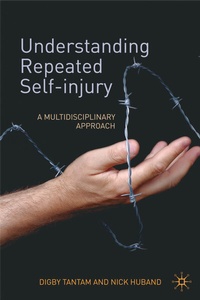
Understanding Repeated Self-Injury
A Multidisciplinary Approach
Published on 31. March 2009
Book
Hardback
248 pages
978-0-230-57939-2 (ISBN)
Description
Why do some people repeatedly injure themselves? How common is this form of self-harm? How can professionals offer appropriate intervention and support to those whose lives are troubled by it, either directly or indirectly? This authoritative and systematic book adopts a holistic approach to the problem of repeated self-injury and the difficult emotions and experiences that it gives
rise to.
Bringing together theory, research and a wealth of case vignettes, Understanding Repeated Self-Injury examines both the psychological and physical aspects of self-injury. The authors explain how deliberate cutting or burning of the skin is used by many as a way to overcome and temporarily escape bad feeling and thus transcend the limits of their identity.
In particular, the book
- presents a unifying model for theory and practice, based on the phenomenology of self-injury
- examines the important role of identity and dissociation in perpetuating self-injury
- considers the wider impact of self-injury on family and friends, and on staff
- addresses treatment strategies and self-help resources.
Each chapter draws on the authors' considerable clinical experience across a range of contexts, and is written with professionals and trainees particularly in mind. This book is an essential introduction and indispensable resource for those working, or considering to work, in counselling, therapeutic and health care settings where they are or might be confronted with the complexities of self-injury.
Reviews / Votes
'...essential reading for healthcare professionals who are seeking an in-depth, comprehensive and holistic perspective on self-harm...[a] fascinating book...' - Healthcare Counselling and Psychotherapy JournalMore details
Edition
2009
Language
English
Place of publication
London
United Kingdom
Publishing group
Bloomsbury Publishing PLC
Target group
College/higher education
Professional and scholarly
Dimensions
Height: 235 mm
Width: 157 mm
Thickness: 19 mm
Weight
559 gr
ISBN-13
978-0-230-57939-2 (9780230579392)
DOI
10.1007/978-1-137-01926-4
Schweitzer Classification
Other editions
Additional editions
Book
03/2009
Red Globe Press
€56.20
Shipment within 10-20 days
Persons
NICK HUBAND is Honorary Research Fellow at the University of Nottingham, UK, and Clinical Research Fellow of the Nottinghamshire Healthcare NHS Trust.
DIGBY TANTAM is Clinical Professor of Psychotherapy and co-Director of the Centre for the Study of Conflict and Reconciliation at the University of Sheffield, UK. He is also Deputy Director of the New School of Psychotherapy and Counselling, Schiller International University; Senior Visiting Research Fellow in the Section of Developmental Psychiatry at the University of Cambridge; an Honorary Consultant Psychiatrist and Psychotherapist for the Sheffield Health and Social Care Foundation NHS Trust; and a director of Dilemma Consultancy Ltd.
DIGBY TANTAM is Clinical Professor of Psychotherapy and co-Director of the Centre for the Study of Conflict and Reconciliation at the University of Sheffield, UK. He is also Deputy Director of the New School of Psychotherapy and Counselling, Schiller International University; Senior Visiting Research Fellow in the Section of Developmental Psychiatry at the University of Cambridge; an Honorary Consultant Psychiatrist and Psychotherapist for the Sheffield Health and Social Care Foundation NHS Trust; and a director of Dilemma Consultancy Ltd.
Content
Preface.- The Basics Facts About Self-Injury.- Understanding the Person Who Self-Injures.- A Unifying Model Based on the Phenomenology of Self-Injury.- Overcoming Self-Injury.- Moulds and Matrices.- Challenges for the Carer.- First Professional Responses to Self-Injury.- Recovery .- Summary and Conclusions.