

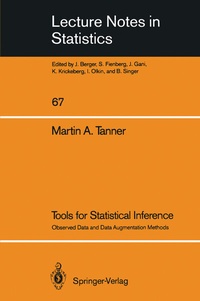
Tools for Statistical Inference
Observed Data and Data Augmentation Methods
Published on 30. March 1993
Book
Paperback/Softback
VI, 110 pages
978-0-387-97525-2 (ISBN)
Description
From the reviews: The purpose of the book under review is to give a survey of methods for the Bayesian or likelihood-based analysis of data. The author distinguishes between two types of methods: the observed data methods and the data augmentation ones. The observed data methods are applied directly to the likelihood or posterior density of the observed data. The data augmentation methods make use of the special "missing" data structure of the problem. They rely on an augmentation of the data which simplifies the likelihood or posterior density. #Zentralblatt für Mathematik#
More details
Series
Edition
Softcover reprint of the original 1st ed. 1991
Language
English
Place of publication
NY
United States
Target group
Professional and scholarly
Research
Illustrations
VI, 110 p.
Dimensions
Height: 22.9 cm
Width: 15.2 cm
Weight
215 gr
ISBN-13
978-0-387-97525-2 (9780387975252)
DOI
10.1007/978-1-4684-0510-1
Schweitzer Classification
Other editions
New editions

Martin Abba Tanner
Tools for Statistical Inference
Methods for the Exploration of Posterior Distributions and Likelihood Functio
Book
01/1993
2nd Edition
Springer
€45.03
Article exhausted; check for reprint
Additional editions
E-Book
12/2012
Springer
€82.38
Available for download
Content
I. Introduction.- A. Problems.- B. Techniques.- References.- II. Observed Data Techniques-Normal Approximation.- A. Likelihood/Posterior Density.- B. Maximum Likelihood.- C. Normal Based Inference.- D. The Delta Method.- E. Significance Levels.- References.- III. Observed Data Techniques.- A. Numerical Integration.- B. Litplace Expansion.- 1. Moments.- 2. Marginalization.- C. Monte Carlo Methods.- 1. Monte Carlo.- 2. Composition.- 3. Importance Sampling.- References.- IV. The EM Algorithm.- A. Introduction.- B. Theory.- C. EM in the Exponential Family.- D. Standard Errors.- 1. Direct Computation.- 2. Missing Information Principle.- 3. Louis' Method.- 4. Simulation.- 5. Using EM Iterates.- E. Monte Carlo Implementation of the E-Step.- F. Acceleration of EM.- References.- V. Data Augmentation.- A. Introduction.- B. Predictive Distribution.- C. HPD Region Computations.- 1. Calculating the Content.- 2. Calculating the Boundary.- D. Implementation.- E. Theory.- F. Poor Man's Data Augmentation.- 1. PMDA#1 65.- 2. PMDA Exact.- 3. PMDA #2.- G. SIR.- H. General Imputation Methods.- 1. Introduction.- 2. Hot Deck 72.- 3. Simple Residual.- 4. Normal and Adjusted Normal.- 5. Nonignorable Nonresponse.- a. Mixture Model-I.- b. Mixture Model-II.- c. Selection Model-I.- d. Selection Model-II.- I. Data Augmentation via Importance Sampling.- 1. General Comments.- 2. Censored Regression.- J. Sampling in the Context of Multinomial Data.- 1. Dirichlet Sampling.- 2. Latent Class Analysis.- References.- VI. The Gibbs Sampler.- A. Introduction.- 1. Chained Data Augmentation.- 2. The Gibbs Sampler.- 3. Historical Comments.- B. Examples.- 1. Rat Growth Data.- 2. Poisson Process.- 3. Generalized Linear Models.- C. The Griddy Gibbs Sampler.- 1. Example.- 2. Adaptive Grid.- References.