

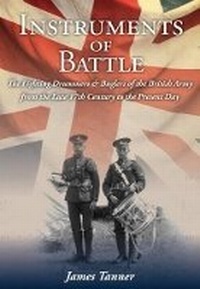
Instruments of Battle
The Fighting Drummers and Buglers of the British Army from the Late 17th Century to the Present Day
Published on 11. September 2017
Book
Hardback
288 pages
978-1-61200-369-6 (ISBN)
Description
Instruments of Battle examines in detail the development and role of the British Army's fighting drummers and buglers, from the time of the foundation of the army up to the present day. While their principal weapon of war was the drum and bugle (and the fife), these men and boys were not musicians as such but fighting soldiers who took their place in the front line.
The origins of the drum and bugle in the Classical Period and the later influence of Islamic armies are examined, leading to the arrival of the drum and fife in early Tudor England. The story proper picks up post-English Civil War and the drum's period of supremacy through much of the eighteenth century army; certain myths as to its use are dispelled. The bugle rapidly superseded the drum for field use in the nineteenth century until developments on the battlefield consigned these instruments largely to barrack-life and the parade-ground. But there are surprising examples of the use of the bugle in the field through both World Wars and the story is brought up to most recent times and relegation to an almost exclusively ceremonial role.
This is all set against a background of campaigns, battles, changing tactical methods and the difficult processes of command and control on the battlefield. Interwoven is relevant comparison with other armies, particularly American and French. The wider roles of drummers, especially, as battlefield heralds, as adjuncts to recruiting and dispensers of punishment are considered, as well as the other roles they and buglers assumed, out of practicability, on the modern battlefield. Stories of the drummers and buglers themselves provide social context to their place in the army.
The origins of the drum and bugle in the Classical Period and the later influence of Islamic armies are examined, leading to the arrival of the drum and fife in early Tudor England. The story proper picks up post-English Civil War and the drum's period of supremacy through much of the eighteenth century army; certain myths as to its use are dispelled. The bugle rapidly superseded the drum for field use in the nineteenth century until developments on the battlefield consigned these instruments largely to barrack-life and the parade-ground. But there are surprising examples of the use of the bugle in the field through both World Wars and the story is brought up to most recent times and relegation to an almost exclusively ceremonial role.
This is all set against a background of campaigns, battles, changing tactical methods and the difficult processes of command and control on the battlefield. Interwoven is relevant comparison with other armies, particularly American and French. The wider roles of drummers, especially, as battlefield heralds, as adjuncts to recruiting and dispensers of punishment are considered, as well as the other roles they and buglers assumed, out of practicability, on the modern battlefield. Stories of the drummers and buglers themselves provide social context to their place in the army.
Reviews / Votes
From the well-known writings of Humphrey Bland of 1727 to many seldom seen sources is good enough reason to read this excellent work which seldom ceases to be both informative and entertaining. * The Bulletin of the Military Historical Society * The hitherto forgotten story of the development of the regimental band, mainly drummers and buglers. A rare piece of social history. * Books Monthly *More details
Language
English
Place of publication
United States
Illustrations
black & white and colour illustrations
Dimensions
Height: 229 mm
Width: 152 mm
ISBN-13
978-1-61200-369-6 (9781612003696)
Copyright in bibliographic data and cover images is held by Nielsen Book Services Limited or by the publishers or by their respective licensors: all rights reserved.
Schweitzer Classification
Other editions
Additional editions
James Tanner
The Instruments of Battle
The Fighting Drummers and Buglers of the British Army from the Late 17th Century to the Present Day
E-Book
01/2020
Casemate
€18.18
Available for download
Person
Brigadier James Tanner was commissioned into the Staffordshire Regiment in 1976 and served in command and staff appointments across the planet in his 35 years in the Army. He commanded his battalion in England, Northern Ireland and Hong Kong in the mid-1990s and was the last Colonel of his Regiment in 2007. He spent much of the decade before retiring from the Army in 2011 in the Middle East and now divides his time between commercial activities in the region, guiding battlefield tours and writing. He has an honours degree in history from the University of Kent and a lifelong interest in the British soldier in battle. He lives with his wife in Suffolk.