

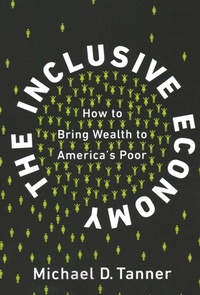
The Inclusive Economy
How to Bring Wealth to America's Poor
Published on 15. May 2020
Book
Paperback/Softback
328 pages
978-1-948647-97-7 (ISBN)
Description
Author Michael Tanner offers a new anti-poverty agenda that includes criminal justice reform, educational freedom, housing deregulation, banking reform, and more inclusive growth.
The Inclusive Economy: How to Bring Wealth to America's Poor energetically challenges the conventional wisdom of both the right and the left that underlies much of the contemporary debate over poverty and welfare policy. National public policy expert Michael Tanner takes to task conservative critiques of a “culture of poverty” for their failure to account for the structural circumstances in which the poor live. In addition, he criticizes liberal calls for fighting poverty primarily through greater redistribution of wealth and new government programs.
Rather than engaging in yet another debate over which government programs should be increased or decreased by billions of dollars, Tanner calls for an end to policies that have continued to push people into poverty. Combining social justice with limited government, his plan includes reforming the criminal justice system and curtailing the War on Drugs, bringing down the cost of housing, reforming education to give more control and choice to parents, and making it easier to bank, save, borrow, and invest.
The comprehensive evidence provided in The Inclusive Economy is overwhelming: economic growth lifts more people out of poverty than any achievable amount of redistribution does. As Tanner notes, “we need a new debate, one that moves beyond our current approach to fighting poverty to focus on what works rather than on noble sentiments or good intentions.” The Inclusive Economy is a major step forward in that debate.
The Inclusive Economy: How to Bring Wealth to America's Poor energetically challenges the conventional wisdom of both the right and the left that underlies much of the contemporary debate over poverty and welfare policy. National public policy expert Michael Tanner takes to task conservative critiques of a “culture of poverty” for their failure to account for the structural circumstances in which the poor live. In addition, he criticizes liberal calls for fighting poverty primarily through greater redistribution of wealth and new government programs.
Rather than engaging in yet another debate over which government programs should be increased or decreased by billions of dollars, Tanner calls for an end to policies that have continued to push people into poverty. Combining social justice with limited government, his plan includes reforming the criminal justice system and curtailing the War on Drugs, bringing down the cost of housing, reforming education to give more control and choice to parents, and making it easier to bank, save, borrow, and invest.
The comprehensive evidence provided in The Inclusive Economy is overwhelming: economic growth lifts more people out of poverty than any achievable amount of redistribution does. As Tanner notes, “we need a new debate, one that moves beyond our current approach to fighting poverty to focus on what works rather than on noble sentiments or good intentions.” The Inclusive Economy is a major step forward in that debate.
More details
Language
English
Place of publication
United States
Product notice
Paperback (trade)
Unsewn / adhesive bound
Dimensions
Height: 228 mm
Width: 150 mm
Thickness: 30 mm
Weight
456 gr
ISBN-13
978-1-948647-97-7 (9781948647977)
Copyright in bibliographic data and cover images is held by Nielsen Book Services Limited or by the publishers or by their respective licensors: all rights reserved.
Schweitzer Classification
Person
By Michael D. Tanner
Content
Preface
1. Introduction
2. A History of Thinking about Poverty and Policy
3. The Cultural or Individual Behavior Theory of Poverty
4. Structural Poverty: Race, Gender, and Economic Dislocation
5. The Limits of Redistribution
6. Fighting Poverty through Criminal Justice Reform
7. Improving Human Capital: The Importance of Education Freedom
8. Reducing the Cost of Housing through Deregulation
9. Savings and the Accumulation of Wealth
10. The Ultimate Answer: Inclusive Economic Growth
11. Looking Ahead
1. Introduction
2. A History of Thinking about Poverty and Policy
3. The Cultural or Individual Behavior Theory of Poverty
4. Structural Poverty: Race, Gender, and Economic Dislocation
5. The Limits of Redistribution
6. Fighting Poverty through Criminal Justice Reform
7. Improving Human Capital: The Importance of Education Freedom
8. Reducing the Cost of Housing through Deregulation
9. Savings and the Accumulation of Wealth
10. The Ultimate Answer: Inclusive Economic Growth
11. Looking Ahead