

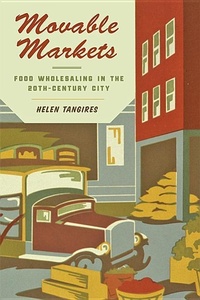
Movable Markets
Food Wholesaling in the Twentieth-Century City
Published on 2. July 2019
Book
Hardback
312 pages
978-1-4214-2747-8 (ISBN)
Description
The untold story of America's wholesale food business.
In nineteenth-century America, municipal deregulation of the butcher trade and state-incorporated market companies gave rise to a flourishing wholesale trade. In Movable Markets, Helen Tangires describes the evolution of the American wholesale marketplace for fresh food, from its development as a bustling produce district in the heart of the city to its current indiscernible place in food industrial parks on the urban periphery.
Tangires follows the middlemen, those intermediaries who became functional necessities as the railroads accelerated the process of delivering perishable food to the city. Tracing their rise and decline in the wake of a deregulated food economy, she asks: How did these people, who occupied such key roles as food distributors and suppliers to the retail trade, end up exiled to urban outskirts? Moving into the early twentieth century, she explains how progressive city planners and agricultural economists responded to anxieties about the high cost of living, traffic congestion, and disruptions in the food supply by questioning the centrality, aging infrastructure, and organizational structure of wholesale markets.
Tangires combines economic and cultural history by analyzing popular literature, innovative scholarship, and USDA publications. Detailing the legal, physical, and organizational means behind the complex exodus of food wholesaling from the urban core, Tangires also reveals how the trade adjusted to life beyond the city limits as it created new channels of distribution, product lines, and markets. Readers interested in US history, city and regional planning history, food history, and public policy, as well as anyone curious about the disappearance of the central produce district as a major component of the city, will find Movable Markets a fascinating read.
In nineteenth-century America, municipal deregulation of the butcher trade and state-incorporated market companies gave rise to a flourishing wholesale trade. In Movable Markets, Helen Tangires describes the evolution of the American wholesale marketplace for fresh food, from its development as a bustling produce district in the heart of the city to its current indiscernible place in food industrial parks on the urban periphery.
Tangires follows the middlemen, those intermediaries who became functional necessities as the railroads accelerated the process of delivering perishable food to the city. Tracing their rise and decline in the wake of a deregulated food economy, she asks: How did these people, who occupied such key roles as food distributors and suppliers to the retail trade, end up exiled to urban outskirts? Moving into the early twentieth century, she explains how progressive city planners and agricultural economists responded to anxieties about the high cost of living, traffic congestion, and disruptions in the food supply by questioning the centrality, aging infrastructure, and organizational structure of wholesale markets.
Tangires combines economic and cultural history by analyzing popular literature, innovative scholarship, and USDA publications. Detailing the legal, physical, and organizational means behind the complex exodus of food wholesaling from the urban core, Tangires also reveals how the trade adjusted to life beyond the city limits as it created new channels of distribution, product lines, and markets. Readers interested in US history, city and regional planning history, food history, and public policy, as well as anyone curious about the disappearance of the central produce district as a major component of the city, will find Movable Markets a fascinating read.
Reviews / Votes
Tangires's careful attention to physical market spaces brings them to life for readers interested in architectural history or urban planning.-Business History Review Helen Tangires tells the story of a time, in the late nineteenth and early twentieth centuries, when wholesale urban food markets mattered very much to the average consumer.
-Journal of Social History
More details
Series
Language
English
Place of publication
Baltimore, MD
United States
Target group
Professional and scholarly
Product notice
sewn/stitched
Cloth over boards
Illustrations
35 s/w Abbildungen
35 Illustrations, black and white
Dimensions
Height: 231 mm
Width: 157 mm
Thickness: 25 mm
Weight
612 gr
ISBN-13
978-1-4214-2747-8 (9781421427478)
DOI
10.1353/book.66172
Copyright in bibliographic data and cover images is held by Nielsen Book Services Limited or by the publishers or by their respective licensors: all rights reserved.
Schweitzer Classification
Other editions
Additional editions

E-Book
07/2019
Johns Hopkins University Press
€45.49
Available for download
Person
Helen Tangires (LANDOVER, MD) is the administrator of the Center for Advanced Study in the Visual Arts at the National Gallery of Art. She is the author of Public Markets and Civic Culture in Nineteenth-Century America and Public Markets.
Content
Acknowledgments
List of Acronyms
Introduction
Part I. Open Entry
1. Shelter for the Middleman
2. The Produce District: Design by Improvisation
Part II. Consolidation
3. Planning the Wholesale Terminal Market
4. The Nation's Capital: Testing Ground for the Wholesale Trade
Part III. New Frontiers
5. The New Deal: Birth of the State-Sponsored Regional Market
6. Industrial Parks and the USDA Paradigm
Conclusion
Notes
Bibliography
Index
List of Acronyms
Introduction
Part I. Open Entry
1. Shelter for the Middleman
2. The Produce District: Design by Improvisation
Part II. Consolidation
3. Planning the Wholesale Terminal Market
4. The Nation's Capital: Testing Ground for the Wholesale Trade
Part III. New Frontiers
5. The New Deal: Birth of the State-Sponsored Regional Market
6. Industrial Parks and the USDA Paradigm
Conclusion
Notes
Bibliography
Index