

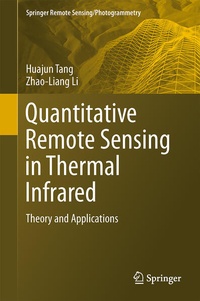
Quantitative Remote Sensing in Thermal Infrared
Theory and Applications
Published on 15. January 2014
Book
Hardback
XXI, 281 pages
978-3-642-42026-9 (ISBN)
Description
This book provides a comprehensive and advanced overview of the basic theory of thermal remote sensing and its application in hydrology, agriculture, and forestry. Specifically, the book highlights the main theory, assumptions, advantages, drawbacks, and perspectives of these methods for the retrieval and validation of surface temperature/emissivity and evapotranspiration from thermal infrared remote sensing. It will be an especially valuable resource for students, researchers, experts, and decision-makers whose interest focuses on the retrieval and validation of surface temperature/emissivity, the estimation and validation of evapotranspiration at satellite pixel scale, and the application of thermal remote sensing.
Both Prof. Huajun Tang and Prof. Zhao-Liang Li work at the Chinese Academy of Agricultural Sciences (CAAS), China.
Both Prof. Huajun Tang and Prof. Zhao-Liang Li work at the Chinese Academy of Agricultural Sciences (CAAS), China.
More details
Series
Edition
2014 ed.
Language
English
Place of publication
Berlin
Germany
Publishing group
Springer Berlin
Target group
Professional and scholarly
Research
Illustrations
43 s/w Abbildungen, 39 farbige Abbildungen
XXI, 281 p. 82 illus., 39 illus. in color.
Dimensions
Height: 23.5 cm
Width: 15.5 cm
Weight
6348 gr
ISBN-13
978-3-642-42026-9 (9783642420269)
DOI
10.1007/978-3-642-42027-6
Schweitzer Classification
Other editions
Additional editions
Book
08/2016
Springer
€128.39
Shipment within 7-9 days
E-Book
12/2013
1st Edition
Springer
€117.69
Available for download
Persons
Dr. Huajun Tang is a research professor and vice president of the Chinese Academy of Agricultural Sciences (CAAS), Beijing. He received his B.S. (1982) in agronomy from South-west Agricultural University, China, and M.S. (1987), Ph.D. (1993) with greatest distinction in Physical Land Resources from University of Ghent, Belgium. His research areas include remote sensing and GIS applications, land use and crop modeling. Over the last decades, he has served as a consultant to a number of governmental agencies, nonprofit organizations and companies including World Bank, FAO, UNESCAP. He has published more than 100 papers in international and Chinese scientific journals and has received a number of scien-tech innovation awards and honors including the corresponding member of Belgian Royal Academy of Overseas Science, President of the Chinese Society of Agricultural Resources and Regional Planning.
Dr. Zhao-Liang Li received the Ph.D. degree in physics of terrestrial environment-remote sensing from University of Strasbourg, France, in 1990. Since 1992, he has been a research scientist (Directeur de Recherche from 2011) at CNRS, France. He joined the Institute of Agricultural Resources and Regional Planning, Chinese Academy of Agricultural Sciences in 2013. He has participated in many national and international projects such as NASA-funded MODIS, EC-funded program EAGLE, and ESA funded programs SPECTRA, etc. His main expertise fields are in thermal infrared radiometry, parameterization of land surface processes at large scale, scaling change, as well as in the assimilation of satellite data to land surface models. He has published more than 100 papers in international refereed journals.
Dr. Zhao-Liang Li received the Ph.D. degree in physics of terrestrial environment-remote sensing from University of Strasbourg, France, in 1990. Since 1992, he has been a research scientist (Directeur de Recherche from 2011) at CNRS, France. He joined the Institute of Agricultural Resources and Regional Planning, Chinese Academy of Agricultural Sciences in 2013. He has participated in many national and international projects such as NASA-funded MODIS, EC-funded program EAGLE, and ESA funded programs SPECTRA, etc. His main expertise fields are in thermal infrared radiometry, parameterization of land surface processes at large scale, scaling change, as well as in the assimilation of satellite data to land surface models. He has published more than 100 papers in international refereed journals.
Content
Basic theory of quantitative remote sensing.- Radiometric calibration.- Emissivity retrieval.- LST retrieval.- Estimation of evapotranspiration.- Applications.- Future development and perspectives.