

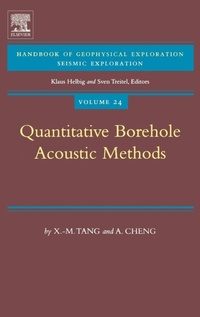
Quantitative Borehole Acoustic Methods: Volume 24
Published on 27. January 2004
Book
Hardback
274 pages
978-0-08-044051-4 (ISBN)
Description
Acoustic logging is a multidisciplinary technology involving basic theory, instrumentation, and data processing/interpretation methodologies. The advancement of the technology now allows for a broad range of measurements to obtain formation properties such as elastic wave velocity and attenuation, formation permeability, and seismic anisotropy that are important for petroleum reservoir exploration. With these advances, it is easier to detect and characterize formation fractures, estimate formation stress field, and locate/estimate petroleum reserves. The technology has evolved from the monopole acoustic logging into the multipole, including dipole, cross-dipole, and even quadrupole, acoustic logging measurements. The measurement process has developed from the conventional wireline logging into the logging-while-drilling stage.
For such a fast developing technology with applications that are interesting to readers of different backgrounds, it is necessary to have systematic documentation of the discipline, including the theory, methods, and applications, as well as the technology's past, present, and near future development trends. Quantitative Borehole Acoustic Methods provides such documentation, with emphasis on the development over the past decade. Although considerable effort has been made to provide a thorough basis for the theory and methodology development, emphasis is placed on the applications of the developed methods. The applications are illustrated with field data examples. Many of the acoustic waveform analysis/processing methods described in the book are now widely used in the well logging industry.
For such a fast developing technology with applications that are interesting to readers of different backgrounds, it is necessary to have systematic documentation of the discipline, including the theory, methods, and applications, as well as the technology's past, present, and near future development trends. Quantitative Borehole Acoustic Methods provides such documentation, with emphasis on the development over the past decade. Although considerable effort has been made to provide a thorough basis for the theory and methodology development, emphasis is placed on the applications of the developed methods. The applications are illustrated with field data examples. Many of the acoustic waveform analysis/processing methods described in the book are now widely used in the well logging industry.
More details
Series
Language
English
Place of publication
London
United Kingdom
Publishing group
Elsevier Science & Technology
Target group
Professional and scholarly
Product notice
Laminated cover
Dimensions
Height: 247 mm
Width: 173 mm
Thickness: 17 mm
Weight
644 gr
ISBN-13
978-0-08-044051-4 (9780080440514)
Copyright in bibliographic data and cover images is held by Nielsen Book Services Limited or by the publishers or by their respective licensors: all rights reserved.
Schweitzer Classification
Other editions
Additional editions
X.M. Tang | A. Cheng
Quantitative Borehole Acoustic Methods: Volume 24
Book
02/1993
Pergamon
€148.56
The article will not be published
Persons
Content
1. Overview of Acoustic Logging - Applications and Recent Advances.
2. Elastic Wave Propagation in Boreholes.
3. Elastic Wave Velocity and Attenuation Estimation from Array Acoustic Waveform Data.
4. Permeability Estimation - Theory, Methods, and Field Examples.
5. Acoustic Logging in Anisotropic Formations: Theory, Method, and Applications.
6. Summary, Related Topics, and Road Ahead.
2. Elastic Wave Propagation in Boreholes.
3. Elastic Wave Velocity and Attenuation Estimation from Array Acoustic Waveform Data.
4. Permeability Estimation - Theory, Methods, and Field Examples.
5. Acoustic Logging in Anisotropic Formations: Theory, Method, and Applications.
6. Summary, Related Topics, and Road Ahead.