

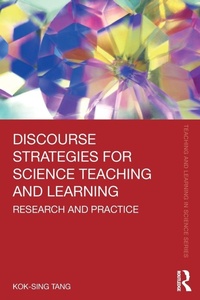
Discourse Strategies for Science Teaching and Learning
Research and Practice
1st Edition
Published on 29. October 2020
Book
Paperback/Softback
198 pages
978-0-367-34424-5 (ISBN)
Description
This engaging and practical volume looks at discourse strategies and how they can be used to facilitate and enhance science teaching and learning within the classroom context, offering a synthesis of research on classroom discourse in science education as well as practical discourse strategies that can be applied to the classroom.
Focusing on the connection between research and practice, this comprehensive guide unpacks and illustrates key concepts on the role of discourse in students' thinking and learning based on empirical analysis of real conversations in a number of science classrooms. Using real-life classroom examples to extend the scope of research into science classroom discourse begun during the 1990s, Kok-Sing Tang offers original discourse strategies as explicit methods of using discourse to engage in meaning-making and work towards a specific instructional goal. This volume covers new and informative topics including how to use discourse to:
Establish classroom activity and interaction
Build and assess scientific content knowledge
Organize and evaluate scientific narrative
Enact scientific practices
Coordinate the use of multimodal representations
Building on more than ten years of research on classroom discourse, Discourse Strategies for Science Teaching and Learning is an ideal text for science teacher educators, pre-service science teachers, scholars, and researchers.
Focusing on the connection between research and practice, this comprehensive guide unpacks and illustrates key concepts on the role of discourse in students' thinking and learning based on empirical analysis of real conversations in a number of science classrooms. Using real-life classroom examples to extend the scope of research into science classroom discourse begun during the 1990s, Kok-Sing Tang offers original discourse strategies as explicit methods of using discourse to engage in meaning-making and work towards a specific instructional goal. This volume covers new and informative topics including how to use discourse to:
Establish classroom activity and interaction
Build and assess scientific content knowledge
Organize and evaluate scientific narrative
Enact scientific practices
Coordinate the use of multimodal representations
Building on more than ten years of research on classroom discourse, Discourse Strategies for Science Teaching and Learning is an ideal text for science teacher educators, pre-service science teachers, scholars, and researchers.
More details
Series
Language
English
Place of publication
London
United Kingdom
Publishing group
Taylor & Francis Ltd
Target group
College/higher education
Illustrations
8 s/w Zeichnungen, 50 s/w Tabellen, 26 s/w Photographien bzw. Rasterbilder, 34 s/w Abbildungen
50 Tables, black and white; 8 Line drawings, black and white; 26 Halftones, black and white; 34 Illustrations, black and white
Dimensions
Height: 229 mm
Width: 152 mm
Thickness: 12 mm
Weight
318 gr
ISBN-13
978-0-367-34424-5 (9780367344245)
Copyright in bibliographic data and cover images is held by Nielsen Book Services Limited or by the publishers or by their respective licensors: all rights reserved.
Schweitzer Classification
Other editions
Additional editions
Book
10/2020
1st Edition
Routledge
€206.20
Shipment within 15-20 days
E-Book
10/2020
1st Edition
Routledge
€55.49
Available for download
E-Book
10/2020
1st Edition
Routledge
€55.49
Available for download
Person
Kok-Sing Tang is Associate Professor at the School of Education and the Discipline Lead of the STEM Education Research Group at Curtin University, Australia. He received a BA and MSc in Physics from the University of Cambridge, UK, and a MA and PhD in Education from the University of Michigan, USA.
Content
1. Introduction to Classroom Discourse 2. Theories of Classroom Discourse 3. Using Discourse To: Establish Classroom Activity and Interaction 4. Using Discourse To: Build and Assess Scientific Content Knowledge 5. Using Discourse To: Organize and Evaluate the Scientific Narrative 6. Using Discourse To: Enact Scientific Practices 7. Using Discourse To: Coordinate Multimodal Translation of Representations 8. Using Discourse To: Coordinate Multimodal Integration of Representations 9. Conclusion