

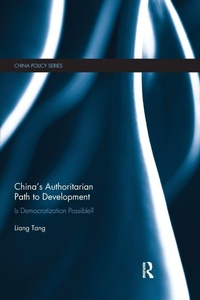
China's Authoritarian Path to Development
Is Democratization Possible?
1st Edition
Published on 12. December 2019
Book
Paperback/Softback
264 pages
978-0-367-86925-0 (ISBN)
Description
This book examines the various stages of China's development, in the economic, social, and political fields, relating theories and models of development to what is actually occurring in China, and discussing how China's development is likely to progress going forward. It argues that China's modernization hitherto can be characterized as "authoritarian development" - a fusion of mixed economic institutions of varying types of ownership with social stability and political cohesiveness - and that the present phase, where more emphasis is being given to social issues, is likely to lead on to a new phase where a more mature civil society and a more extensive middle class are likely to look for greater democratization. It presents an in-depth analysis of China's changing social structure and civil society, explores the forces for and processes of democratization, and assesses the prospects for further democratization in the light of changing social structures.
More details
Series
Language
English
Place of publication
London
United Kingdom
Publishing group
Taylor & Francis Ltd
Target group
College/higher education
Postgraduate and Undergraduate
Dimensions
Height: 234 mm
Width: 156 mm
Thickness: 15 mm
Weight
427 gr
ISBN-13
978-0-367-86925-0 (9780367869250)
Copyright in bibliographic data and cover images is held by Nielsen Book Services Limited or by the publishers or by their respective licensors: all rights reserved.
Schweitzer Classification
Other editions
Additional editions
E-Book
06/2017
Routledge
€61.99
Available for download
E-Book
06/2017
Routledge
€61.99
Available for download
Book
06/2017
1st Edition
Routledge
€207.90
Shipment within 10-20 days
Person
Liang Tang is a Professor at the School of Political Science and Economics, Waseda University, Japan.
Content
Introduction: Preconditions and Patterns of Democratization: A Theoretical Framework for Political Changes in China
1. Chinese Model of Modernization under One-Party Rule
2. Evolution of China's Political Institutions
3. China's Developmental Strategy under Authoritarianism
4. Political Reform from the Above
5. Media Reform, Information Transparency and the Transmutation of Authoritarian System
6. Rise of the Middle Class and Development of Civil Society
7. Rights Protection in the Low-Tide Period of Democracy Movement
Conclusion: Authoritarian Developmentalism and China's Democratic Future
1. Chinese Model of Modernization under One-Party Rule
2. Evolution of China's Political Institutions
3. China's Developmental Strategy under Authoritarianism
4. Political Reform from the Above
5. Media Reform, Information Transparency and the Transmutation of Authoritarian System
6. Rise of the Middle Class and Development of Civil Society
7. Rights Protection in the Low-Tide Period of Democracy Movement
Conclusion: Authoritarian Developmentalism and China's Democratic Future