

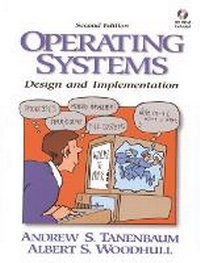
Operating Systems
Design And Implementation: United States Edition
2nd Edition
Published on 8. January 1997
Book
Mixed media product
940 pages
978-0-13-638677-3 (ISBN)
Description
Appropriate for introductory courses on computer operating systems.
This book offers a unique and carefully integrated combination of principles and practice. While the usual principles are covered in detail, the book also describes a small, but real UNIX-like operating system: MINIX. It shows how it works and illustrates the principles behind it. By using MINIX, students learn principles and then can apply them in hands-on system design projects.
This book offers a unique and carefully integrated combination of principles and practice. While the usual principles are covered in detail, the book also describes a small, but real UNIX-like operating system: MINIX. It shows how it works and illustrates the principles behind it. By using MINIX, students learn principles and then can apply them in hands-on system design projects.
More details
Edition
2nd edition
Language
English
Place of publication
United States
Publishing group
Pearson Education (US)
Target group
College/higher education
Dimensions
Width: 240 mm
Thickness: 40 mm
Weight
1582 gr
ISBN-13
978-0-13-638677-3 (9780136386773)
Copyright in bibliographic data and cover images is held by Nielsen Book Services Limited or by the publishers or by their respective licensors: all rights reserved.
Schweitzer Classification
Other editions
New editions
Andrew Tanenbaum | Albert Woodhull
Operating Systems Design and Implementation
Book
02/2006
3rd Edition
Pearson
€204.56
Shipment within 15-20 days
Persons
Andrew S. Tanenbaum has a B.S. Degree from M.I.T. and a Ph.D. from the University of California at Berkeley. He is currently a Professor of Computer Science at the Vrije Universiteit in Amsterdam, The Netherlands, where he heads the Computer Systems Group. He is also Dean of the Advanced School for Computing and Imaging, an interuniversity graduate school doing research on advanced parallel, distributed, and imaging systems. Nevertheless, he is trying very hard to avoid turning into a bureaucrat.
In the past, he has done research on compilers, operating systems, networking, and local-area distributed systems. His current research focuses primarily on the design of wide-area distributed systems that scale to a billion users. These research projects have led to five books and over 85 referred papers in journals and conference proceedings.
Prof. Tanenbaum has also produced a considerable volume of software. He was the principal architect of the Amsterdam Compiler Kit, a widely-used toolkit for writing portable compilers, as well as of MINIX, a small UNIX clone intended for use in student programming labs. Together with his Ph.D. students and programmers, he helped design the Amoeba distributed operating system, a high-performance microkernel-based distributed operating system. The MINIX and Amoeba systems are now available for free via the Internet..
Prof. Tanenbaum is a Fellow of the ACM, a Fellow of the IEEE, a member of the Royal Netherlands Academy of Arts and Sciences, winner of the 1994 ACM Karl V. Karlstrom Outstanding Educator Award, and winner of the 1997 ACM/SIGCSE Award for Outstanding Contributions to Computer Science Education. He is also listed in Who's Who in the World.
In the past, he has done research on compilers, operating systems, networking, and local-area distributed systems. His current research focuses primarily on the design of wide-area distributed systems that scale to a billion users. These research projects have led to five books and over 85 referred papers in journals and conference proceedings.
Prof. Tanenbaum has also produced a considerable volume of software. He was the principal architect of the Amsterdam Compiler Kit, a widely-used toolkit for writing portable compilers, as well as of MINIX, a small UNIX clone intended for use in student programming labs. Together with his Ph.D. students and programmers, he helped design the Amoeba distributed operating system, a high-performance microkernel-based distributed operating system. The MINIX and Amoeba systems are now available for free via the Internet..
Prof. Tanenbaum is a Fellow of the ACM, a Fellow of the IEEE, a member of the Royal Netherlands Academy of Arts and Sciences, winner of the 1994 ACM Karl V. Karlstrom Outstanding Educator Award, and winner of the 1997 ACM/SIGCSE Award for Outstanding Contributions to Computer Science Education. He is also listed in Who's Who in the World.
Content
I. INTRODUCTION.
What Is An Operating Systems?
History of Operating Systems.
Operating System Concepts.
System Calls.
Operating System Structure.
Outline of the Rest of this Book.
Summary.
II. PROCESSES.
Introduction to Processes.
Interprocess Communication.
Classical IPC Problems.
Process Scheduling.
Overview of Processes in MINIX.
Implementation of Processes in MINIX.
III. INPUT/OUTPUT.
Principles of Input/Output Hardware.
Principles of Input/Output Software.
Deadlocks.
Overview of Input/Output in MINIX.
Block Devices in MINIX.
Ram Disks.
Disks.
Clocks.
Terminals.
The Summary Task in MINIX.
Summary.
IV. MEMORY MANAGEMENT.
Memory Management Without Swapping or Paging.
Swapping.
Virtual Memory.
Page Replacement Algorithms.
Design Issues for Paging Systems
Segmentation.
Overview of Memory Management in MINIX.
Implementation of Memory Management in MINIX.
Summary.
V. FILE SYSTEMS.
Files.
Directories.
File System Implementation.
Security.
Protection Mechanisms.
Overview of the MINIX File System.
Implementation of the MINIX File System.
Summary.
What Is An Operating Systems?
History of Operating Systems.
Operating System Concepts.
System Calls.
Operating System Structure.
Outline of the Rest of this Book.
Summary.
II. PROCESSES.
Introduction to Processes.
Interprocess Communication.
Classical IPC Problems.
Process Scheduling.
Overview of Processes in MINIX.
Implementation of Processes in MINIX.
III. INPUT/OUTPUT.
Principles of Input/Output Hardware.
Principles of Input/Output Software.
Deadlocks.
Overview of Input/Output in MINIX.
Block Devices in MINIX.
Ram Disks.
Disks.
Clocks.
Terminals.
The Summary Task in MINIX.
Summary.
IV. MEMORY MANAGEMENT.
Memory Management Without Swapping or Paging.
Swapping.
Virtual Memory.
Page Replacement Algorithms.
Design Issues for Paging Systems
Segmentation.
Overview of Memory Management in MINIX.
Implementation of Memory Management in MINIX.
Summary.
V. FILE SYSTEMS.
Files.
Directories.
File System Implementation.
Security.
Protection Mechanisms.
Overview of the MINIX File System.
Implementation of the MINIX File System.
Summary.