

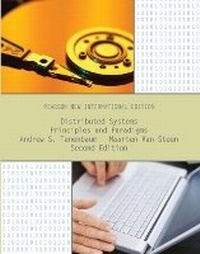
Distributed Systems: Principles and Paradigms
Pearson New International Edition
2nd Edition
Published on 2. August 2013
Book
Paperback/Softback
640 pages
978-1-292-02552-0 (ISBN)
Description
For courses on Distributed Systems, Distributed Operating Systems, and Advanced Operating Systems focusing on distributed systems, found in departments of Computer Science, Computer Engineering and Electrical Engineering.
In this text, esteemed authors Tanenbaum and van Steen provide full coverage of the field in a systematic way that can be readily used for teaching. This text examines the underlying principles - and their applications to a wide variety of practical distributed systems.
In this text, esteemed authors Tanenbaum and van Steen provide full coverage of the field in a systematic way that can be readily used for teaching. This text examines the underlying principles - and their applications to a wide variety of practical distributed systems.
More details
Other editions
Additional editions
Andrew S. Tanenbaum | Maarten Van Steen
Distributed Systems: Pearson New International Edition PDF eBook
Principles and Paradigms
E-Book
08/2013
2nd Edition
Pearson Higher Education;Pearson
from
€49.22
Available for download
Previous edition
Andrew S. Tanenbaum | Maarten Van Steen
Distributed Systems
Principles and Paradigms: International Edition
Book
04/2008
2nd Edition
Pearson
€137.40
Article exhausted; check for reprint
Content
1 Introduction
2 Architectures
3 Processess
4 Communication
5 Naming
6 Synchronization
7 Consistency and replication
8 Fault tolerance
9 Security
10 Distributed object-based systems
11 Distributed file systems
12 Distributed web-based systems
13 Distributed coordination-based
Index
2 Architectures
3 Processess
4 Communication
5 Naming
6 Synchronization
7 Consistency and replication
8 Fault tolerance
9 Security
10 Distributed object-based systems
11 Distributed file systems
12 Distributed web-based systems
13 Distributed coordination-based
Index