

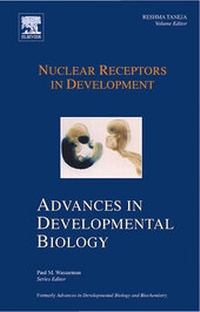
Nuclear Receptors in Development: Volume 16
Published on 1. February 2007
Book
Hardback
448 pages
978-0-444-52873-5 (ISBN)
Description
A superb compilation of reviews from leading experts in the field of nuclear receptors, volume 16 in the Advances in Developmental Biology series covers the role of different nuclear receptor subfamilies in development, physiology and metabolism. This volume brilliantly reviews how genetic defects in the function of nuclear receptors leads to various developmental defects. Receptors discussed include: thyroid receptors, peroxisome proliferators activated receptors, and retinoic acid receptors. Additionaly, this volume offers an indespesable chapter on the orphan receptors Ftz-F1, COUPs, and RORs in embryonic and postnatal development.
More details
Series
Language
English
Place of publication
Oxford
United Kingdom
Publishing group
Elsevier Science & Technology
Target group
Professional and scholarly
Developmental and cell biologists
Illustrations
Illustrated
Dimensions
Height: 229 mm
Width: 152 mm
Weight
760 gr
ISBN-13
978-0-444-52873-5 (9780444528735)
Copyright in bibliographic data and cover images is held by Nielsen Book Services Limited or by the publishers or by their respective licensors: all rights reserved.
Schweitzer Classification
Other editions
Additional editions
Persons
Paul M. Wassarman, the Series Editor of CTDB since 2007, is Professor in the Dept. Developmental and Regenerative Biology at the Icahn School of Medicine at Mount Sinai in New York City. He received a Ph.D. in biochemistry from Brandeis University where he carried out thesis research in the Graduate Dept. Biochemistry with Professor Nathan O. Kaplan. In 1967 Wassarman joined the Division of Structural Studies at the MRC, Laboratory of Molecular Biology in Cambridge, England as a Helen Hay Whitney Foundation Fellow with Sir John C. Kendrew. In 1972 he joined the faculty of the Dept. Biological Chemistry at Harvard Medical School and in 1986 moved to the Roche Institute of Molecular Biology where he was Chair of the Dept. Cell and Developmental Biology and Adjunct Professor in the Dept. Cell Biology, New York University School of Medicine. In 1996 he moved to the Icahn School of Medicine at Mount Sinai where he was the Lillian and Henry M. Stratton Professorial Chair of the Dept. Molecular, Cell, and Developmental Biology. Wassarman has published more than 200 research papers and reviews, dealing primarily with mammalian oogenesis, fertilization, and early embryogenesis. Reshma Taneja obtained her Ph.D. at Indian Institute of Science in Bangalore working on gene transcription under the supervision of Professor KP Gopinathan. During the course of her postdoctoral training in Prof Pierre Chambon's laboratory at the IGBMC in France she started working on a bHLH transcription factor Stra13, which was identified as a retinoic target gene. Her own laboratory initially at the Mount Sinai School of Medicine in New York, and currently at the National University of Singapore has had a long-standing interest in bHLH proteins and their ability to regulate cellular differentiation programs. Her group has made ground-breaking discoveries including generating Stra13-/- mice which first revealed its function in homeostasis of the immune system, as well as in skeletal muscle biology. In addition, her laboratory has identified novel transcriptional repression mechanisms mediated by recruitment of chromatin modifying enzymes that impact the function of bHLH factors in cellular differentiation. Currently, she holds an appointment at the Department of Physiology at the National University of Singapore and an adjunct appointment at the Mount Sinai School of Medicine. Her work has been well funded over the years from major funding bodies including the National Institutes of Health, The Muscular Dystrophy Association, March of Dimes Birth Defects Foundation, The Leukemia and Lymphoma Society, Lupus Research Foundation in the USA; and from National Medical Research Council, Singapore Stem Cell Consortium, and Ministry of Education in Singapore. She has won several honors and awards including the prestigious Scholar Award from the Leukemia and Lymphoma society. She serves as reviewer for several international funding agencies including NIH, NSF, NSERC Canada, Research Grants Council Hong Kong, Israel Science Foundation, Telethon, Association Francaise contre les Myopathies, French National Research Agency, and the National Medical Research Council Singapore. She is currently on the editorial board of PLoS ONE, Differentiation, and Open Journal of Genetics.
Content
1. Developmental Roles of the Thyroid Hormone Receptor A And A Genes
2. PPARs in fetal and early post-natal development
3. Regulation of murine embryonic patterning and morphogenesis by retinoic acid signaling
4. Molecular mediators of retinoic acid signalling during development
5. Hindbrain development and retinoids
6. Retinoid receptors in vertebral patterning
7. Mouse Embryocarcinoma F9 cells and Retinoic Acid: A model to study the molecular mechanisms of endodermal differentiation
8. The Ftz-F1 family: orphan nuclear receptors regulated by novel protein-protein interactions
9. Role of Chicken Ovalbumin Upstream Promoter-Transcription Factor I in the Development of Nervous System
10. Retinoid-related Orphan Receptors (RORs): Roles in Cellular Differentiation and Development
11. Hairless, a nuclear receptor corepressor essential for skin function
12. Nuclear receptor transcriptional coactivators in development and metabolism
2. PPARs in fetal and early post-natal development
3. Regulation of murine embryonic patterning and morphogenesis by retinoic acid signaling
4. Molecular mediators of retinoic acid signalling during development
5. Hindbrain development and retinoids
6. Retinoid receptors in vertebral patterning
7. Mouse Embryocarcinoma F9 cells and Retinoic Acid: A model to study the molecular mechanisms of endodermal differentiation
8. The Ftz-F1 family: orphan nuclear receptors regulated by novel protein-protein interactions
9. Role of Chicken Ovalbumin Upstream Promoter-Transcription Factor I in the Development of Nervous System
10. Retinoid-related Orphan Receptors (RORs): Roles in Cellular Differentiation and Development
11. Hairless, a nuclear receptor corepressor essential for skin function
12. Nuclear receptor transcriptional coactivators in development and metabolism