

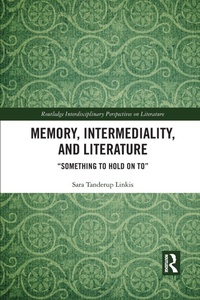
Memory, Intermediality, and Literature
Something to Hold on to
1st Edition
Published on 30. June 2021
Book
Paperback/Softback
280 pages
978-1-032-09285-0 (ISBN)
Description
"If readers of Sara Tanderup Linkis' "Something to hold on to ..." open the book in the expectation of entering a niche of literature and literary studies, they will leave it after having encountered a new highway in literature. Here, the traditional theme of memory and the most recent use of digital media merge into a new understanding of the role of the book in the contemporary media landscape and of vicissitudes of memorial processes literature, which also offers a broader perspective on literature in human history. Spurred by Sara Tanderup Linkis' sharp eye the readings of texts are lucid, engaging and offers so many ideas that teachers will renew their curricula, and readers will open the internet for more or rush to the library."
- Svend Erik Larsen, professor emeritus
Memory, Intermediality, and Literature investigates how selected literary works use intermedial strategies to represent and perform cultural memory. Drawing on the theoretical perspectives of cultural memory studies, this engaging, reader-friendly monograph examines new materialism and intermediality studies, analyzying works by Alexander Kluge, W.G. Sebald, Jonathan Safran Foer, Anne Carson, Mette Hegnhoj, William Joyce, J.J. Abrams and Doug Dorst. The works emerge out of different traditions and genres, ranging from neo-avant-garde montages through photo-novels and book objects to apps and children's stories.
In this new monograph, Sara Tanderup Linkis presents an interdisciplinary and comparative approach, reading the works together, across genres and decades, and combining the perspectives of memory studies and materialist and media-oriented analysis. This approach makes it possible to argue that the works not only use intermedial strategies to represent memory, but also to remember literature, reflecting on the changing status and function of literature as a mediator of cultural memory in the age of new media. Thus, the works may be read as reactions to modern media culture, suggesting the ways in which literature and memory are affected by new media and technologies - photography and television as well as iPads and social media.
- Svend Erik Larsen, professor emeritus
Memory, Intermediality, and Literature investigates how selected literary works use intermedial strategies to represent and perform cultural memory. Drawing on the theoretical perspectives of cultural memory studies, this engaging, reader-friendly monograph examines new materialism and intermediality studies, analyzying works by Alexander Kluge, W.G. Sebald, Jonathan Safran Foer, Anne Carson, Mette Hegnhoj, William Joyce, J.J. Abrams and Doug Dorst. The works emerge out of different traditions and genres, ranging from neo-avant-garde montages through photo-novels and book objects to apps and children's stories.
In this new monograph, Sara Tanderup Linkis presents an interdisciplinary and comparative approach, reading the works together, across genres and decades, and combining the perspectives of memory studies and materialist and media-oriented analysis. This approach makes it possible to argue that the works not only use intermedial strategies to represent memory, but also to remember literature, reflecting on the changing status and function of literature as a mediator of cultural memory in the age of new media. Thus, the works may be read as reactions to modern media culture, suggesting the ways in which literature and memory are affected by new media and technologies - photography and television as well as iPads and social media.
Reviews / Votes
If readers of Sara Tanderup's "Something to hold on to ..." open the book in the expectation of entering a niche of literature and literary studies, they will leave it after having encountered a new highway in literature. Here, the traditional theme of memory and the most recent use of digital media merge into a new understanding of the role of the book in the contemporary media landscape and of vicissitudes of memorial processes literature, which also offers a broader perspective on literature in human history. Spurred by Sara Tanderup's sharp eye the readings of texts are lucid, engaging and offers so many ideas that teachers will renew their curricula, and readers will open the internet for more or rush to the library.More details
Series
Language
English
Place of publication
London
United Kingdom
Publishing group
Taylor & Francis Ltd
Target group
College/higher education
Postgraduate and Undergraduate
Illustrations
34 s/w Abbildungen
34 Illustrations, black and white
Dimensions
Height: 229 mm
Width: 152 mm
Thickness: 15 mm
Weight
410 gr
ISBN-13
978-1-032-09285-0 (9781032092850)
Copyright in bibliographic data and cover images is held by Nielsen Book Services Limited or by the publishers or by their respective licensors: all rights reserved.
Schweitzer Classification
Other editions
Additional editions
Book
05/2019
1st Edition
Routledge
€232.00
Shipment within 15-20 days
E-Book
04/2019
1st Edition
Routledge
€60.49
Available for download
E-Book
04/2019
1st Edition
Routledge
€60.49
Available for download
Person
Sara Tanderup Linkis holds a PhD in Comparative Literature from Aarhus University. She is currently employed as a postdoc at Lund University. Her research focuses on intermediality, transmediality, cultural memory and media oriented literary analysis, and she has published several articles in internationally acclaimed journals such as Narrative, Orbis Litterarum and Image & Narrative.
Content
Introduction PART I. Close-Ups and Counter-Stories. Image-Texts and Photo-Novels by Kluge, Sebald And Foer 1. Image-Books and Modern Visual Culture 2. History between Media. Kluge's Literary Montages 3. Present Pasts. Sebald's Image-texts 4. History Close up. Foer's Broken Books PART II. Books Between Media. Scrapbooks, Library Books and Flying Books by Carson, Hegnhoj, Abrams and Dorst, and Joyce 5. Remembering Books 6. Bits of Books in Boxes. Carson's and Hegnhoj's Scrapbooks 7. The Book Between Media. Abrams and Dorst's S. 8. Bookishness beyond the Book? Lessmore's Flying Books