

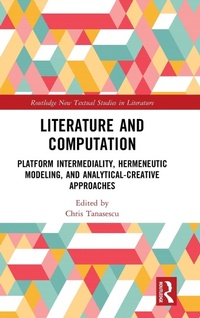
Literature and Computation
Platform Intermediality, Hermeneutic Modeling, and Analytical-Creative Approaches
1st Edition
Published on 28. June 2024
Book
Hardback
266 pages
978-1-032-34166-8 (ISBN)
Description
Literature and Computation presents some of the most relevantly innovative recent approaches to literary practice, theory, and criticism as driven by computation and situated in digital environments. These approaches rely on automated analyses, but use them creatively, engage in text modeling but inform it with qualitative[-interpretive] critical possibilities, and contribute to present-day platform culture in revolutionizing intermedial ways. While such new directions involve more and more sophisticated machine learning and artificial intelligence, they also mark a spectacular return of the (trans)human(istic) and of traditional-modern literary or urgent political, gender, and minority-related concerns and modes now addressed in ever subtler and more nuanced ways within human-computer interaction frameworks. Expanding the boundaries of literary and data studies, digital humanities, and electronic literature, the featured contributions unveil an emerging landscape of trailblazing practice and theoretical crossovers ready and able to spawn and/or chart the witness literature of our age and cultures.
Introduction and Chapter 3 of this book is freely available as a downloadable Open Access PDF at http://www.taylorfrancis.com under a Creative Commons Attribution-Non Commercial-No Derivatives (CC-BY-NC-ND) 4.0 license.
Introduction and Chapter 3 of this book is freely available as a downloadable Open Access PDF at http://www.taylorfrancis.com under a Creative Commons Attribution-Non Commercial-No Derivatives (CC-BY-NC-ND) 4.0 license.
More details
Series
Language
English
Place of publication
London
United Kingdom
Publishing group
Taylor & Francis Ltd
Target group
College/higher education
Postgraduate and Undergraduate Advanced
Illustrations
29 s/w Abbildungen, 13 s/w Photographien bzw. Rasterbilder, 16 s/w Zeichnungen, 5 s/w Tabellen
5 Tables, black and white; 16 Line drawings, black and white; 13 Halftones, black and white; 29 Illustrations, black and white
Dimensions
Height: 235 mm
Width: 157 mm
Thickness: 20 mm
Weight
563 gr
ISBN-13
978-1-032-34166-8 (9781032341668)
Copyright in bibliographic data and cover images is held by Nielsen Book Services Limited or by the publishers or by their respective licensors: all rights reserved.
Schweitzer Classification
Other editions
Additional editions
Chris Tanasescu
Literature and Computation
Platform Intermediality, Hermeneutic Modeling, and Analytical-Creative Approaches
Book
approx. 11/2025
1st Edition
Routledge
€64.10
Not yet published
Chris Tanasescu
Literature and Computation
Platform Intermediality, Hermeneutic Modeling, and Analytical-Creative Approaches
E-Book
06/2024
1st Edition
Routledge
€55.49
Available for download
Chris Tanasescu
Literature and Computation
Platform Intermediality, Hermeneutic Modeling, and Analytical-Creative Approaches
E-Book
06/2024
1st Edition
Routledge
€55.49
Available for download
Person
Chris Tanasescu is a poet and academic with backgrounds in English and computer science. The Graph Poem project he started 15 years ago has outputted natural language processing and network science-based poetry classifiers, intermedia performances, and computationally assembled poetry anthologies. His alias MARGENTO refers to a cyber cross-artform ensemble and international coalition of poets-translators, visual artists/musicians, and coders throwing events and launching publications on and off-line in four continents. Chris is currently a research scientist on the PIETRA project at the University of Galway. Previous or ongoing positions and affiliations include Coordinator of Digital Humanities at the University of Ottawa, Altissia Chair in Digital Cultures and Ethics at Universite Catholique de Louvain, Senior Researcher in Global Literary Studies and Complex Systems at Universitat Oberta de Catalunya, and Visiting Scholar at the Electronic Textual Cultures Lab, University of Victoria. He is an Asymptote Editor-at-Large.
Content
Literature and Computation. An Introduction
Chris Tanasescu
Part 1: Platform Intermediality
1. Dynamical Systems and Interplatform Intermediality. The Case of #GraphPoem @ DHSI
Chris Tanasescu
2. Platform Intermediality. Rimbaud ZAP @ Abruept
Servanne Monjour and Nicolas Sauret
3. Reimagining Translation Anthologies. A Journey into Non-Linear Computational Assemblages
Raluca Tanasescu
Part 2: Hermeneutic Modeling
4. Hermeneutic Modeling of Detail in Textual Zoom and Literary Texts
Florentina Armaselu
5. The Novel's Factory of Opinions: adapting sentiment-analysis tools to ELTeC prefaces
Ioana Galleron, Roxana Patras, Rosario Arias, Javier Fernandez-Cruz, Frederique Melanie-Becquet, and Olga Seminck
6. Reflective Modeling (Modeling what would be there). A critical, creative, and constructive approach to data modeling
Jan-Erik Stange
Part 3: Analytical-creative Approaches
7. Writing like a Machine or Becoming an Algorithmic Subject
Johanna Drucker
8. The Shepherds of Electric Sheep: Generative AI and Creativity
Andrew Klobucar
Chris Tanasescu
Part 1: Platform Intermediality
1. Dynamical Systems and Interplatform Intermediality. The Case of #GraphPoem @ DHSI
Chris Tanasescu
2. Platform Intermediality. Rimbaud ZAP @ Abruept
Servanne Monjour and Nicolas Sauret
3. Reimagining Translation Anthologies. A Journey into Non-Linear Computational Assemblages
Raluca Tanasescu
Part 2: Hermeneutic Modeling
4. Hermeneutic Modeling of Detail in Textual Zoom and Literary Texts
Florentina Armaselu
5. The Novel's Factory of Opinions: adapting sentiment-analysis tools to ELTeC prefaces
Ioana Galleron, Roxana Patras, Rosario Arias, Javier Fernandez-Cruz, Frederique Melanie-Becquet, and Olga Seminck
6. Reflective Modeling (Modeling what would be there). A critical, creative, and constructive approach to data modeling
Jan-Erik Stange
Part 3: Analytical-creative Approaches
7. Writing like a Machine or Becoming an Algorithmic Subject
Johanna Drucker
8. The Shepherds of Electric Sheep: Generative AI and Creativity
Andrew Klobucar