

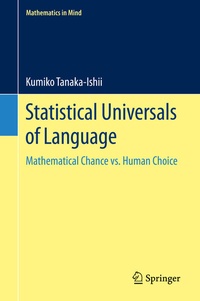
Statistical Universals of Language
Mathematical Chance vs. Human Choice
Published on 2. April 2021
Book
Hardback
VIII, 236 pages
978-3-030-59376-6 (ISBN)
Description
This volume explores the universal mathematical properties underlying big language data and possible reasons why such properties exist, revealing how we may be unconsciously mathematical in our language use. These properties are statistical and thus different from linguistic universals that contribute to describing the variation of human languages, and they can only be identified over a large accumulation of usages. The book provides an overview of state-of-the art findings on these statistical universals and reconsiders the nature of language accordingly, with Zipf's law as a well-known example.
The main focus of the book further lies in explaining the property of long memory, which was discovered and studied more recently by borrowing concepts from complex systems theory. The statistical universals not only possibly lie as the precursor of language system formation, but they also highlight the qualities of language that remain weak points in today's machine learning.
In summary, this book provides an overview of language's global properties. It will be of interest to anyone engaged in fields related to language and computing or statistical analysis methods, with an emphasis on researchers and students in computational linguistics and natural language processing. While the book does apply mathematical concepts, all possible effort has been made to speak to a non-mathematical audience as well by communicating mathematical content intuitively, with concise examples taken from real texts.
The main focus of the book further lies in explaining the property of long memory, which was discovered and studied more recently by borrowing concepts from complex systems theory. The statistical universals not only possibly lie as the precursor of language system formation, but they also highlight the qualities of language that remain weak points in today's machine learning.
In summary, this book provides an overview of language's global properties. It will be of interest to anyone engaged in fields related to language and computing or statistical analysis methods, with an emphasis on researchers and students in computational linguistics and natural language processing. While the book does apply mathematical concepts, all possible effort has been made to speak to a non-mathematical audience as well by communicating mathematical content intuitively, with concise examples taken from real texts.
Reviews / Votes
"The chapters and the parts are intelligently curated and well-thought-out to give the subject matter a free-flowing and coherent structure. ... The book has a lot of exciting discussions on offer. ... the book has a lot to learn from. ... The book is unique in the sense that language is presented ... . The book provides excellent food for thought. ... the book is worth every single second that a reader would be spending on reading it ... ." (Firdous Ahmad Mala, risingkashmir.com, January 25, 2022)"The chapters and the parts are intelligently curated and well-thought-out to give the subject matter a free-flowing and coherent structure. ... The book has a lot of exciting discussions on offer. ... the book has a lot to learn from. ... The book is unique in the sense that language is presented ... . The book provides excellent food for thought. ... the book is worth every single second that a reader would be spending on reading it ... ." (Firdous Ahmad Mala, risingkashmir.com, January 25, 2022)
More details
Product info
Book
Series
Edition
1st ed. 2021
Language
English
Place of publication
Cham
Switzerland
Publishing group
Springer International Publishing
Target group
Professional and scholarly
Illustrations
52 s/w Abbildungen, 100 farbige Abbildungen
VIII, 236 p. 152 illus., 100 illus. in color.
Dimensions
Height: 241 mm
Width: 160 mm
Thickness: 20 mm
Weight
547 gr
ISBN-13
978-3-030-59376-6 (9783030593766)
DOI
10.1007/978-3-030-59377-3
Schweitzer Classification
Other editions
Additional editions
Book
04/2022
1st Edition
Springer
€69.54
Shipment within 7-9 days
E-Book
04/2021
1st Edition
Springer
€66.99
Available for download
Content
I. Preface.- 1. Introduction.- 2. Universals.- 3. Language as a Complex System.- II. Property of Population.- 4. Relation Between Rank and Frequency.- 5. Bias in Rank-Frequency Relation.- 6. Related Statistical Universals.- III. Property of Sequence.- 7. Returns.- 8. Long-Range Correlation.- 9. Fluctuation.- 10. Complexity.- IV. Relation to Linguistic Elements and Structure.- 11. Articulation of Elements.- 12. Word Meaning and Value.- 13. Size and Frequency.- 14. Grammatical Structure and Long Memory.- V. Mathematical Model.- 15. Theories Behind Zipf's Law.- 16. Mathematical Generative Models.- 17. Language Models.- VI. Ending Remarks.- 18. Conclusion.- VII. Appendix.- 19. Glossary and Notations.- 20. Mathematical Details.- 21. Data.- References.- Index.