

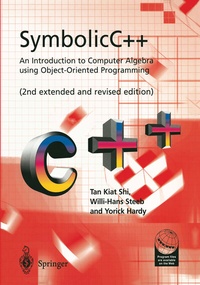
SymbolicC++:An Introduction to Computer Algebra using Object-Oriented Programming
An Introduction to Computer Algebra using Object-Oriented Programming
2nd Edition
Published on 2. February 2000
Book
Paperback/Softback
XVI, 692 pages
978-1-85233-260-0 (ISBN)
Description
Symbolic C++: An Introduction to Computer Algebra Using Object-Oriented
Programming provides a concise introduction to C++ and object-oriented
programming, using a step-by-step construction of a new object-oriented
designed computer algebra system - Symbolic C++. It shows how
object-oriented programming can be used to implement a symbolic algebra
system and how this can then be applied to different areas in mathematics
and physics.
This second revised edition:-
* Explains the new powerful classes that have been added to Symbolic
C++.
* Includes the Standard Template Library.
* Extends the Java section.
* Contains useful classes in scientific computation.
* Contains extended coverage of Maple, Mathematica, Reduce and MuPAD.
More details
Edition
Second Edition 2000
Language
English
Place of publication
London
United Kingdom
Target group
Lower undergraduate
Illustrations
XVI, 692 p.
Dimensions
Height: 254 mm
Width: 178 mm
Thickness: 37 mm
Weight
1272 gr
ISBN-13
978-1-85233-260-0 (9781852332600)
DOI
10.1007/978-1-4471-0405-6
Schweitzer Classification
Other editions
Previous edition
Willi-hans Steeb | Kiat-Shi Tan
SymbolicC++: An Introduction to Computer Algebra using Object-Oriented Programming
Book
02/1998
Springer
€49.00
Article exhausted; check for reprint
Persons
Content
1 Introduction.- 1.1 What is Computer Algebra ?.- 1.2 Properties of Computer Algebra Systems.- 1.3 Pitfalls in Computer Algebra Systems.- 1.4 Design of a Computer Algebra System.- 2 Mathematics for Computer Algebra.- 2.1 Rings and Fields.- 2.2 Integers.- 2.3 Rational Numbers.- 2.4 Real Numbers.- 2.5 Complex Numbers.- 2.6 Vectors and Matrices.- 2.7 Quaternions.- 2.8 Polynomials.- 2.9 Differentiation.- 2.10 Integration.- 2.11 Commutativity and Noncommutativity.- 2.12 Tensor and Kronecker Product.- 2.13 Exterior Product.- 3 Computer Algebra Systems.- 3.1 Introduction.- 3.2 Reduce.- 3.3 Maple.- 3.4 Axiom.- 3.5 Mathematica.- 3.6 MuPAD.- 4 Object-Oriented Programming.- 4.1 Objects, Classes and Abstract Data Types.- 4.2 Message Passing.- 4.3 Inheritance.- 4.4 Polymorphism.- 4.5 Object-Oriented Languages.- 4.6 Summary.- 5 Basic Tools in C++.- 5.1 Pointers and References.- 5.2 Classes.- 5.3 Constructors and Destructor.- 5.4 Copy Constructor and Assignment Operator.- 5.5 Type Conversion.- 5.6 Operator Overloading.- 5.7 Class Templates.- 5.8 Function Templates.- 5.9 Friendship.- 5.10 Inheritance.- 5.11 Virtual Functions.- 5.12 Wrapper Class.- 5.13 Standard Template Library.- 5.14 Recursion.- 5.15 Summary.- 6 Classes for Computer Algebra.- 6.1 The Verylong Integer Class.- 6.2 The Rational Number Class.- 6.3 The Complex Number Class.- 6.4 The Quaternion Class.- 6.5 The Derive Class.- 6.6 The Vector Class.- 6.7 The Matrix Class.- 6.8 Array Classes.- 6.9 The String Class.- 6.10 Bit Vectors.- 6.11 The Linked List Class.- 6.12 The Polynomial Class.- 6.13 The Set Class.- 6.14 Summary.- 7 The Symbolic Class.- 7.1 Object-Oriented Design.- 7.2 Data Fields and Types of Symbol.- 7.3 Constructors.- 7.4 Operators.- 7.5 Functions.- 7.6 Simplification.- 7.7 Commutativity.- 7.8 Symbolic and Numeric Interface.- 7.9 Summary.- 8 Applications.- 8.1 Bit Vector Class.- 8.2 Verylong Class.- 8.3 Verylong and Rational Classes.- 8.4 Verylong, Rational and Derive Classes.- 8.5 Verylong, Rational and Complex Classes.- 8.6 Symbolic Class.- 8.7 Symbolic Class and Symbolic Differentiation.- 8.8 Matrix Class.- 8.9 Array and Symbolic Classes.- 8.10 Polynomial and Symbolic Classes.- 8.11 Lie Series Techniques.- 8.12 Spectra of Small Spin Clusters.- 8.13 Nonlinear Maps and Chaotic Behaviour.- 8.14 Numerical-Symbolic Application.- 8.15 Summary.- 9 Lisp and Computer Algebra.- 9.1 Introduction.- 9.2 Basic Functions of Lisp.- 9.3 Examples from Symbolic Computation.- 9.4 Lisp System based on C++.- 10 Program Listing.- 10.1 Verylong Class.- 10.2 Rational Class.- 10.3 Complex Class.- 10.4 Quaternion Class.- 10.5 Derive Class.- 10.6 Vector Class.- 10.7 Matrix Class.- 10.8 Array Class.- 10.9 String Class.- 10.10Bit Vector Class.- 10.11Linked List Class.- 10.12Polynomial Class.- 10.13Set Class.- 10.14Symbolic Class.- 11 PVM and Abstract Data Types.- 12 Error Handling Techniques.- 12.1 Error State.- 12.2 Exception Handling.- 13 Gnuplot and PostScript.