

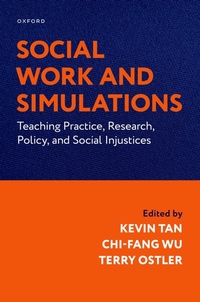
Social Work and Simulations
Teaching Practice, Research, Policy, and Social Injustices
Published on 23. April 2025
Book
Hardback
320 pages
978-0-19-777046-7 (ISBN)
Description
Based on five years of work and research on simulated learning experiences, this book highlights the integration of simulations in practice, research, and policy classes at the School of Social Work, University of Illinois Urbana-Champaign (UIUC). It illustrates the versatile application of simulations in teaching social work practice across various settings, including mental health, schools, libraries, disabilities, and end-of-life care. It explores the use of simulations in teaching clinical research methods, program evaluation, policy analysis, macro social work, and fostering interprofessional collaborations. This book further discusses the use of online simulations in social work education, highlighting the pivotal role played by doctoral students in designing and executing simulations, aligning them with specific learning objectives, and facilitating student engagement and reflection in various contexts.
Presented in a mixture of writing styles and research methodologies, Social Work and Simulations offers a candid reflection on simulations from the perspectives of students and instructors. It emphasizes the creation of brave spaces to foster open dialogue, sharing, and reflection on social work competencies within the context of social injustice, diversity, and inclusion. Through immersive experiences, simulations offer a transformative approach to social work education, encouraging students and instructors to engage more deeply with the multifaced and human aspects of social work practice. Overall, this book provides rich case studies and practical guidance, offering valuable resources for developing ethical and effective simulations in social work education.
Presented in a mixture of writing styles and research methodologies, Social Work and Simulations offers a candid reflection on simulations from the perspectives of students and instructors. It emphasizes the creation of brave spaces to foster open dialogue, sharing, and reflection on social work competencies within the context of social injustice, diversity, and inclusion. Through immersive experiences, simulations offer a transformative approach to social work education, encouraging students and instructors to engage more deeply with the multifaced and human aspects of social work practice. Overall, this book provides rich case studies and practical guidance, offering valuable resources for developing ethical and effective simulations in social work education.
Reviews / Votes
With its many practical examples, this is an important resource for social work educators interested in using simulation to reenergize traditional social work education. An excellent volume for students and faculty in social work programs and professionals in the field. * C. W. Filippelli, Choice *More details
Language
English
Place of publication
New York
United States
Target group
College/higher education
Product notice
sewn/stitched
Cloth over boards
Dimensions
Height: 239 mm
Width: 168 mm
Thickness: 24 mm
Weight
617 gr
ISBN-13
978-0-19-777046-7 (9780197770467)
Copyright in bibliographic data and cover images is held by Nielsen Book Services Limited or by the publishers or by their respective licensors: all rights reserved.
Schweitzer Classification
Other editions
Additional editions
Kevin Tan | Chi-Fang Wu | Terry Ostler
Social Work and Simulations
Teaching Practice, Research, Policy, and Social Injustices
E-Book
01/2025
OUP eBook
€70.49
Available for download
Kevin Tan | Chi-Fang Wu | Terry Ostler
Social Work and Simulations
Teaching Practice, Research, Policy, and Social Injustices
E-Book
01/2025
OUP eBook
€70.49
Available for download
Persons
Kevin Tan is Associate Dean for Engagement, Diversity, Equity, and Inclusion and Associate Professor at the School of Social Work, University of Illinois Urbana-Champaign. He is notably recognized for his contributions to school social work practice and community engagement initiatives with the 2021 Gary Lee Shaffer Award and the 2023 University of Illinois distinguished faculty award. He earned his PhD from the University of Chicago School of Social Service Administration, a Masters in Social Work from Washington University in St. Louis Brown School of Social Work, and a Bachelors in Social Work (Honors) from the National University of Singapore.
Chi-Fang Wu is Professor and PhD Program Director at the School of Social Work, University of Illinois Urbana-Champaign. As a poverty researcher, she has devoted her career to scholarship assessing the effectiveness of public benefits programs that promote economic advancement among women and improve the well-being of low-income families. She received the Tony Halter Excellence in Teaching Award, the Excellence in Mentoring and Advising, and the University Excellence in Graduate Student Mentoring Award. Dr Wureceived her master's degree in social work from NationalTaiwan University and her PhD in social work from the University of Wisconsin-Madison, School of Social Work.
Terry Ostler received her BA (Summa Cum Laude), MA, and PhD degrees at the University of California Berkeley. She worked for two years as a postdoctoral scholar at the Max Planck Institute for Human Development and Education in Berlin. A developmental and clinical psychologist by training, she served on the faculty of psychiatry at the University of Illinois Chicago before teaching in the School of Social Work at the University of Illinois Urbana-Champaign. She has published on parent-child attachment bonds and on parenting in individuals with severe mental illness. She is happily retired.
Chi-Fang Wu is Professor and PhD Program Director at the School of Social Work, University of Illinois Urbana-Champaign. As a poverty researcher, she has devoted her career to scholarship assessing the effectiveness of public benefits programs that promote economic advancement among women and improve the well-being of low-income families. She received the Tony Halter Excellence in Teaching Award, the Excellence in Mentoring and Advising, and the University Excellence in Graduate Student Mentoring Award. Dr Wureceived her master's degree in social work from NationalTaiwan University and her PhD in social work from the University of Wisconsin-Madison, School of Social Work.
Terry Ostler received her BA (Summa Cum Laude), MA, and PhD degrees at the University of California Berkeley. She worked for two years as a postdoctoral scholar at the Max Planck Institute for Human Development and Education in Berlin. A developmental and clinical psychologist by training, she served on the faculty of psychiatry at the University of Illinois Chicago before teaching in the School of Social Work at the University of Illinois Urbana-Champaign. She has published on parent-child attachment bonds and on parenting in individuals with severe mental illness. She is happily retired.
Editor
Associate Dean for Engagement, Diversity, Equity, and InclusionAssociate Dean for Engagement, Diversity, Equity, and Inclusion, University of Illinois at Urbana-Champaign
Professor and PhD Program Director of Social WorkProfessor and PhD Program Director of Social Work, University of Illinois at Urbana-Champaign
Professor Emerita of School of Social WorkProfessor Emerita of School of Social Work, University of Illinois at Urbana-Champaign
Content
FOREWORD by Benjamin J. Lough PREFACE by Kevin Tan Section 1: Introduction
CHAPTER 1: Teaching Social Justice from a Social Work Perspective by Kevin Tan, Jeanna Campbell, Liliane Windsor CHAPTER 2: Looking to the Past to Inform Future Simulations: A Brief History of Simulations in Social Work at the University of Illinois Urbana-Champaign by Terry Ostler, Kevin Tan, Chi-Fang Wu Section 2: Simulations in Practice
CHAPTER 3: The Power of Live Simulations in Learning: How to Intervene in a Mental Health Crisis by Monica Cherry, Mary Maurer, Sandra Kopels, Terry Ostler CHAPTER 4: Adapting Simulations to Different Settings: Learning from Experience by Kevin Tan, Terry Ostler Working with People Who Are Disabled: Tuyen Bui and Grace Mishler Working with People Who Are Grieving: Flavia Andrade, Anissa Chitwanga, Kang Sun Working with People Who Are in Schools: Kevin Tan, Jeanna Campbell, Brenda Lindsey Preparing Librarians to Work with People and Their Mental Health: Yali Feng Section 3: Simulations in Research
CHAPTER 5: Promoting Critical Conversations about SMART Goals in Clinical simulations: Issues and Challenges by Vanessa L. Parker, Wan-Jung Hsieh, Allison A. Carrington CHAPTER 6: Using Simulations in Teaching Program Evaluation to MSW Students by Tuyen Bui Section 4: Simulations in Policy
CHAPTER 7: Bringing Macro Social Work Education into the Future through Simulations by Melissa Iverson, Tiffany Laursen CHAPTER 8: The Role of Simulations in Teaching Policy by Chi-Fang Wu, Tiffany Laursen Section 5: The Promise and Future of Simulations
CHAPTER 9: Using Online Simulations in the Social Work Classroom by Valerie Cintron, Kang Sun CHAPTER 10: Simulations in Teaching Interprofessional Collaboration to Address Social Determinants of Health by Janet M. Liechty, Sharva Hampton-Campbell CHAPTER 11: Trauma-Informed Response and Social Justice through Simulations with Police by Tiffany Laursen, Jenna Mahoney, Anissa Chitwanga CHAPTER 12: Involving Doctoral Students in Teaching Diversity, Equity, and Inclusion through Simulations by Nicole Cantoni, Wan-Jung Hsieh, Allison A. Carrington, Chi-Fang Wu, Kevin Tan, Terry Ostler, Kyle Bennett CHAPTER 13: Future Directions: A Call to Action, a Call for Reflection by Kevin Tan, Terry Ostler, Chi-Fang Wu APPENDIX A: Simulation Cases APPENDIX B: Crisis Assessment Cheat Sheet APPENDIX C: Advancing the Elimination of Fees & Fines in Juvenile Court
APPENDIX D: Guidelines For Actors
CHAPTER 1: Teaching Social Justice from a Social Work Perspective by Kevin Tan, Jeanna Campbell, Liliane Windsor CHAPTER 2: Looking to the Past to Inform Future Simulations: A Brief History of Simulations in Social Work at the University of Illinois Urbana-Champaign by Terry Ostler, Kevin Tan, Chi-Fang Wu Section 2: Simulations in Practice
CHAPTER 3: The Power of Live Simulations in Learning: How to Intervene in a Mental Health Crisis by Monica Cherry, Mary Maurer, Sandra Kopels, Terry Ostler CHAPTER 4: Adapting Simulations to Different Settings: Learning from Experience by Kevin Tan, Terry Ostler Working with People Who Are Disabled: Tuyen Bui and Grace Mishler Working with People Who Are Grieving: Flavia Andrade, Anissa Chitwanga, Kang Sun Working with People Who Are in Schools: Kevin Tan, Jeanna Campbell, Brenda Lindsey Preparing Librarians to Work with People and Their Mental Health: Yali Feng Section 3: Simulations in Research
CHAPTER 5: Promoting Critical Conversations about SMART Goals in Clinical simulations: Issues and Challenges by Vanessa L. Parker, Wan-Jung Hsieh, Allison A. Carrington CHAPTER 6: Using Simulations in Teaching Program Evaluation to MSW Students by Tuyen Bui Section 4: Simulations in Policy
CHAPTER 7: Bringing Macro Social Work Education into the Future through Simulations by Melissa Iverson, Tiffany Laursen CHAPTER 8: The Role of Simulations in Teaching Policy by Chi-Fang Wu, Tiffany Laursen Section 5: The Promise and Future of Simulations
CHAPTER 9: Using Online Simulations in the Social Work Classroom by Valerie Cintron, Kang Sun CHAPTER 10: Simulations in Teaching Interprofessional Collaboration to Address Social Determinants of Health by Janet M. Liechty, Sharva Hampton-Campbell CHAPTER 11: Trauma-Informed Response and Social Justice through Simulations with Police by Tiffany Laursen, Jenna Mahoney, Anissa Chitwanga CHAPTER 12: Involving Doctoral Students in Teaching Diversity, Equity, and Inclusion through Simulations by Nicole Cantoni, Wan-Jung Hsieh, Allison A. Carrington, Chi-Fang Wu, Kevin Tan, Terry Ostler, Kyle Bennett CHAPTER 13: Future Directions: A Call to Action, a Call for Reflection by Kevin Tan, Terry Ostler, Chi-Fang Wu APPENDIX A: Simulation Cases APPENDIX B: Crisis Assessment Cheat Sheet APPENDIX C: Advancing the Elimination of Fees & Fines in Juvenile Court
APPENDIX D: Guidelines For Actors