

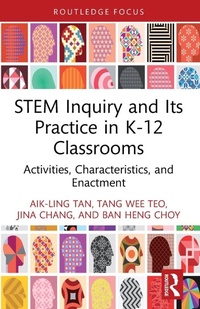
STEM Inquiry and Its Practice in K-12 Classrooms
Activities, Characteristics, and Enactment
1st Edition
Published on 30. July 2025
Book
Paperback/Softback
152 pages
978-1-032-72769-1 (ISBN)
Description
Through examining the theoretical ideas of disciplinarity and disciplinary practices, the book presents instructional aspects for teachers to explore when engaged with integrated STEM inquiry.
Are you interested to understand the difference between science inquiry and STEM inquiry? Do you want to introduce integrated STEM problem solving to your students but need help with the key features of STEM inquiry? This book presents in-depth discussions related to the features and affordances of integrated STEM inquiry. Written for K-12 teachers and teacher educators, this book conceptualises STEM inquiry and integrated STEM and their enactment, using three practical STEM instructional frameworks: problem-centric, solution/design-centric, and user-centric STEM. The three STEM instructional frameworks serve as a key anchor for teachers to interpret and apply when planning various STEM lessons in meaningful, practical, and coherent ways.
Whether you are an aspiring K-12 STEM teacher or an in-service teacher teaching K-12 students, the ideas of integrated STEM inquiry presented in this book challenge educators to think about the principles of integrated STEM inquiry and how they can be incorporated into classroom practice and lessons.
Are you interested to understand the difference between science inquiry and STEM inquiry? Do you want to introduce integrated STEM problem solving to your students but need help with the key features of STEM inquiry? This book presents in-depth discussions related to the features and affordances of integrated STEM inquiry. Written for K-12 teachers and teacher educators, this book conceptualises STEM inquiry and integrated STEM and their enactment, using three practical STEM instructional frameworks: problem-centric, solution/design-centric, and user-centric STEM. The three STEM instructional frameworks serve as a key anchor for teachers to interpret and apply when planning various STEM lessons in meaningful, practical, and coherent ways.
Whether you are an aspiring K-12 STEM teacher or an in-service teacher teaching K-12 students, the ideas of integrated STEM inquiry presented in this book challenge educators to think about the principles of integrated STEM inquiry and how they can be incorporated into classroom practice and lessons.
More details
Series
Language
English
Place of publication
London
United Kingdom
Publishing group
Taylor & Francis Ltd
Target group
College/higher education
Postgraduate
Illustrations
21 s/w Tabellen, 48 s/w Abbildungen, 35 s/w Photographien bzw. Rasterbilder, 13 s/w Zeichnungen
21 Tables, black and white; 13 Line drawings, black and white; 35 Halftones, black and white; 48 Illustrations, black and white
Dimensions
Height: 216 mm
Width: 140 mm
Thickness: 9 mm
Weight
223 gr
ISBN-13
978-1-032-72769-1 (9781032727691)
Copyright in bibliographic data and cover images is held by Nielsen Book Services Limited or by the publishers or by their respective licensors: all rights reserved.
Schweitzer Classification
Other editions
Additional editions
Aik-Ling Tan | Tang Wee Teo | Jina Chang
STEM Inquiry and Its Practice in K-12 Classrooms
Activities, Characteristics, and Enactment
E-Book
03/2024
1st Edition
Routledge
€27.49
Available for download
Aik-Ling Tan | Tang Wee Teo | Jina Chang
STEM Inquiry and Its Practice in K-12 Classrooms
Activities, Characteristics, and Enactment
E-Book
03/2024
1st Edition
Routledge
€27.49
Available for download
Aik-Ling Tan | Tang Wee Teo | Jina Chang
STEM Inquiry and Its Practice in K-12 Classrooms
Activities, Characteristics, and Enactment
Book
03/2024
1st Edition
Routledge
€78.80
Shipment within 10-20 days
Persons
Aik-Ling Tan is Deputy Head (Teaching & Curriculum Matters), Natural Sciences and Science Education. She is also an associate professor of science education at the National Institute of Education, Nanyang Technological University, Singapore. She teaches biology education methods courses and courses related to integrated STEM curriculum. Prior to teaching at the National Institute of Education in 2007, Aik-Ling taught Biology and Lower Secondary General Science at River Valley High School, Singapore for ten years.
Tang Wee Teo is an associate professor in the Natural Sciences and Science Education at the National Institute of Education, Nanyang Technological University, Singapore. She is also the Co-Head of the Multi-centric Education, Research and Industry STEM Centre (meriSTEM@NIE).
Jina Chang is a visiting scholar at the National Institute of Education, Nanyang Technological University, Singapore. Her research interests include science inquiry from a sociocultural perspective. She has recently broadened her interests to encompass STEM education and multimodal approach in science inquiry.
Ban Heng Choy is an assistant professor in Mathematics Education at the National Institute of Education, Nanyang Technological University, Singapore. As a recipient of the NIE Overseas Graduate Scholarship, Dr Choy received his PhD from the University of Auckland, New Zealand, in 2015. He is currently one of the co-Heads for meriSTEM@NIE, a Multi-centric Education, Research, and Industry STEM centre in NIE.
Tang Wee Teo is an associate professor in the Natural Sciences and Science Education at the National Institute of Education, Nanyang Technological University, Singapore. She is also the Co-Head of the Multi-centric Education, Research and Industry STEM Centre (meriSTEM@NIE).
Jina Chang is a visiting scholar at the National Institute of Education, Nanyang Technological University, Singapore. Her research interests include science inquiry from a sociocultural perspective. She has recently broadened her interests to encompass STEM education and multimodal approach in science inquiry.
Ban Heng Choy is an assistant professor in Mathematics Education at the National Institute of Education, Nanyang Technological University, Singapore. As a recipient of the NIE Overseas Graduate Scholarship, Dr Choy received his PhD from the University of Auckland, New Zealand, in 2015. He is currently one of the co-Heads for meriSTEM@NIE, a Multi-centric Education, Research, and Industry STEM centre in NIE.
Content
1. Making Sense of STEM Inquiry: Reasons, Inquiry, and Problem Solving 2. Planning for Integrated STEM 3. Disciplinarity in Integrated STEM Inquiry 4. Assessing Integrated STEM Inquiry 5. Enactment of Integrated STEM Inquiry in Classrooms 6. Working as a Multidisciplinary Team 7. Learning from Nature's Design 8. Growing Humanistic Values through Integrated STEM Inquiry 9. Working with Evidence in Integrated STEM Inquiry 10. Using Expert Voices to Increase Task Authenticity 11. Conclusions