

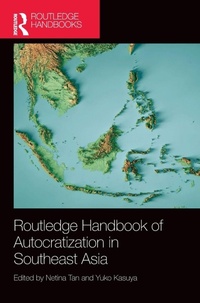
Routledge Handbook of Autocratization in Southeast Asia
1st Edition
Published on 31. July 2025
Book
Hardback
392 pages
978-1-032-53216-5 (ISBN)
Description
The Routledge Handbook of Autocratization in Southeast Asia examines how global and domestic forces of autocratization affect regional and local politics. It analyzes how the interactions of international and domestic factors affect actors and institutions in both democracies and autocracies in the region.
Bringing together a representative slate of both local and international, junior and senior scholars of different methodological backgrounds, this Handbook cross-examines regional trends and provides an insider view of the causes and effects of autocratization in a region with diverse experiences with de-colonization, state-building, and economic and political developments. The 28 chapters are organized into three sections. Part I examines a range of structural, international, socio-political, technological, and ideological causal factors of autocratization. Part II offers a comparative analysis of the consequences of autocratization on key actors and democratic institutions. Part III provides a more detailed study of autocratic consolidation and pushback in each country in Southeast Asia. Taking into account structural-historical, institutional, and cultural factors, the contributors analyze how domestic actors and democratic institutions withstand the global forces of autocratization.
This Handbook fills empirical gaps in the current scholarship by focusing on all nation-states in the Association of Southeast Asia Nations and Timor-Leste, varied regime types with diverse socio-religious backgrounds. It is the first authoritative reference work dedicated to Southeast Asia's autocratization and will be an indispensable reference work for academics and policymakers interested in democracy and autocracy, regime transition, and Southeast Asian politics.
Bringing together a representative slate of both local and international, junior and senior scholars of different methodological backgrounds, this Handbook cross-examines regional trends and provides an insider view of the causes and effects of autocratization in a region with diverse experiences with de-colonization, state-building, and economic and political developments. The 28 chapters are organized into three sections. Part I examines a range of structural, international, socio-political, technological, and ideological causal factors of autocratization. Part II offers a comparative analysis of the consequences of autocratization on key actors and democratic institutions. Part III provides a more detailed study of autocratic consolidation and pushback in each country in Southeast Asia. Taking into account structural-historical, institutional, and cultural factors, the contributors analyze how domestic actors and democratic institutions withstand the global forces of autocratization.
This Handbook fills empirical gaps in the current scholarship by focusing on all nation-states in the Association of Southeast Asia Nations and Timor-Leste, varied regime types with diverse socio-religious backgrounds. It is the first authoritative reference work dedicated to Southeast Asia's autocratization and will be an indispensable reference work for academics and policymakers interested in democracy and autocracy, regime transition, and Southeast Asian politics.
More details
Language
English
Place of publication
London
United Kingdom
Publishing group
Taylor & Francis Ltd
Target group
College/higher education
Postgraduate
Illustrations
16 s/w Abbildungen, 16 s/w Zeichnungen, 15 s/w Tabellen
17 Tables, black and white; 16 Line drawings, black and white; 16 Illustrations, black and white
Dimensions
Height: 250 mm
Width: 175 mm
Thickness: 27 mm
Weight
884 gr
ISBN-13
978-1-032-53216-5 (9781032532165)
Copyright in bibliographic data and cover images is held by Nielsen Book Services Limited or by the publishers or by their respective licensors: all rights reserved.
Schweitzer Classification
Other editions
Additional editions
Netina Tan | Yuko Kasuya
Routledge Handbook of Autocratization in Southeast Asia
E-Book
07/2025
Routledge
€68.49
Available for download
Netina Tan | Yuko Kasuya
Routledge Handbook of Autocratization in Southeast Asia
E-Book
07/2025
Routledge
€68.49
Available for download
Persons
Netina Tan is University Scholar and Associate Professor of Political Science at McMaster University, Canada.
Yuko Kasuya is the Director of the V-Dem Regional Center for East Asia, and a Professor of Political Science at the Faculty of Law, Keio University, Tokyo, Japan.
Yuko Kasuya is the Director of the V-Dem Regional Center for East Asia, and a Professor of Political Science at the Faculty of Law, Keio University, Tokyo, Japan.
Content
Section 1: Sources of Autocratization
1. Introduction to Autocratization in Southeast Asia
Netina Tan and Yuko Kasuya
2. Global Public Governance
Sorpong Peou
3. China and Autocratization
Alvin Camba and Ray Asada
4. Polarization and Autocratization
Diego Fossati
5. Digital Authoritarianism
Netina Tan and Rebecca Denyer
6. Religion and Autocratization
Kikue Hamayotsu
7. Populist Leaders
Ronald Pernia and Rogelio Alicor Panao
8. Monarchy
Kana Inata
9. The Coup Trap
Terence Lee
Section 2: Impact of Autocratization
10. Democratic Values and Resistance
Huang Kai-Ping and Saiful Mujani
11. Judicial Independence
Bjoern Dressel and Cristina Regina Bonoan
12. Parties and Party systems
Don Lee and Fernando Casal Bertoa
13. Ethnic Minorities
Cassandra Preece and Wu Chun Ying
14. Gender Equality
Shan-Jan Sarah Liu
15. Media freedom
James Gomez
16. Academic freedom
Sriprapha Petcharamesree
17. The Association of Southeast Asian Nations (ASEAN)
Avery Poole
Section 3: Country Trends and Patterns
18. Brunei
Nasuke Mukoyama
19. Cambodia
Sokphea Young and Soksamphoas Im
20. Indonesia
Marcus Mietzner
21. Laos
Norihiko Yamada
22. Malaysia
Saleena Saleem
23. Myanmar
Ardeth Maung Thawnghmung and Aye Lei Tun
24. The Philippines
Justin Keith Basquisal and Aries A. Arugay
Chapter 25: Singapore
Walid Jumblatt Abdullah
26. Thailand
Aim Sinpeng and Itsakul Unahakate
27. Timor Leste
Rui Graca Feijo and Michael Leach
28. Vietnam
Adam Fforde
1. Introduction to Autocratization in Southeast Asia
Netina Tan and Yuko Kasuya
2. Global Public Governance
Sorpong Peou
3. China and Autocratization
Alvin Camba and Ray Asada
4. Polarization and Autocratization
Diego Fossati
5. Digital Authoritarianism
Netina Tan and Rebecca Denyer
6. Religion and Autocratization
Kikue Hamayotsu
7. Populist Leaders
Ronald Pernia and Rogelio Alicor Panao
8. Monarchy
Kana Inata
9. The Coup Trap
Terence Lee
Section 2: Impact of Autocratization
10. Democratic Values and Resistance
Huang Kai-Ping and Saiful Mujani
11. Judicial Independence
Bjoern Dressel and Cristina Regina Bonoan
12. Parties and Party systems
Don Lee and Fernando Casal Bertoa
13. Ethnic Minorities
Cassandra Preece and Wu Chun Ying
14. Gender Equality
Shan-Jan Sarah Liu
15. Media freedom
James Gomez
16. Academic freedom
Sriprapha Petcharamesree
17. The Association of Southeast Asian Nations (ASEAN)
Avery Poole
Section 3: Country Trends and Patterns
18. Brunei
Nasuke Mukoyama
19. Cambodia
Sokphea Young and Soksamphoas Im
20. Indonesia
Marcus Mietzner
21. Laos
Norihiko Yamada
22. Malaysia
Saleena Saleem
23. Myanmar
Ardeth Maung Thawnghmung and Aye Lei Tun
24. The Philippines
Justin Keith Basquisal and Aries A. Arugay
Chapter 25: Singapore
Walid Jumblatt Abdullah
26. Thailand
Aim Sinpeng and Itsakul Unahakate
27. Timor Leste
Rui Graca Feijo and Michael Leach
28. Vietnam
Adam Fforde