

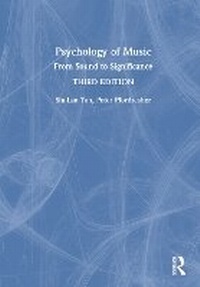
Psychology of Music
From Sound to Significance
3rd Edition
Published on 22. December 2025
Book
Hardback
426 pages
978-1-032-26414-1 (ISBN)
Description
From the physical vibrations of sound to the perplexing questions of how music conveys meaning, Psychology of Music: From Sound to Significance takes readers on a wide-ranging exploration of this vibrant multidisciplinary field of study. Now in its third edition, the book emphasizes meaningful links between academic learning and real-world contexts, pointing readers towards intriguing strands of research in both basic and applied areas that are highlighted throughout.
In this new edition, the authors apply the same richness of depth and scope that were the hallmarks of the previous editions of this text, exploring the foundations of music psychology; the perception and cognition of music; development, learning, and performance; and the meaning and significance of music.
Key features include:
More than 450 new citations to reflect advances in the field
New boxes exploring topics such as the musical experience of cochlear implant users, pitch and rhythm perception in animals, gene-environment interplay, and the benefits of music in medical and therapeutic contexts
An expanded appendix including many new tried-and-tested projects and exercises for instructors
This book continues to be invaluable to both psychology and music undergraduate and postgraduate students and instructors, and will appeal to anyone interested in the vital and expanding field of psychology of music.
In this new edition, the authors apply the same richness of depth and scope that were the hallmarks of the previous editions of this text, exploring the foundations of music psychology; the perception and cognition of music; development, learning, and performance; and the meaning and significance of music.
Key features include:
More than 450 new citations to reflect advances in the field
New boxes exploring topics such as the musical experience of cochlear implant users, pitch and rhythm perception in animals, gene-environment interplay, and the benefits of music in medical and therapeutic contexts
An expanded appendix including many new tried-and-tested projects and exercises for instructors
This book continues to be invaluable to both psychology and music undergraduate and postgraduate students and instructors, and will appeal to anyone interested in the vital and expanding field of psychology of music.
Reviews / Votes
'Comprehensive yet comprehensible, this greatly revised edition builds naturally upon the strengths of the previous versions. The text offers a helpful overview of everything from hearing mechanisms and the basics of auditory perception to grappling with complex questions related to the origins and meaning of music. With a flexible chapter structure affording customization for different pedagogical goals, I have enjoyed using previous editions for classes of both Music and Psychology students. This greatly revised version adds hundreds of additional citations, practical tips on in-class assignments, and practical applications of basic discoveries helping bring material to life for students of all backgrounds. In essence, it is the book I wish I had written!'Michael Schutz, Professor of Music Cognition/Percussion, McMaster University, Canada
'The newest edition of Psychology of Music: From Sound to Significance illustrates the subtitle even more strongly than the prior editions I've used in my Psychology of Music seminar. The authors take care to introduce readers to the methods used in the field, to help them appreciate the significance of the findings of the foundational and contemporary studies in each chapter. They are vigilant in alerting readers to some of 'hype' and unsupported claims that sometimes appear in the media, emphasizing the most validated findings from researchers all over the world. This book will not only edify students in undergraduate courses in music and psychology, but will also be of interest to any reader who has experienced music in any form'.
Andrea R Halpern, Professor of Psychology, Bucknell University, US; past president of the Society for Music Perception and Cognition
'In this new edition of their book, Tan, Pfordresher, and Harre engage in the formidable task of reviewing and sharing research on the main topics in the field of Psychology of Music through accessible and inviting language. The authors use the same structure from the previous editions and individual chapters are carefully crafted, offering a good balance between seminal works and new developments. Topics like musical development (pre-birth to adulthood), the perception and cognition of musical structures, the social psychology of music, the musical brain, and music and meaning, are covered with precision and without too much jargon. Reflective questions, images from actual research studies, and practical applications are all weaved into the narrative, appealing to a broader audience. In short: There is something for everyone! I have used this book in courses aimed at music majors and non-majors, at both the undergraduate and graduate levels, and cannot wait to bring this third edition into my classroom'.
Beatriz Ilari, Professor of Music Teaching and Learning, University of Southern California, US; co-editor of the Routledge Companion to Interdisciplinary Studies in Singing (Vol. 1: Development).
Praise for the previous editions
Second edition
'Tan, Pfordresher, and Harre have thoroughly revised and updated Psychology of Music: From Sound to Significance with great success. Topics are seamlessly integrated across chapters with valuable cross-references and clear links are drawn between the classic studies and the vibrant, contemporary research. Anyone involved in music, as performer or listener, will find an engaging array of ideas about music and human thought and emotion - and many fascinating unanswered, questions.'
Carol Krumhansl, Professor of Psychology, Cornell University. Past president, Society for Music Perception and Cognition
'The authors' revision of Psychology of Music: From Sound to Significance provides students and instructors with a rich and deep resource for learning about the field of music psychology. Approachable in its language and sweeping in scope, this text introduces readers to the many areas of scientific research into the powerful, deeply human experiences of listeners and performers, children and adults. I have used the first edition as a text in my undergraduate survey course for years and highly recommend this book as an excellent choice, both in the classroom and for the independent learner.'
Richard Ashley, Associate Professor of Music, Northwestern University, Past president, Society for Music Perception and Cognition
Published reviews
Second edition
'[I]t is very challenging to ensure a comprehensive yet easily comprehended introduction to many profound theories. In this regard, Professors Tan, Pfordresher, and Harre have been most successful in this revised version... Psychology of Music: From Sound to Significance (Second Edition) is a fantastic book for anyone interested in the psychology of music.
Xuanyi Ma, Psychology of Music
First edition
'As it stands, Tan, Pfordresher, and Harre's volume is an engaging exposition of the current state of our knowledge of the psychology of music .... To paraphrase Nietzsche, experiencing music without knowledge may not entirely be a mistake, but experiencing it with the kind of up-to-date knowledge that may be gleaned from Psychology of Music: From Sound to Significance is even more marvelous.'
Aaron Kozbelt, PsycCRITIQUES
'Tan et al.'s volume is an impressive achievement and merits serious consideration by anyone teaching a survey course in music cognition or seeking to recommend to a friend or colleague .... Its 300-odd pages are packed with the most detailed overview of our field we are likely to see in any text in the near term and it covers the major aspects of the field quite comprehensively.'
Richard Ashley, Music Perception
'[A]ll topics are introduced with sophistication and an interesting balance is provided between references to classical work and more recent work. Similarly, quantitative and qualitative investigations are both included .... The broadness of the book is splendid and allows for a complete introduction to the field. It will indeed be invaluable to undergraduate and postgraduate studies in the fields of psychology of music ....'
Renee Timmers, British Journal of Music Education
'The field of Music Psychology has received formative influences from many domains, thus it is no mean feat to create a representative survey of the literature. The authors have met the challenge, achieving a detailed and useful introduction to the field with this text.'
Jessica Grahn, Empirical Musicology Review
'We expect that this book will play an influential role in establishing the canonical organization for music psychology textbooks and hope to see it go through many editions in the years to come .... Meanwhile, we heartily welcome this ambitious book as a valuable new resource for teaching the psychology of music.'
Roger Chaffin and Alexander Demos, Psychomusicology
More details
Edition
3rd edition
Language
English
Place of publication
London
United Kingdom
Publishing group
Taylor & Francis Ltd
Target group
College/higher education
Professional and scholarly
Postgraduate, Professional, and Undergraduate
Illustrations
3 s/w Tabellen, 91 s/w Abbildungen, 55 s/w Photographien bzw. Rasterbilder, 36 s/w Zeichnungen
3 Tables, black and white; 36 Line drawings, black and white; 55 Halftones, black and white; 91 Illustrations, black and white
Dimensions
Height: 250 mm
Width: 175 mm
Thickness: 28 mm
Weight
944 gr
ISBN-13
978-1-032-26414-1 (9781032264141)
Copyright in bibliographic data and cover images is held by Nielsen Book Services Limited or by the publishers or by their respective licensors: all rights reserved.
Schweitzer Classification
Other editions
Additional editions
Book
approx. 12/2025
3rd Edition
Routledge
€90.00
Not yet published
E-Book
12/2025
3rd Edition
Routledge
€81.99
Available for download
E-Book
12/2025
3rd Edition
Routledge
€81.99
Available for download
Previous edition
Book
11/2017
2nd Edition
Routledge
€217.50
Article exhausted; check for reprint
Persons
Siu-Lan Tan is Professor of Psychology at Kalamazoo College in Michigan, USA. She completed degrees in Music, graduate studies at Oxford University, and a Ph.D. in Psychology at Georgetown University. She has published research on musical form, music notation, and film music, is co-editor of The Psychology of Music in Multimedia and The Oxford Handbook of Music and Advertising, and appears in 'Score: A Film Music Documentary'.
Peter Pfordresher is Professor of Psychology at SUNY Buffalo in New York, USA. He completed his Ph.D. in Psychology at the Ohio State University. His research on the relationship between perception and action in music has been published in psychology, music cognition, and music education journals, and he has received support from the National Science Foundation. He sings and plays piano, guitar, and the trumpet.
Rom Harre (1927-2019) held appointments in many institutions around the world, including Fellow at Oxford University, Distinguished Research Professor of Psychology at Georgetown University, and Director of the Centre for the Philosophy of the Natural and Social Sciences at the London School of Economics, and authored or edited over 65 scholarly books in numerous fields. For many years, he played clarinet and saron in amateur Western and Indonesian gamelan ensembles.
Peter Pfordresher is Professor of Psychology at SUNY Buffalo in New York, USA. He completed his Ph.D. in Psychology at the Ohio State University. His research on the relationship between perception and action in music has been published in psychology, music cognition, and music education journals, and he has received support from the National Science Foundation. He sings and plays piano, guitar, and the trumpet.
Rom Harre (1927-2019) held appointments in many institutions around the world, including Fellow at Oxford University, Distinguished Research Professor of Psychology at Georgetown University, and Director of the Centre for the Philosophy of the Natural and Social Sciences at the London School of Economics, and authored or edited over 65 scholarly books in numerous fields. For many years, he played clarinet and saron in amateur Western and Indonesian gamelan ensembles.
Content
Introduction 1. The scope of psychology of music. PART I Foundations. 2. The acoustics of music. 3. Music perception and the auditory system. 4 Cognitive neuroscience of music. PART II Perception and cognition of music. 5. Perception of musical pitch and melody. 6. Perception of musical time. 7. Understanding musical structure. PART II Development, learning, and performance. 8. Emergence of music perception.9. Early musical development. 10 Practice and musical expertise. 11. The psychology of music performance. PART IV The meaning and significance of music. 12. The social psychology of music. 13. Meaning in music. 14. The emotional power of music. Final Coda. 15. From sound to significance: Looking forward. Appendix: The chapters in action: Exercises and assignments.