

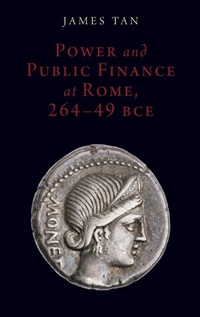
Power and Public Finance at Rome, 264-49 BCE
Published on 13. April 2017
Book
Hardback
248 pages
978-0-19-063957-0 (ISBN)
Description
Rome's wars delivered great wealth to the conquerors, but how did this affect politics and society on the home front? In Power and Public Finance at Rome, James Tan offers the first examination of the Roman Republic from the perspective of fiscal sociology and makes the case that no understanding of Roman history is complete without an appreciation of the role of economics in defining political interactions. Examining how imperial profits were distributed, Tan explores how imperial riches turned Roman public life on its head. Rome's lofty aristocrats had traditionally been constrained by their dependence on taxpayer money. They relied on the state to fund wars, and the state in turn relied on citizens' taxes to fuel the war machine. This fiscal chain bound the elite to taxpayer consent, but as the spoils of Empire flooded into Rome, leaders found that they could fund any policy they chose without relying on the support of the citizens who funded them. The influx of wealth meant that taxation at home was ended and citizens promptly lost what bargaining power they had enjoyed as a result of the state's reliance on their fiscal contributions. With their dependence on the taxpayers loosened, Rome's aristocratic leaders were free to craft a fiscal system which prioritized the enrichment of their own private estates and which devoted precious few resources to the provision of public goods. In six chapters on the nature of Rome's imperialist enrichment, on politics during the Punic Wars and on the all-important tribunates of the Gracchi, Tan offers new conceptions of Roman state creation, fiscal history, civic participation, aristocratic pre-eminence, and the eventual transition to autocracy.
Reviews / Votes
This revelatory book creatively employs the methods of fiscal sociology to provide new perspectives on Rome's turbulent politics. Tan's accessible vision of a republic ruined by a predatory elite, an inattentive populace, and destabilizing concentrations of wealth is a cautionary tale that would benefit an audience of concerned scholars outside the narrow circle of ancient historians. * Michael J. Taylor, Journal of Interdisciplinary History * This exciting, accessible book about finance in the Roman Republic breaks new ground and challenges old paradigms. ... The argument is nevertheless vitally important for ancient historians; modern economic theorists will also gain much from this study. ... Summing Up: Highly recommended. Most levels/libraries. * J. Clark, CHOICE * In this wonderfully thought-provoking book, James Tan examines Rome's fiscal skeleton to produce an original treatment of the state and society of the Roman Republic. Rich with sociological insights, the book proves that there are still lessons to be learned from Roman history. Tan demonstrates how tax revenue shaped politics in Rome and how the spoils of empire ultimately ruined its chances for democracy. * Andrew Monson, New York University * A blockbuster of a book, Power and Public Finance at Rome, 264-49 BCE is bound to unsettle everything we thought we knew about the economics of Republican imperialism. Tan zeros in on the crucial questions: Who has the money? Who doesn't? Why? And what are the implications? In answering them, he opens a strikingly new perspective on the decisions that determined who benefited from the profits of empire. * Nathan Rosenstein, Ohio State University *More details
Series
Language
English
Place of publication
New York
United States
Target group
Professional and scholarly
Dimensions
Height: 240 mm
Width: 161 mm
Thickness: 18 mm
Weight
537 gr
ISBN-13
978-0-19-063957-0 (9780190639570)
Copyright in bibliographic data and cover images is held by Nielsen Book Services Limited or by the publishers or by their respective licensors: all rights reserved.
Schweitzer Classification
Other editions
Additional editions
E-Book
02/2017
1st Edition
OUP eBook
€68.99
Available for download
E-Book
02/2017
1st Edition
OUP eBook
€54.49
Available for download
Person
James Tan studied ancient history at The University of Sydney and at Columbia University, and works mainly in the fields of Roman political and economic history. He was Visiting Professor of Classics at Union College in Schenectady NY, and is now Assistant Professor of History and Classics at Hofstra University in Hempstead NY.
Content
Table of Contents:
- Preface
- Introduction
- The Argument
Part I
- Chapter One: Rich Rome, Poor State
- Chapter Two: The Use and Abuse of Tax Farming
- Chapter Three: Profiteering in the Provinces
Part II
- Chapter Four: The Power of Taxpayers in the First Punic War
- Chapter Five: The Plight of Taxpayers in the Second Punic War
- Chapter Six: The Death and Taxes of the Gracchi
- Conclusions
- Bibliography
- Index
- Preface
- Introduction
- The Argument
Part I
- Chapter One: Rich Rome, Poor State
- Chapter Two: The Use and Abuse of Tax Farming
- Chapter Three: Profiteering in the Provinces
Part II
- Chapter Four: The Power of Taxpayers in the First Punic War
- Chapter Five: The Plight of Taxpayers in the Second Punic War
- Chapter Six: The Death and Taxes of the Gracchi
- Conclusions
- Bibliography
- Index