

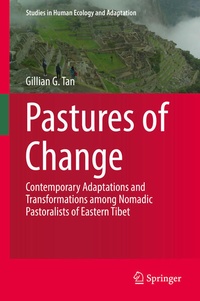
Pastures of Change
Description
Tibetan nomads have developed a way of life that is dependent in multiple ways on their animals and shaped by the phenomenological experience of mobility. These pastoralists have adapted to many changes in their social, political and environmental contexts over time. From the earliest historically recorded systems of segmentary lineage to the incorporation first into local fiefdoms and then into the Chinese state (of both Nationalist and Communist governments), Tibetan pastoralists have maintained their way of life, complemented by interactions with "the outside world".
Rapid changes brought about by an intensification of interactions with the outside world call into question the sustained viability of a nomadic way of life, particularly as pastoralists themselves sell their herds and settle into towns. This book probes how we can more clearly understand these changes by looking specifically at one particular area of high-altitude grasslands in the Tibetan Plateau.
Reviews / Votes
"Tan's book is an ethnographically rich and analytically sharp examination of the contemporary social transformation that the nomadic pastoralists have been experiencing for the last several decades. It is well written and reflects her extensive knowledge of and profound theoretical engagement in her fields of study. This book is a must-read for scholars and graduate students working in the fields of political ecology, human ecology, rangeland studies, development studies, and contemporary Tibetan studies." (Ga Errang, Human Ecology, Vol. 50, 2022)
"Gillian Tan's Pastures of Change is a welcome addition to a growing body of literature that examines ongoing adaptations and transformations in the lives of contemporary nomadic pastoralists in Eastern Tibet. . Pastures of Change remains a valuable contribution to the literature on contemporary pastoralism in Eastern Tibet, and should be of broad interest to scholars interested in understanding ongoing patterns of statemaking in China." (Kenneth Bauer, Nomadic Peoples, Vol. 23 (1), 2019)
More details
Other editions
Additional editions
Person
Gillian G. Tan is an anthropologist with research interests that cover 1) contemporary social and environmental changes on the Tibetan plateau, 2) human-nonhuman relationships among Tibetan nomadic pastoralists, and 3) theoretical and practical intersections between ecology and religiosity. She received her Ph.D from the University of Melbourne and has been a postdoctoral research fellow at the Laboratoire d'Anthropologie Sociale. Currently, she lectures in anthropology at the School of Humanities and Social Sciences, Deakin University in Geelong, Australia.
Content
Chapter 1: Pastoralism and Change in the Eastern Tibetan Plateau.- Chapter 2: Ethnographic Setting of Nomadic Pastoralism in Eastern Tibet.- Chapter 3: Ideologies of Change from Maoist Development to Market-Oriented Governmentality.- Chapter 4: 'Change for a Better Future': International Development in Eastern Tibet.- Chapter 5: Historical Engagements in Eastern Tibet.- Chapter 6: Contemporary Adaptations and Transformations.- Chapter 7: Caterpillar Fungus and Transforming Subjectivities.- Chapter 8: Conclusion.