

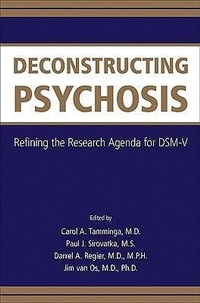
Deconstructing Psychosis
Refining the Research Agenda for DSM-V
Published on 10. October 2009
Book
Paperback/Softback
202 pages
978-0-89042-653-1 (ISBN)
Description
Deconstructing Psychosis: Refining the Research Agenda
for DSM-V provides an all-important summary of the latest research
about the diagnosis and pathophysiology of psychosis. This volume gives the
reader an inside look at how psychotic phenomena are represented in the
current diagnostic system and how DSM-V might better address the needs of
patients with such disorders.
The book presents a selection of papers
reporting the proceedings of a conference titled "Deconstructing Psychosis"
convened by the American Psychiatric Association (APA) in collaboration with
the World Health Organization (WHO) and the U.S. National Institutes of
Health (NIH). The conference was designed to be a key element in the
multiphase research review process for the fifth revision of DSM. This book
is one in a series of ten that reflects some of the most current and
critical examinations of psychiatric disorders and psychotic syndromes. APA
published the fourth edition of DSM in 1994 and a text revision in 2000.
DSM-V is scheduled for publication in 2013.
Deconstructing
Psychosis: Refining the Research Agenda for DSM-V examines the
current evidence regarding the diagnosis and pathophysiology of common
psychotic syndromes including:
* Schizophrenia
* Bipolar disorder
* Major depressive
psychosis
* Substance-induced psychosis
It also addresses broad
issues relating to diagnosis such as the ways in which psychosis cuts across
multiple diagnostic categories. Beyond merely summarizing the current state
of the science, the authors of these papers critique the current research
and clinical evidence, and raise questions about gaps in our
knowledge.
The book provides recommendations for the most promising
areas of research in psychosis, which may lead to more refined treatments
based on a better understanding of what biological and environmental factors
contribute to its development and symptoms.
In the learned editors'
selection of papers for inclusion in this volume, they have exhibited their
conviction that DSM-V is a "living document" that will reflect the pace of
progress in multiple areas, ranging from molecular genetics and brain
imaging to social, behavioral, and anthropological science.
As a book
on the narrowly defined topic of linking the classification of psychotic
syndromes with their underlying pathophysiology and potential etiology,
there is no other writing of comparable content available today.
for DSM-V provides an all-important summary of the latest research
about the diagnosis and pathophysiology of psychosis. This volume gives the
reader an inside look at how psychotic phenomena are represented in the
current diagnostic system and how DSM-V might better address the needs of
patients with such disorders.
The book presents a selection of papers
reporting the proceedings of a conference titled "Deconstructing Psychosis"
convened by the American Psychiatric Association (APA) in collaboration with
the World Health Organization (WHO) and the U.S. National Institutes of
Health (NIH). The conference was designed to be a key element in the
multiphase research review process for the fifth revision of DSM. This book
is one in a series of ten that reflects some of the most current and
critical examinations of psychiatric disorders and psychotic syndromes. APA
published the fourth edition of DSM in 1994 and a text revision in 2000.
DSM-V is scheduled for publication in 2013.
Deconstructing
Psychosis: Refining the Research Agenda for DSM-V examines the
current evidence regarding the diagnosis and pathophysiology of common
psychotic syndromes including:
* Schizophrenia
* Bipolar disorder
* Major depressive
psychosis
* Substance-induced psychosis
It also addresses broad
issues relating to diagnosis such as the ways in which psychosis cuts across
multiple diagnostic categories. Beyond merely summarizing the current state
of the science, the authors of these papers critique the current research
and clinical evidence, and raise questions about gaps in our
knowledge.
The book provides recommendations for the most promising
areas of research in psychosis, which may lead to more refined treatments
based on a better understanding of what biological and environmental factors
contribute to its development and symptoms.
In the learned editors'
selection of papers for inclusion in this volume, they have exhibited their
conviction that DSM-V is a "living document" that will reflect the pace of
progress in multiple areas, ranging from molecular genetics and brain
imaging to social, behavioral, and anthropological science.
As a book
on the narrowly defined topic of linking the classification of psychotic
syndromes with their underlying pathophysiology and potential etiology,
there is no other writing of comparable content available today.
More details
Language
English
Place of publication
VA
United States
Target group
Professional and scholarly
US School Grade: College Graduate Student and over
Product notice
Paperback (trade)
Illustrations
4 Illustrations, color; 11 Line drawings, black and white; 7 Tables, unspecified
Dimensions
Height: 229 mm
Width: 152 mm
Thickness: 10 mm
Weight
350 gr
ISBN-13
978-0-89042-653-1 (9780890426531)
Copyright in bibliographic data and cover images is held by Nielsen Book Services Limited or by the publishers or by their respective licensors: all rights reserved.
Schweitzer Classification
Other editions
Additional editions
Carol A. Tamminga | Paul J. Sirovatka | Darrel A. Regier
Deconstructing Psychosis
Refining the Research Agenda for DSM-V
E-Book
08/2009
1st Edition
American Psychiatric Association
€65.49
Available for download
Persons
Carol A. Tamminga, M.D., is a Professor of
Psychiatry and Interim Chair of the Department of Psychiatry at the
University of Texas Southwestern Medical Center in Dallas,
Texas.
Paul J. Sirovatka, M.S., (1947-2007), was Director
of Research Policy Analysis at the Division of Research and American
Psychiatric Institute for Research and Education at the American Psychiatric
Association.
Darrel A. Regier, M.D., M.P.H., is Executive
Director of the American Psychiatric Institute for Research and Education
and Director of the Division of Research at the American Psychiatric
Association in Arlington, Virginia.
Jim van Os, M.D., Ph.D., is
a Professor of Psychiatric Epidemiology in the Department of Psychiatry and
Neuropsychology at the South Limburg Mental Health Research and Teaching
Network, European Graduate School for Neuroscience at Maastricht University
in Maastricht, The Netherlands; and Visiting Professor of Psychiatric
Epidemiology in the Division of Psychological Medicine at the Institute of
Psychiatry in London, England.
Psychiatry and Interim Chair of the Department of Psychiatry at the
University of Texas Southwestern Medical Center in Dallas,
Texas.
Paul J. Sirovatka, M.S., (1947-2007), was Director
of Research Policy Analysis at the Division of Research and American
Psychiatric Institute for Research and Education at the American Psychiatric
Association.
Darrel A. Regier, M.D., M.P.H., is Executive
Director of the American Psychiatric Institute for Research and Education
and Director of the Division of Research at the American Psychiatric
Association in Arlington, Virginia.
Jim van Os, M.D., Ph.D., is
a Professor of Psychiatric Epidemiology in the Department of Psychiatry and
Neuropsychology at the South Limburg Mental Health Research and Teaching
Network, European Graduate School for Neuroscience at Maastricht University
in Maastricht, The Netherlands; and Visiting Professor of Psychiatric
Epidemiology in the Division of Psychological Medicine at the Institute of
Psychiatry in London, England.
Content
CONTRIBUTORS
DISCLOSURE STATEMENT
FOREWORD:
Rethinking Psychosis in DSM-V
INTRODUCTION
Chapter 1. DECONSTRUCTING
PSYCHOSIS CONFERENCE FEBRUARY 2006: The Validity of Schizophrenia and
Alternative Approaches to the Classification of Psychosis
Chapter 2.
BIOLOGICAL, LIFE COURSE, AND CROSS-CULTURAL STUDIES ALL POINT TOWARD THE
VALUE OF DIMENSIONAL AND DEVELOPMENTAL RATINGS IN THE CLASSIFICATION OF
PSYCHOSIS
Chapter 3. CURRENT ISSUES IN THE CLASSIFICATION OF PSYCHOTIC
MAJOR DEPRESSION
Chapter 4. DECONSTRUCTING BIPOLAR DISORDER: A Critical
Review of Its Diagnostic Validity and a Proposal for DSM-V and
ICD-1
Chapter 5. DSM-V RESEARCH AGENDA: Substance Abuse/Psychosis
Comorbidity
Chapter 6. THE GENETIC DECONSTRUCTION OF
PSYCHOSIS
Chapter 7. HOW SHOULD DSM-V CRITERIA FOR SCHIZOPHRENIA INCLUDE
COGNITIVE IMPAIRMENT?
Chapter 8. SEARCHING FOR UNIQUE ENDOPHENOTYPES FOR
SCHIZOPHRENIA AND BIPOLAR DISORDER WITHIN NEURAL CIRCUITS AND THEIR
MOLECULAR REGULATORY MECHANISMS
Chapter 9. DECONSTRUCTING PSYCHOSIS WITH
HUMAN BRAIN IMAGING
Chapter 10. IDENTIFYING FUNCTIONAL NEUROIMAGING
BIOMARKERS OF BIPOLAR DISORDER: Toward DSM-V
Chapter 11. THE
NEUROPHARMACOLOGY OF PSYCHOSIS
INDEX
DISCLOSURE STATEMENT
FOREWORD:
Rethinking Psychosis in DSM-V
INTRODUCTION
Chapter 1. DECONSTRUCTING
PSYCHOSIS CONFERENCE FEBRUARY 2006: The Validity of Schizophrenia and
Alternative Approaches to the Classification of Psychosis
Chapter 2.
BIOLOGICAL, LIFE COURSE, AND CROSS-CULTURAL STUDIES ALL POINT TOWARD THE
VALUE OF DIMENSIONAL AND DEVELOPMENTAL RATINGS IN THE CLASSIFICATION OF
PSYCHOSIS
Chapter 3. CURRENT ISSUES IN THE CLASSIFICATION OF PSYCHOTIC
MAJOR DEPRESSION
Chapter 4. DECONSTRUCTING BIPOLAR DISORDER: A Critical
Review of Its Diagnostic Validity and a Proposal for DSM-V and
ICD-1
Chapter 5. DSM-V RESEARCH AGENDA: Substance Abuse/Psychosis
Comorbidity
Chapter 6. THE GENETIC DECONSTRUCTION OF
PSYCHOSIS
Chapter 7. HOW SHOULD DSM-V CRITERIA FOR SCHIZOPHRENIA INCLUDE
COGNITIVE IMPAIRMENT?
Chapter 8. SEARCHING FOR UNIQUE ENDOPHENOTYPES FOR
SCHIZOPHRENIA AND BIPOLAR DISORDER WITHIN NEURAL CIRCUITS AND THEIR
MOLECULAR REGULATORY MECHANISMS
Chapter 9. DECONSTRUCTING PSYCHOSIS WITH
HUMAN BRAIN IMAGING
Chapter 10. IDENTIFYING FUNCTIONAL NEUROIMAGING
BIOMARKERS OF BIPOLAR DISORDER: Toward DSM-V
Chapter 11. THE
NEUROPHARMACOLOGY OF PSYCHOSIS
INDEX