

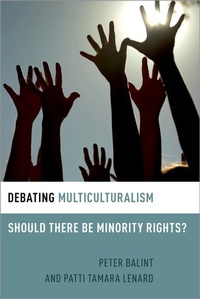
Debating Multiculturalism
Should There be Minority Rights?
Published on 29. April 2022
Book
Hardback
318 pages
978-0-19-752837-2 (ISBN)
Description
Multiculturalism has become a political touchstone in many countries around the world. While many of those on the right oppose it, and many of those on the left embrace it, things are not this simple. For those who defend them, multicultural policies are generally seen as key to the fair and successful integration of minorities, many of whom are immigrants, into diverse democratic societies. For those who oppose multiculturalism, who have become part of the so-called "backlash" against multiculturalism, they are charged with generating segregation rather than inclusion, undermining national cultures, reinforcing difference, and privileging minority groups.
Around the world, we see failing attempts at migrant integration, persistent religious intolerance and racial and ethnic discrimination, resurgent national minorities, emboldened majorities, permanent minorities, continuing social isolation, and increasing extremism, including in the form of white nationalism. But is multiculturalism the solution to these problems or does it just make them worse?
In this for-and-against book, two prominent scholars of multiculturalism put forward different answers to this important question. While Patti Tamara Lenard argues for minority rights as both the consequence of a right to culture and a way to redress the effects of nation-building, Peter Balint rejects minority rights altogether, instead arguing for a re-imagined liberal neutrality. This theoretical disagreement plays out in real-world policy disagreement. Lenard, for example, argues strongly in favor of exemptions from general rules for minority cultures including the right of Sikhs to be exempt from helmet laws, and for Jews and Muslims to be exempt from bans on male circumcision. She also defends the right of minority cultures to have government-supported separate spaces. Balint, on the other hand, argues directly against these types of exemptions and government support. He is opposed to any form of differentiation based on culture, religion, or ethnicity. The book uses a wide range of real-world examples to demonstrate their significant theoretical disagreement, and to recommend very different policy proposals.
Around the world, we see failing attempts at migrant integration, persistent religious intolerance and racial and ethnic discrimination, resurgent national minorities, emboldened majorities, permanent minorities, continuing social isolation, and increasing extremism, including in the form of white nationalism. But is multiculturalism the solution to these problems or does it just make them worse?
In this for-and-against book, two prominent scholars of multiculturalism put forward different answers to this important question. While Patti Tamara Lenard argues for minority rights as both the consequence of a right to culture and a way to redress the effects of nation-building, Peter Balint rejects minority rights altogether, instead arguing for a re-imagined liberal neutrality. This theoretical disagreement plays out in real-world policy disagreement. Lenard, for example, argues strongly in favor of exemptions from general rules for minority cultures including the right of Sikhs to be exempt from helmet laws, and for Jews and Muslims to be exempt from bans on male circumcision. She also defends the right of minority cultures to have government-supported separate spaces. Balint, on the other hand, argues directly against these types of exemptions and government support. He is opposed to any form of differentiation based on culture, religion, or ethnicity. The book uses a wide range of real-world examples to demonstrate their significant theoretical disagreement, and to recommend very different policy proposals.
Reviews / Votes
To this reader at least, this lively debate volume shows very clearly that traditional liberalism, with its core principles of public neutrality and toleration, requires multiculturalism-the position laid out here by Peter Balint. Others will find in Patti Lenard`s 'political inclusion' model a new way of defending a more orthodox multiculturalism of minority rights. But the perhaps most powerful message of this book is the narrow range of disagreement on the necessity of multiculturalism in liberal-democratic societies. * Christian Joppke, University of Bern (Switzerland) * Has multiculturalism failed, and if so, why has it failed? Lenard and Balint explore these questions while offering their positions for and against multiculturalism. Lenard justifies multiculturalism on the basis of political inclusion. Balint criticizes multiculturalism on the basis of liberal neutrality. The authors broadly agree about the ideals of liberal democracy and they both take minority rights seriously. But they disagree about the 'knowability' of culture, the application of multiculturalism to Indigenous peoples and national minorities, and the sources and risks of social fragmentation. Readers will find two cogent arguments and an illuminating debate that remind us why multicultural ideals are still worth defending and yet remain contested today. * Avigail Eisenberg, University of Victoria (Canada) *More details
Series
Language
English
Place of publication
New York
United States
Target group
Professional and scholarly
Dimensions
Height: 216 mm
Width: 143 mm
Thickness: 22 mm
Weight
467 gr
ISBN-13
978-0-19-752837-2 (9780197528372)
Copyright in bibliographic data and cover images is held by Nielsen Book Services Limited or by the publishers or by their respective licensors: all rights reserved.
Schweitzer Classification
Other editions
Additional editions
Book
04/2022
Oxford University Press Inc
€29.50
Shipment within 15-20 days
E-Book
01/2022
OUP eBook
€15.49
Available for download
E-Book
01/2022
OUP eBook
€15.49
Available for download
Persons
Peter Balint is a Senior Lecturer in International & Political Studies at UNSW Canberra. His most recent book Respecting Toleration: Traditional Liberalism and Contemporary Diversity (Oxford University Press, 2017), was awarded an APSA CRISP Prize in 2018. His research is in political theory and is primarily focussed on the principles for diversity, including respect, toleration, neutrality, and social cohesion. He is regularly asked to consult government on issues of migration, multiculturalism, and citizenship.
Patti Tamara Lenard is Professor of Applied Ethics in the Graduate School of Public and International Affairs, University of Ottawa.. She is the author of Trust, Democracy and Multicultural Challenges (Penn State, 2012) and How Should Democracies Fight Terrorism? (Polity, 2020). She is active in the fields of political theory of migration, counter-terrorism, and democracy more generally. In Ottawa, she runs a small community organization called Rainbow Haven, which
sponsors, settles and advocates for LGBTQ refugees and asylum seekers.
Patti Tamara Lenard is Professor of Applied Ethics in the Graduate School of Public and International Affairs, University of Ottawa.. She is the author of Trust, Democracy and Multicultural Challenges (Penn State, 2012) and How Should Democracies Fight Terrorism? (Polity, 2020). She is active in the fields of political theory of migration, counter-terrorism, and democracy more generally. In Ottawa, she runs a small community organization called Rainbow Haven, which
sponsors, settles and advocates for LGBTQ refugees and asylum seekers.
Content
Introduction: Multiculturalism and Minority Rights
Peter Balint & Patti Tamara Lenard
PART I: Pro Multiculturalism
Patti Tamara Lenard
Chapter 1: Introduction to Part I
Chapter 2: What is Culture? Why Political Inclusion?
Chapter 3: Cultural Claims and Political Inclusion
Chapter 4: Cultural Preservation and Multicultural Accommodation
Chapter 5: Non-Interference and Political Inclusion
Chapter 6: Shared Public Culture in Diverse States
PART II: Against Multicultural Minority Rights
Peter Balint
Chapter 7: Introduction to Part II
Chapter 8: We are All Neutralists Now!
Chapter 9: Neutrality without Minority Rights
Chapter 10: National Minorities, Indigenous Peoples, and Historical Injustice
Chapter 11: Multiculturalism and the Demands on Citizens
Chapter 12: Conclusion to Part II
Part III: Responses
Chapter 13: Response to Balint
Culture not Colanders: Why Neutralism Fails to Respond Effectively to the Challenges of Cultural Diversity
Patti Tamara Lenard
Chapter 14: Response to Lenard
Multiculturalism without Minority (or Majority) Rights
Peter Balint
Peter Balint & Patti Tamara Lenard
PART I: Pro Multiculturalism
Patti Tamara Lenard
Chapter 1: Introduction to Part I
Chapter 2: What is Culture? Why Political Inclusion?
Chapter 3: Cultural Claims and Political Inclusion
Chapter 4: Cultural Preservation and Multicultural Accommodation
Chapter 5: Non-Interference and Political Inclusion
Chapter 6: Shared Public Culture in Diverse States
PART II: Against Multicultural Minority Rights
Peter Balint
Chapter 7: Introduction to Part II
Chapter 8: We are All Neutralists Now!
Chapter 9: Neutrality without Minority Rights
Chapter 10: National Minorities, Indigenous Peoples, and Historical Injustice
Chapter 11: Multiculturalism and the Demands on Citizens
Chapter 12: Conclusion to Part II
Part III: Responses
Chapter 13: Response to Balint
Culture not Colanders: Why Neutralism Fails to Respond Effectively to the Challenges of Cultural Diversity
Patti Tamara Lenard
Chapter 14: Response to Lenard
Multiculturalism without Minority (or Majority) Rights
Peter Balint