

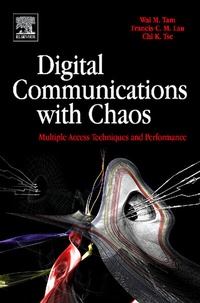
Digital Communications with Chaos
Multiple Access Techniques and Performance
Published on 18. October 2006
Book
Hardback
256 pages
978-0-08-045151-0 (ISBN)
Description
Since the 1970's, there has been a great deal of research effort spent on studying chaotic systems and the properties of the chaotic signals generated. Characterized by their wideband, impulse-like autocorrelation and low cross-correlation properties, chaotic signals are useful spread-spectrum signals for carrying digital information. Spectrum spreading has become one of the most popular modulation techniques for high-speed wireless communications. It makes use of signals of very wide bandwidth to carry information at relatively low data rates, and possesses advantages such as low probability of interception, resistance to jamming, multiple-access capability and mitigation to multipath effect, which are particularly important in a wireless scenario. In addition to enjoying the aforementioned benefits, chaotic signals can be generated using simple circuitries, thus lowering the cost of transceivers.
Early study of chaos-based communication systems was focused on a single-user case. In the past few years, more effort has been put on investigating systems with multiple-access capability, which is a key feature of spread-spectrum communication systems. Digital Communications with Chaos presents a detailed study of some multiple-access schemes used for chaos-based communications, and evaluates their performance. In addition, the effectiveness of the multiuser detection techniques, whose primary objective is to reduce interference between users and hence improve performance, is evaluated in the context of multiple-access digital communication systems.
Early study of chaos-based communication systems was focused on a single-user case. In the past few years, more effort has been put on investigating systems with multiple-access capability, which is a key feature of spread-spectrum communication systems. Digital Communications with Chaos presents a detailed study of some multiple-access schemes used for chaos-based communications, and evaluates their performance. In addition, the effectiveness of the multiuser detection techniques, whose primary objective is to reduce interference between users and hence improve performance, is evaluated in the context of multiple-access digital communication systems.
More details
Language
English
Place of publication
Oxford
United Kingdom
Publishing group
Elsevier Science & Technology
Target group
Professional and scholarly
For graduate students and researchers who are involved in the study of chaos communications, also providing useful information for communication engineers and technology developers
Dimensions
Height: 229 mm
Width: 152 mm
Weight
490 gr
ISBN-13
978-0-08-045151-0 (9780080451510)
Copyright in bibliographic data and cover images is held by Nielsen Book Services Limited or by the publishers or by their respective licensors: all rights reserved.
Schweitzer Classification
Other editions
Additional editions

Wai M. Tam | Francis C. M. Lau | Chi K. Tse
Digital Communications with Chaos
Multiple Access Techniques and Performance
E-Book
07/2010
Elsevier
€170.00
Available for download
Persons
Author
Department of Electronic & Information Engineering, Hong Kong Polytechnic University, Hunghom
Kowloon, Hong Kong
Kowloon, Hong Kong
Department of Electronic & Information Engineering, Hong Kong Polytechnic University, Hunghom
Kowloon, Hong Kong
Kowloon, Hong Kong
Department of Electronic & Information Engineering, Hong Kong Polytechnic University, Hunghom
Kowloon, Hong Kong
Kowloon, Hong Kong
Content
1. Introduction
2. Chaos-Based Digital Communication Systems
3. Multiple-Access Coherent Antipodal Chaos-Shift-Keying Systems
4. Multiuser Detection Techniques for Multiple-Access Coherent Antipodal Chaos-Shift-Keying Systems
5. Multiple-Access Generalized Correlation Delay-Shift-Keying Systems
6. Enhancements of Correlation-Delay-Shift-Keying Scheme
7. Multiple-Access Scheme Utilizing Transmitted References And Training Sequences
8. Near-Optimum Communication Schemes
2. Chaos-Based Digital Communication Systems
3. Multiple-Access Coherent Antipodal Chaos-Shift-Keying Systems
4. Multiuser Detection Techniques for Multiple-Access Coherent Antipodal Chaos-Shift-Keying Systems
5. Multiple-Access Generalized Correlation Delay-Shift-Keying Systems
6. Enhancements of Correlation-Delay-Shift-Keying Scheme
7. Multiple-Access Scheme Utilizing Transmitted References And Training Sequences
8. Near-Optimum Communication Schemes