

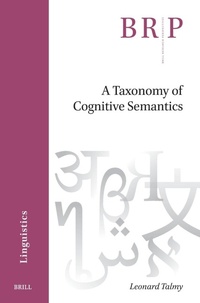
A Taxonomy of Cognitive Semantics
Published on 3. April 2025
Book
Paperback/Softback
116 pages
978-90-04-73025-0 (ISBN)
Description
Cognitive semantics is a relatively new field whose central concern is how language structures conceptual content. This book aims to approach the field comprehensively and outline its main contours. It both summarizes previous research and presents novel analyses. The main issues it covers range from concept structuring mechanisms, through crosslinguistic contrasts of concepts, to relations across cognitive faculties. Along the way, it examines communication systems, including gesture and signed language; diachronic change from long to short-term; differences between universal, typological, and language-specific features; ten conceptual categories represented by closed-class forms; and tropes as a form of "constructive discrepancy".
More details
Series
Language
English
Place of publication
Leiden
Netherlands
Target group
Professional and scholarly
Product notice
Paperback (trade)
Unsewn / adhesive bound
Dimensions
Height: 233 mm
Width: 161 mm
Thickness: 1 mm
Weight
181 gr
ISBN-13
978-90-04-73025-0 (9789004730250)
Copyright in bibliographic data and cover images is held by Nielsen Book Services Limited or by the publishers or by their respective licensors: all rights reserved.
Schweitzer Classification
Person
Leonard Talmy is Professor Emeritus of Linguistics and Director Emeritus of the Center for Cognitive Science, University at Buffalo. He has authored the Targeting System of Language and the two-volume set Toward a Cognitive Semantics, both with MIT Press, plus numerous articles.
Content
Contents
Acknowledgements
?Introduction
?1?Major Language Divisions (A)
?2?Participant Structure (B)
?3?Arenas of Assembly (C)
?4?Content Structuring Mechanisms (D)
?5?Combination (E)
?6?Diachronic Comparison (F)
?7?Crosslinguistic Comparison (G)
?8?Quantity of Manifestation (H)
?9?Communication Systems (I)
?10?Relations across Cognitive Faculties (J)
?11?Research Characteristics (K)
?Conclusion
?References
?Index
Acknowledgements
?Introduction
?1?Major Language Divisions (A)
?2?Participant Structure (B)
?3?Arenas of Assembly (C)
?4?Content Structuring Mechanisms (D)
?5?Combination (E)
?6?Diachronic Comparison (F)
?7?Crosslinguistic Comparison (G)
?8?Quantity of Manifestation (H)
?9?Communication Systems (I)
?10?Relations across Cognitive Faculties (J)
?11?Research Characteristics (K)
?Conclusion
?References
?Index