

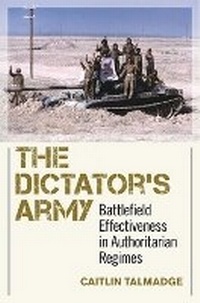
The Dictator's Army
Battlefield Effectiveness in Authoritarian Regimes
Published on 22. September 2015
Book
Hardback
320 pages
978-0-8014-5347-2 (ISBN)
Description
In The Dictator's Army, Caitlin Talmadge presents a compelling new argument to help us understand why authoritarian militaries sometimes fight very well-and sometimes very poorly. Talmadge's framework for understanding battlefield effectiveness focuses on four key sets of military organizational practices: promotion patterns, training regimens, command arrangements, and information management. Different regimes face different domestic and international threat environments, leading their militaries to adopt different policies in these key areas of organizational behavior.
Authoritarian regimes facing significant coup threats are likely to adopt practices that squander the state's military power, while regimes lacking such threats and possessing ambitious foreign policy goals are likely to adopt the effective practices often associated with democracies. Talmadge shows the importance of threat conditions and military organizational practices for battlefield performance in two paired comparisons of states at war: North and South Vietnam (1963-1975) and Iran and Iraq (1980-1988). Drawing on extensive documentary sources, her analysis demonstrates that threats and practices can vary not only between authoritarian regimes but also within them, either over time or across different military units. The result is a persuasive explanation of otherwise puzzling behavior by authoritarian militaries. The Dictator's Army offers a vital practical tool for those seeking to assess the likely course, costs, and outcomes of future conflicts involving nondemocratic adversaries, allies, or coalition partners.
Authoritarian regimes facing significant coup threats are likely to adopt practices that squander the state's military power, while regimes lacking such threats and possessing ambitious foreign policy goals are likely to adopt the effective practices often associated with democracies. Talmadge shows the importance of threat conditions and military organizational practices for battlefield performance in two paired comparisons of states at war: North and South Vietnam (1963-1975) and Iran and Iraq (1980-1988). Drawing on extensive documentary sources, her analysis demonstrates that threats and practices can vary not only between authoritarian regimes but also within them, either over time or across different military units. The result is a persuasive explanation of otherwise puzzling behavior by authoritarian militaries. The Dictator's Army offers a vital practical tool for those seeking to assess the likely course, costs, and outcomes of future conflicts involving nondemocratic adversaries, allies, or coalition partners.
Reviews / Votes
"The Dictator's Army is a landmark book that greatly deepens our understanding of how dictators fight wars. Students, scholars, and policymakers will all benefit from reading this important work." -- Dan Reiter, Samuel Candler Dobbs Chair of Political Science, Emory University "Through superb case comparisons Caitlin Talmadge shows carefully how military effectiveness varies, why it depends on far more than the technical factors normally considered, and especially the differences due to political and social characteristics of regimes. She takes analysis of the subject to a new level." -- Richard K. Betts, Director, Saltzman Institute of War and Peace Studies, Columbia University "Understanding the military behavior of autocracies is an important topic for both policymakers and political scientists. Combining new theory with in-depth research, The Dictator's Army persuasively demonstrates how fear of domestic turmoil influences both the military organizational choices of autocrats and the success of their militaries on the battlefield. This book is a fascinating read, one that makes a significant contribution to our scholarship on military effectiveness and security studies more generally." -- Michael C. Horowitz, University of Pennsylvania "Why are some nondemocracies more effective than others on the battlefield? This question is really important for U.S. policy. In this highly original book, Caitlin Talmadge shows how the measures taken by authoritarian regimes to protect against coups makes their militaries less able to fight conventional wars." -- Theo Farrell, Head of the Department of War Studies, King's College LondonMore details
Series
Language
English
Place of publication
Ithaca
United States
Product notice
Paper over boards
Illustrations
18 tables, 15 maps - 18 Tables, unspecified
Dimensions
Height: 235 mm
Width: 155 mm
Thickness: 25 mm
Weight
907 gr
ISBN-13
978-0-8014-5347-2 (9780801453472)
Copyright in bibliographic data and cover images is held by Nielsen Book Services Limited or by the publishers or by their respective licensors: all rights reserved.
Schweitzer Classification
Other editions
Additional editions
E-Book
09/2015
Cornell University Press
€27.49
Available for download
Person
Caitlin Talmadge is Assistant Professor of Political Science and International Affairs at The George Washington University. She is coauthor of US Defense Politics: The Origins of Security Policy.
Content
Introduction: The Puzzle of Battlefield Effectiveness1. A Framework for Explaining Battlefield Effectiveness2. Threats and Military Organizational Practices in North and South Vietnam3. Battlefield Effectiveness in North and South Vietnam4. Threats and Military Organizational Practices in Iraq and Iran5. Battlefield Effectiveness in Iraq and IranConclusion: Threats, Military Organizational Practices, and the Battlefields of the FutureNotes
Index
Index