

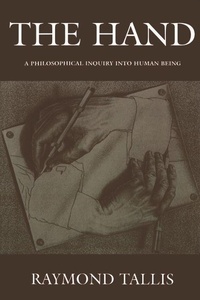
The Hand
A Philosophical Inquiry into Human Being
Published on 15. July 2003
Book
Paperback/Softback
368 pages
978-0-7486-1738-8 (ISBN)
Description
What are the origins of human difference? The Hand, which is the first part of a bold philosophical inquiry into the nature of the difference between human beings and other animals, argues that it is the result of a complex sequence of events which began several million years ago with the evolution of the human hand.Possession of a fully developed hand profoundly transformed the relationship of the human being to its own body, thus altering the relationship between humans and the natural world. The interaction of the hand with the rest of the body brought about self-consciousness and laid the foundations for the unique sense of agency that is experienced by humans. Crucially, the hand inspired the tool-use that has come to dominate human life and which has led to the emergence of the complex symbolic systems - most importantly language - that underpin civilisation.The book also celebrates the hand in human life: the almost miraculous complexity of its manipulative, exploratory and communicative functions. Raymond Tallis combines philosophical reflection with a light-hearted look at gestures, the role of each finger, the origins of numbers - and the case for and against what he names 'handkind'.The Hand is the first of three volumes. The other titles are I Am: A Philosophical Inquiry into First-Person Being and The Knowing Animal: A Philosophical Inquiry into Truth and Knowledge.
Reviews / Votes
Compellingly interesting ... An extraordinary achievement. -- Michael Grant, editor of <i>The Raymond Tallis Reader</i> Raymond Tallis is a man unusual in modern medicine. His career has been devoted to caring for, studying, and advancing the health of older people in society. But while working as a Professor of Geriatric medicine at the University of Manchester, he has developed a parallel career - as a philosopher, critic, poet and novelist - largely unknown to his clinical brotherhood and sisterhood. Indeed, important though his medical work has been, it is likely that his philosophy, and especially his philosophical anthropology will leave a particularly indelible mark on human affairs. -- Richard HortonMore details
Language
English
Place of publication
Edinburgh
United Kingdom
Target group
Professional and scholarly
Product notice
Paperback (trade)
Unsewn / adhesive bound
Dimensions
Height: 240 mm
Width: 156 mm
Thickness: 20 mm
Weight
558 gr
ISBN-13
978-0-7486-1738-8 (9780748617388)
Copyright in bibliographic data and cover images is held by Nielsen Book Services Limited or by the publishers or by their respective licensors: all rights reserved.
Schweitzer Classification
Other editions
Additional editions
E-Book
08/2019
1st Edition
Edinburgh University Press
€0.00
Available for download
Person
Raymond Tallis is Professor of Geriatric Medicine at the University of Manchester and Fellow of the Academy of Medical Sciences. Over the last 15 years he has published extensively outside the field of medicine. There have been three books which mount a critique of post-structuralist theory: Not Saussure: A Critique of Post-saussurean Literary Theory (Macmillan, 2nd edn, 1995), In Defence of Realism (Arnold & University of Nebraska Press, 2nd edn, 1998) and Theorrhoea and After (Macmillan, 1998). He has also published four books in the philosophy of mind: The Explicit Animal: A Defence of Human Consciousness (Macmillan, 1991), The Pursuit of Mind (co-edited with Howard Robinson, Carcanet, 1991), Psycho Electronics (Ferrington, 1994) and On the Edge of Certainty and Other Essays (Macmillan, 1999). Further books include Newton's Sleep: The Two Cultures and the Two Kingdoms (Macmillan, 1995), Enemies of Hope: A Critique of Contemporary Pessimism (Macmillan, 1997) and A Conversation with Martin Heidegger (Macmillan (Palgrave), 2002). An anthology of his theoretical writing - The Raymond Tallis Reader, edited by Michael Grant - was published by Macmillan (Palgrave) in 2000. He was awarded the degree of Doctor of Letters (hon causa) at the University of Hull in 1997 for his non-medical writings and the degree of Doctor of Letters (hon causa) at the University of Manchester in 2003 for 'contributions to literary theory and our understanding of human consciousness'. The Knowing Animal is the final volume in the trilogy of books for EUP which began with The Hand and continued with I Am.
Content
Contents; Acknowledgements; Introduction; Overture; 1 Grasping the Hand; 1.1 Preliminary Grapplings; 1.2 The Manipulative Hand; 1.3 The Knowing Hand; 1.4 The Communicative Hand; 1.5 From Prehension to Apprehension; Part I Brachio-Chiral; 2 The Armed Hand; 2.1 Two Fingers to Over-digitisation; 2.2 The Genius of Reaching; 2.3 Mechanism and Agency; 3 The Talking Hand; 3.1 Introduction: The Sign-making Animal; 3.2 Gesturing; 3.3 Clapping and Other Hand Shouting; 3.4 Handsome; 4 Hand Talking to Hand; 4.1 Manucaption; 4.2 The Dialogue of the Left Hand with the Right; 4.3 The Interlocutors; 4.4 The Hand Talking to its Self or the Self; 5 The Playful Hand; 5.1 Introduction; 5.2 The Carnal Hand; 5.3 Hand Games; 5.4 Post-script: Handy (like); Part II Chiro-Digital; 6 One-finger Exercises; 6.1 Introduction; 6.2 Thumb; 6.3 Index; 6.4 Middle; 6.5 Ring; 6.6 Little; 7 Polydactylic Exercises; 7.1 Introduction: The Ordeal of Precision; 7.2 Two Fingers; 7.3 Three Fingers; 7.4 Four Fingers; 7.5 Five Fingers; 7.6 Ten Fingers; 8 Abstract Digits; 8.1 Introduction and Disclaimer; 8.2 The Number Sense: From Magnitudes to Digits; 8.3 Digits and Digits; 8.4 Units: From Counting to Measurement; 8.5 The Unreasonable Power of the Precision of Abstract Digits; 9The Tool of Tools; 9.1 Prologue: The Self-shaping Hand; 9.2 Tool-using, Tool-making and the Tool of Tools; 9.3 Tools and the Origin of Human Culture; 9.4 Eolith and SuperCray; 9.5 Tools and Language; 9.6 Brain, Tools and Language; 9.7 Beyond Biology and Biologism; 9.8 Epilogue: Handicraft; Appendix: Karl Marx and the Collectivisation of; Human Consciousness in Tools; Part III Towards Chiro-Philosophy; 10 Getting and Grip on the Conscious Human Agent; 10.1 Recapitulation; 10.2 The Dawn of the Conscious Human Agent; 10.3 From Biology to Philosophical Anthropology; Coda; 11 Waving Farewell to the Hand; 11.1 Introduction; 11.2 The Paradox of Handyman: (1) Part of; and Separate from Nature; 11.3 The Paradox of the Handyman: (2) Subject to and Yet Manipulating Nature's Laws; 11.4 The Balance Sheet: (1) Knowledge. Does the Hand Grasp the Truth?; 11.5 The Balance Sheet: (2) Moral and Spiritual; 11.6 Handing On; 11.7 A Last Wave Farewell; Index.