

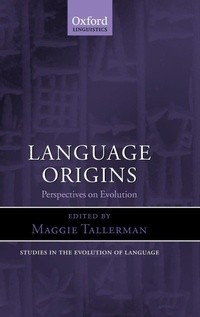
Language Origins
Perspectives on Evolution
Published on 26. May 2005
Book
Hardback
448 pages
978-0-19-927903-6 (ISBN)
Description
This book addresses central questions in the evolution of language: where it came from; how and why it evolved; how it came to be culturally transmitted; and how languages diversified. It does so from the perspective of the latest work in linguistics, neuroscience, psychology, and computer science, and deploys the latest methods and theories to probe into the origins and subsequent development of the only species that has languages.
Reviews / Votes
...will interest a wide range of linguists, cognitive scientists, biologists, psychologists, neuroscientists, and experts in artificial intelligence, as well as all those fascinated by issues, puzzles, and problems raised by the evolution of language. * Folia Linguistica *More details
Series
Language
English
Place of publication
Oxford
United Kingdom
Target group
Professional and scholarly
Linguists, phoneticians, biologists, psychologists, archaeologists, anthropologists, ethologists, neuroscientists, specialists in AI, and computer scientists, plus their advanced students. Will also interest the dedicated general reader.
Illustrations
numerous figures
Dimensions
Height: 240 mm
Width: 161 mm
Thickness: 29 mm
Weight
834 gr
ISBN-13
978-0-19-927903-6 (9780199279036)
Copyright in bibliographic data and cover images is held by Nielsen Book Services Limited or by the publishers or by their respective licensors: all rights reserved.
Schweitzer Classification
Other editions
Additional editions

E-Book
05/2005
1st Edition
OUP
€335.19
Available for download
Book
05/2005
Oxford University Press
€51.98
Shipment within 15-20 days
Person
Maggie Tallerman is Reader in Linguistics at Newcastle University. She has spent her professional life in North East England, having previously taught for 21 years at the University of Durham. Her research interests centre on the origins and evolution of syntax and morphology; modern Brythonic Celtic syntax and morphology; and language typology. She is the author of Understanding Syntax (1998; second edition 2005), and has published widely on the morphosyntax of modern Welsh and Breton, as well as on language evolution. She was review editor for the Journal of Linguistics from 1994 to 2005.
Content
1. Introduction ; PART I EVOLUTION OF SPEECH AND SPEECH SOUNDS: HOW DID SPOKEN LANGUAGE EMERGE? ; Introduction to Part I: How did links between perception and production emerge for spoken language? ; 2. The Mirror System Hypothesis: How did protolanguage evolve? ; 3. How Did Language go Discrete? ; 4. From Holistic to Discrete Speech Sounds: The blind snowflake maker hypothesis ; 5. Infant-Directed Speech and Evolution of Language ; PART II EVOLUTION OF GRAMMAR: HOW DID SYNTAX AND MORPHOLOGY EMERGE? ; Introduction to Part II: Protolanguage and the Development of Complexity ; 6. Initial Syntax and Modern Syntax: Did the clause evolve from the syllable? ; 7. The Potential Role of Production in the Evolution of Syntax ; 8. The Evolutionary Origin of Morphology ; 9. The Evolution of Grammatical Structures and 'Functional Need' Explanations ; 10. Deception and Mate Selection: Some implications for relevance and the evolution of language ; PART III ANALOGOUS AND HOMOLOGOUS TRAITS: WHAT CAN WE LEARN FROM OTHER SPECIES? ; Introductin to Part III: The Broadening Scope of Animal Communication Research ; 11. An Avian Perspective on Language Evolution: Implications of simultaneous development of vocal and physical object combinations by a Grey parrot (Psittacus erithacus) ; 12. Linguistic Prerequisites in the Primate Lineage ; PART IV LEARNABILITY AND DIVERSITY: HOW DID LANGUAGES EMERGE AND DIVERGE? ; Introduction to Part IV: Computer Modelling Widens the Focus of Language Study ; 13. Cultural Selection for Learnability: Three principles underlying the view that language adapts to be learnable ; 14. Coevolution of the Language Faculty and Language(s) With Decorrelated Encodings ; 15. Acquisition and Evolution of Quasi-regular Languages: Two puzzles for the price of one ; 16. Evolution of Language Diversity: Why fitness counts ; 17. Mutual Exclusivity: Communicative success despite conceptual divergence