

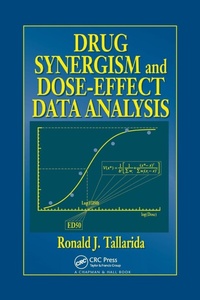
Drug Synergism and Dose-Effect Data Analysis
1st Edition
Published on 5. September 2019
Book
Paperback/Softback
264 pages
978-0-367-39834-7 (ISBN)
Description
Not since this author's bestselling Manual of Pharmacologic Calculation-long out of print-has there been a reference available for drug data analysis, and even that work did not deal with drug combinations. Although pharmacologists and most other scientists know what synergism is, mainstream textbooks tend to neglect it as a quantitative topic. Few researchers are familiar with the quantitative methodology needed to differentiate synergistic responses from the simply additive responses expected from drug combinations or a single drug's interaction with endogenous chemicals.
In Drug Synergism and Dose-Effect Data Analysis, noted pharmacologist, mathematician, and author Ronald J. Tallarida finally brings these methods to light. Drawing on statistical theory and methods but keeping the special needs of the pharmacologist in mind, he begins his treatment with dose-response relations, the statistical analysis of the data, and the models that describe them. He also offers the only modern presentation of probit and logit analysis and provides detailed calculation methods not found in typical statistics books.
Numerous examples accompany a presentation that clearly illustrates the calculations and experimental design considerations for modern drug analysis. You'll find the conceptual background, the algorithms, and new research developments. In short, Drug Synergism and Dose-Effect Data Analysis has everything you need to perform, with confidence, the quantitative analysis of dose response data.
In Drug Synergism and Dose-Effect Data Analysis, noted pharmacologist, mathematician, and author Ronald J. Tallarida finally brings these methods to light. Drawing on statistical theory and methods but keeping the special needs of the pharmacologist in mind, he begins his treatment with dose-response relations, the statistical analysis of the data, and the models that describe them. He also offers the only modern presentation of probit and logit analysis and provides detailed calculation methods not found in typical statistics books.
Numerous examples accompany a presentation that clearly illustrates the calculations and experimental design considerations for modern drug analysis. You'll find the conceptual background, the algorithms, and new research developments. In short, Drug Synergism and Dose-Effect Data Analysis has everything you need to perform, with confidence, the quantitative analysis of dose response data.
More details
Language
English
Place of publication
Oxford
United Kingdom
Publishing group
Taylor & Francis Ltd
Target group
Professional and scholarly
Professional Practice & Development
Dimensions
Height: 234 mm
Width: 156 mm
Thickness: 14 mm
Weight
409 gr
ISBN-13
978-0-367-39834-7 (9780367398347)
Copyright in bibliographic data and cover images is held by Nielsen Book Services Limited or by the publishers or by their respective licensors: all rights reserved.
Schweitzer Classification
Other editions
Additional editions
Ronald J. Tallarida
Drug Synergism and Dose-Effect Data Analysis
Book
07/2000
1st Edition
Chapman & Hall/CRC
€262.20
Shipment within 15-20 days
Ronald J. Tallarida
Drug Synergism and Dose-Effect Data Analysis
E-Book
07/2000
1st Edition
Chapman and Hall
€89.99
Available for download
Ronald J. Tallarida
Drug Synergism and Dose-Effect Data Analysis
E-Book
07/2000
Chapman & Hall/CRC
€89.99
Available for download
Person
Tallarida, Ronald J.
Content
Combinations of Chemicals. Dose-Response Analysis. Linear Regression: A Further Discussion. Calculations for Combination Drug Analysis. The Composite Additive Curve. Quantal Dose-Response Data: Probit and Logit Analysis. Analysis of Drug Combinations over a Range of Drug Ratios. Analysis of a Single Dose Combination. Different Experimental Designs. Response Surface Analysis of Drug Combinations. Nonlinear Regression Analysis. Statistical Concepts and Tests of Hypotheses. Appendix.