

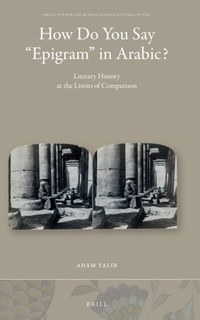
How Do You Say "Epigram" in Arabic?: Literary History at the Limits of Comparison
Published on 26. October 2017
Book
Hardback
352 pages
978-90-04-34996-4 (ISBN)
Description
The qa?idah and the qi??ah are well known to scholars of classical Arabic literature, but the maq?u?, a form of poetry that emerged in the thirteenth century and soon became ubiquitous, is as obscure today as it was once popular. These poems circulated across the Arabo-Islamic world for some six centuries in speech, letters, inscriptions, and, above all, anthologies. Drawing on more than a hundred unpublished and published works, How Do You Say "Epigram" in Arabic? is the first study of this highly popular and adaptable genre of Arabic poetry. By addressing this lacuna, the book models an alternative comparative literature, one in which the history of Arabic poetry has as much to tell us about epigrams as does Greek.
Reviews / Votes
"... a major contribution to the history of pre-modern Arabic literature." - Hakan OEzkan, in: Mamluk Studies Review, Vol. 21, 2018."... Adam Talib's monograph is a useful preliminary tool for experienced scholars and young researchers alike." - Luca Rizzo, Universita Ca' Foscari, Venezia & Westfaelische Wilhelms-Universitaet Muenster, in: Quaderni di Studi Arabi 13 (2018)
"... his careful and thoughtful treatment of the subject of genre sets future research on the right path" - Lara Harb, Princeton University, in: Journal of Arabic Literature 50 (2019)
"The work under review is a relevant example of both these scholarly achievements and the persistence of biased narrowness, for it does not only venture into a still largely unexplored chronology, but also into the terra incognita of a hitherto overlooked genre: the short poems (maqa?i?) conventionally called epigrams. [...] The main objective of Talib's ground-breaking study is to claim the maqa?i? as a genre of their own. This is undoubtedly achieved, and this work will become a compulsory reference for researchers of Arabic literature. Despite its complexity, this will be also a very useful text for BA students, who can profit from Talib's editions, translations and close reading of the poems. Scholars interested in postcolonial studies and comparative literature will find insightful discussions and enjoy Talib's aporetic disquisitions." - Ignacio Sanchez, University of Warwick in: Orientalistische Literaturzeitung Volume 115, Issue 4-5 (2020).
More details
Series
Language
English
Place of publication
Leiden
Netherlands
Target group
Professional and scholarly
Product notice
sewn/stitched
Cloth over boards
Dimensions
Height: 241 mm
Width: 159 mm
Thickness: 25 mm
Weight
612 gr
ISBN-13
978-90-04-34996-4 (9789004349964)
Copyright in bibliographic data and cover images is held by Nielsen Book Services Limited or by the publishers or by their respective licensors: all rights reserved.
Schweitzer Classification
Person
Adam Talib, DPhil (2014) Oxford, teaches Arabic language and literature at Durham University and is an assistant editor of the Journal of Arabic Literature. Before joining Durham, he taught at the American University in Cairo from 2012-2017.
Content
Note to Readers
Acknowledgments
List of Abbreviations
Preamble: Growth and Graft
On Wholeness
1 A Bounding Line
2 The Sum of its Parts
Arabic Poetry, Greek Terminology
Preliminary Remarks
3 Epigrams in the World
4 Hegemonic Presumptions and Atomic Fallout
5 Epigrams in Parallax
Appendix
Annotated Bibliography of Unpublished Sources
Sources
Index
Acknowledgments
List of Abbreviations
Preamble: Growth and Graft
On Wholeness
1 A Bounding Line
2 The Sum of its Parts
Arabic Poetry, Greek Terminology
Preliminary Remarks
3 Epigrams in the World
4 Hegemonic Presumptions and Atomic Fallout
5 Epigrams in Parallax
Appendix
Annotated Bibliography of Unpublished Sources
Sources
Index