

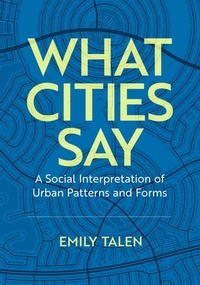
What Cities Say
A Social Interpretation of Urban Patterns and Forms
Published on 24. December 2024
Book
Paperback/Softback
312 pages
978-0-19-764777-6 (ISBN)
Description
Cities come in all shapes and sizes, with different patterns and forms. Streets might be strictly gridded or curvilinear. Buildings might be tightly packed or spread out. Patterns and forms might reflect the highest aspirations, or they might simply be responses to mundane, utilitarian needs. So what do cities "say" about a society? What do patterns and forms reveal about social priorities and cultural preferences, or about who has power and who does not?
In What Cities Say, Emily Talen provides a wide-ranging yet concise synthesis of the fundamental drivers of built form, its social and cultural meaning, and how we should interpret it. Including thirty-five distinct city patterns and forms, Talen develops a language of interpretation to understand the motive and meaning behind the city and its elements. Talen argues that meaning is often implicit, and even if it's more explicit, it is woven in haphazardly through city planning texts in often contradictory ways. To cut through the noise and ambiguity, she focuses on the persistent themes that inhere in built pattern and form, whether for complete cities or individual places. She makes ample use of digital resources to render these interpretations in explicit terms. By exposing these meanings, Talen asserts that we will be in a stronger position to articulate, and argue for, the kinds of cities we want. Richly illustrated and tightly presented, What Cities Say is essential reading for anyone interested in the values and ideas that serve as the foundation of how we construct our cities.
In What Cities Say, Emily Talen provides a wide-ranging yet concise synthesis of the fundamental drivers of built form, its social and cultural meaning, and how we should interpret it. Including thirty-five distinct city patterns and forms, Talen develops a language of interpretation to understand the motive and meaning behind the city and its elements. Talen argues that meaning is often implicit, and even if it's more explicit, it is woven in haphazardly through city planning texts in often contradictory ways. To cut through the noise and ambiguity, she focuses on the persistent themes that inhere in built pattern and form, whether for complete cities or individual places. She makes ample use of digital resources to render these interpretations in explicit terms. By exposing these meanings, Talen asserts that we will be in a stronger position to articulate, and argue for, the kinds of cities we want. Richly illustrated and tightly presented, What Cities Say is essential reading for anyone interested in the values and ideas that serve as the foundation of how we construct our cities.
More details
Language
English
Place of publication
New York
United States
Product notice
Paperback (trade)
Unsewn / adhesive bound
Dimensions
Height: 253 mm
Width: 179 mm
Thickness: 18 mm
Weight
567 gr
ISBN-13
978-0-19-764777-6 (9780197647776)
Copyright in bibliographic data and cover images is held by Nielsen Book Services Limited or by the publishers or by their respective licensors: all rights reserved.
Schweitzer Classification
Other editions
Additional editions

Book
12/2024
Oxford University Press Inc
€79.23
Shipment within 15-20 days
Person
Emily Talen is Professor of Urbanism at the University of Chicago, where she teaches urban design and directs the Urbanism Lab. She is a Fellow of the American Institute of Certified Planners, and the recipient of a Guggenheim Fellowship. Talen has written extensively on the topics of urban design, New Urbanism, and social equity. Her books include New Urbanism and American Planning; Design for Diversity; Urban Design Reclaimed; City Rules; and Neighborhood.
Content
Introduction
Greek Polis
Medieval Towns
Small Cities
Big Cities
Linear Cities
New Towns and Colonial Outposts
Industrial Villages and Company Towns
Garden Cities
Urban Suburbs
Planned Suburbs
Garden Suburbs
Modernist Urbanism
New Urbanism
Neighborhoods
Districts
The Baroque
Monumentalism
Urban Renewal
Uniformity
Variation
Sprawl
Grids
Wide Streets
Street Hierarchy
Curved and Irregular Streets
Boulevards and Avenues
Radials, Rings, and Diagonals
Superblocks
Plazas and Squares
Centers
Government
Towers in a Park
Buildings and Settings
Enclosure
Boundaries
Conclusion
Bibliography
Index
Greek Polis
Medieval Towns
Small Cities
Big Cities
Linear Cities
New Towns and Colonial Outposts
Industrial Villages and Company Towns
Garden Cities
Urban Suburbs
Planned Suburbs
Garden Suburbs
Modernist Urbanism
New Urbanism
Neighborhoods
Districts
The Baroque
Monumentalism
Urban Renewal
Uniformity
Variation
Sprawl
Grids
Wide Streets
Street Hierarchy
Curved and Irregular Streets
Boulevards and Avenues
Radials, Rings, and Diagonals
Superblocks
Plazas and Squares
Centers
Government
Towers in a Park
Buildings and Settings
Enclosure
Boundaries
Conclusion
Bibliography
Index