

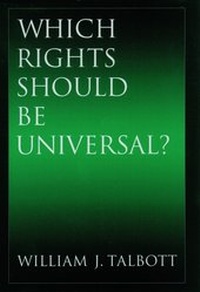
Which Rights Should be Universal?
Published on 17. March 2005
Book
Hardback
232 pages
978-0-19-517347-5 (ISBN)
Description
How can the advocate of universal rights avoid being a moral imperialist? In this book, Talbott builds on the work of Rawls, Habermas, Mill, Sen, and Shue to explain how, over the course of history, human beings have learned how to adopt a distinctively moral standpoint from which it is possible to make universal, though not infallible, judgments of right and wrong. He explains how this distinctively moral standpoint has led to the discovery of the moral importance of nine basic rights. His accessible book is important for debates on human rights, but also for the broader issues of moral and cultural relativism.
Reviews / Votes
No other work I am aware of comes close in making the consequentialist approach to rights come alive. Talbott somehow manages to provide the most detailed and skillful account of the philosophical, institutional, and empircal complexity of this approach without ever letting us lose sight of the simple humanitarianism that motivates it. Liam Murphy, New York UniversityMore details
Language
English
Place of publication
New York
United States
Target group
College/higher education
Professional and scholarly
Will interest a broad range of readers concerned with debates on human rights, and issues of moral and cultural relativism
Dimensions
Height: 234 mm
Width: 156 mm
ISBN-13
978-0-19-517347-5 (9780195173475)
Copyright in bibliographic data and cover images is held by Nielsen Book Services Limited or by the publishers or by their respective licensors: all rights reserved.
Schweitzer Classification
Other editions
Additional editions
William Talbott
Which Rights Should Be Universal?
E-Book
03/2005
1st Edition
OUP eBook
€24.99
Available for download