

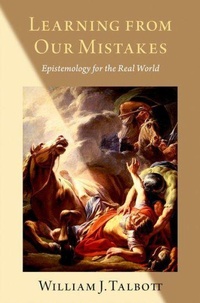
Learning from Our Mistakes
Epistemology for the Real World
Published on 22. November 2021
Book
Hardback
362 pages
978-0-19-756765-4 (ISBN)
Description
In Learning from Our Mistakes: Epistemology for the Real World, William J. Talbott provides a new framework for understanding the history of Western epistemology and uses it to propose a new way of understanding rational belief that can be applied to pressing social and political issues.
Talbott's new model of rational belief is not a model of a theorem prover in mathematics - It is a model of a good learner. Being a good learner requires sensitivity to clues, the imaginative ability to generate alternative explanatory narratives that fit the clues, and the ability to select the most coherent explanatory narrative. Sensitivity to clues requires sensitivity not only to evidence that supports one's own beliefs, but also to evidence that casts doubt on them. One of the most important characteristics of a good learner is the ability to correct mistakes.
From this model, Talbott articulates nine principles that help to explain the difference between rational and irrational belief. Talbott contrasts his approach with the approach of historically important philosophers, including Socrates, Plato, Aristotle, Hume, Kant, Wittgenstein, and Kuhn, as well as with a range of contemporary approaches, including pragmatism, Bayesianism, and naturalism.
On the basis of his model of rational belief, Talbott articulates a new theory of prejudice, which he uses to help diagnose the sources of inequity in the U.S. criminal justice system, as well as to provide insight into the proliferation of tribal and fascist epistemologies based on alt-facts and alt-truth. Learning from Our Mistakes offers a new lens through which to interpret the history of Western epistemology and analyze the complicated social and political phenomena facing us today.
Talbott's new model of rational belief is not a model of a theorem prover in mathematics - It is a model of a good learner. Being a good learner requires sensitivity to clues, the imaginative ability to generate alternative explanatory narratives that fit the clues, and the ability to select the most coherent explanatory narrative. Sensitivity to clues requires sensitivity not only to evidence that supports one's own beliefs, but also to evidence that casts doubt on them. One of the most important characteristics of a good learner is the ability to correct mistakes.
From this model, Talbott articulates nine principles that help to explain the difference between rational and irrational belief. Talbott contrasts his approach with the approach of historically important philosophers, including Socrates, Plato, Aristotle, Hume, Kant, Wittgenstein, and Kuhn, as well as with a range of contemporary approaches, including pragmatism, Bayesianism, and naturalism.
On the basis of his model of rational belief, Talbott articulates a new theory of prejudice, which he uses to help diagnose the sources of inequity in the U.S. criminal justice system, as well as to provide insight into the proliferation of tribal and fascist epistemologies based on alt-facts and alt-truth. Learning from Our Mistakes offers a new lens through which to interpret the history of Western epistemology and analyze the complicated social and political phenomena facing us today.
Reviews / Votes
In this brilliantly conceived volume, William Talbott takes aim at the 'Proof Paradigm', composed of five erroneous principles, which as he sees it has dominated Western epistemology since the ancient Greeks, and proposes to replace it with a superior alternative, one that involves on his part daring speculation about the metaphysical necessity of the principles of proper reasoning... Talbott's impressive book abounds with original ideas that, I am glad to say, are expressed with clarity and as much simplicity as the subject allows. * David Gordon, The Philosophical Quarterly * [T]he positive account . . . is intuitive and elegantly constructed.. . . [T]he book offers rich rewards. . . . Recommended. Upper-division undergraduates through faculty. * N. D. Smith, CHOICE * William Talbott offers a fundamentally new way of thinking about epistemic rationality, one that seems to me to constitute a third alternative to the ultimately frustrating demands of traditional internalism (growing out of what he describes as the "proof paradigm") and the sterile and unsatisfying externalist approach. On Talbott's view, the essence of epistemic rationality, rather than proof from unassailable premises or mere third-person evaluation, is the capacity to rationally correct one's own mistakes. Developing and elaborating this idea yields many rich insights into both the history of western epistemology and a wide range of issues, both epistemological and topical. It seems to me to offer a real and urgently needed antidote to the cognitive and epistemological chaos that presently afflicts our society. * Lawrence BonJour, University of Washington (Emeritus) * This is a strikingly original book... Talbott has insightful things to say about the nature of prejudice, the faults with Bayesian approaches to rationality, the significance of self-undermining theories, the epistemological significance of higher-order belief, the role of experience in rationality, the importance of necessity and universality in a theory of rationality, and much more besides. Every epistemologist should read this book. * Hilary Kornblith, University of Massachusetts, Amherst * Talbott's sophisticated theory of rationality is wide-ranging and innovative, and should interest any serious epistemologist. * Alvin Goldman, Rutgers University, Emeritus, and U. C. Berkeley *More details
Language
English
Place of publication
New York
United States
Target group
Professional and scholarly
Product notice
sewn/stitched
Cloth over boards
Dimensions
Height: 241 mm
Width: 163 mm
Thickness: 33 mm
Weight
635 gr
ISBN-13
978-0-19-756765-4 (9780197567654)
Copyright in bibliographic data and cover images is held by Nielsen Book Services Limited or by the publishers or by their respective licensors: all rights reserved.
Schweitzer Classification
Other editions
Additional editions
E-Book
09/2021
OUP eBook
€56.99
Available for download
E-Book
09/2021
OUP eBook
€56.99
Available for download
Person
William J. Talbott is a Professor of Philosophy at the University of Washington, Seattle. He teaches and has published articles in epistemology; moral and political philosophy, including the philosophy of human rights; rational choice theory; and the philosophy of law. He is the author of a book on reliabilist epistemology, The Reliability of the Cognitive Mechanism and two books in the philosophy of human rights: Which Rights Should Be Universal? and Human Rights and Human Well-Being (both OUP).
Content
Part I. The Proof Paradigm and the Causal Revolution in Epistemology
Introduction
Chapter 1. The Proof Paradigm
Chapter 2. Two Crises for the Proof Paradigm in the Enlightenment
Chapter 3. The End of the Proof Paradigm?
Chapter 4. The Causal Revolution in Epistemology
Part II. A New Way of Understanding Epistemic Rationality
Chapter 5. An Alternative to the Proof Paradigm for Ground-Level Rationality
Chapter 6. Two More Principles of Epistemic Rationality
Part III. And Epistemic Irrationality
Chapter 7. Epistemology for the Real World: Prejudices and Other Kinds of Epistemically Irrational Biased Beliefs
Chapter 8. Internally Inconsistent, Self-refuting, and Self-Undermining Views
Part IV. More on Epistemic Rationality
Chapter 9. Bayesian Accounts of Epistemic Rationality
Chapter 10. An Alternative to the Proof Paradigm for Metacognitive Rationality
Chapter 11. Necessity and Universality
Chapter 12. The Evolutionary Naturalist Challenge to the Reliability of Particular Epistemic Judgments
Part V. Clarifications, Responses to Objections, and Conclusion
Chapter 13. Clarifications and Objections
Conclusion
Appendix A
Appendix B
References
Introduction
Chapter 1. The Proof Paradigm
Chapter 2. Two Crises for the Proof Paradigm in the Enlightenment
Chapter 3. The End of the Proof Paradigm?
Chapter 4. The Causal Revolution in Epistemology
Part II. A New Way of Understanding Epistemic Rationality
Chapter 5. An Alternative to the Proof Paradigm for Ground-Level Rationality
Chapter 6. Two More Principles of Epistemic Rationality
Part III. And Epistemic Irrationality
Chapter 7. Epistemology for the Real World: Prejudices and Other Kinds of Epistemically Irrational Biased Beliefs
Chapter 8. Internally Inconsistent, Self-refuting, and Self-Undermining Views
Part IV. More on Epistemic Rationality
Chapter 9. Bayesian Accounts of Epistemic Rationality
Chapter 10. An Alternative to the Proof Paradigm for Metacognitive Rationality
Chapter 11. Necessity and Universality
Chapter 12. The Evolutionary Naturalist Challenge to the Reliability of Particular Epistemic Judgments
Part V. Clarifications, Responses to Objections, and Conclusion
Chapter 13. Clarifications and Objections
Conclusion
Appendix A
Appendix B
References