

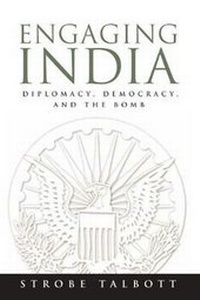
Engaging India
Diplomacy, Democracy, and the Bomb
Published on 5. August 2004
Book
Hardback
250 pages
978-0-8157-8300-8 (ISBN)
Description
On May 11, 1998 , three nuclear devices exploded under the Thar, or Great Indian Desert, shaking the surrounding villages-and the rest of the world. The immediate effect was to plunge U.S.-India relations, already vexed by decades of tension and estrangement, into a new acrimonious standoff. The situation deteriorated further when Pakistan responded with a test of its own two weeks later.
Engaging India is the revealing, authoritative account of the intensive talks that the United States conducted on parallel tracks with the South Asian nuclear powers over the next two and a half years. Bill Clinton's point man for that high-stakes diplomacy takes us behind the scenes of one of the most intriguing and consequential political dramas of our time, reconstructing what happened-and why-with narrative verve, rich human detail, and penetrating analysis.
From June 1998 through September 2000, in the most extensive engagement ever between the United States and India, Deputy Secretary of State Strobe Talbott and Minister of External Affairs Jaswant Singh met fourteen times in seven countries on three continents. They grappled with the urgent issue of arms control and nonproliferation, but they also discussed their visions for the U.S.-Indian relationship, the potential for economic and strategic cooperation between the two countries, and the implications of Hindu nationalism for the evolution of Indian society, politics, and security. Their personal rapport helped raise the level of trust between the two governments. As a result, the United States was able to play a crucial role in defusing the crisis between India and Pakistan over the contested territory of Kashmir in the summer of 1999-thus, perhaps, averting a war that could have escalated to nuclear conflagration.
The Talbott-Singh dialogue laid the ground for Clinton's transformational visit to South Asia in March 2000. That presidential journey opened a new chapter in relations between the United States and India. It also set the scene for U.S. cooperation with both India and Pakistan in the war against terror after September 11, 2001.
In addition to providing an insider's perspective on a fascinating and instructive episode in diplomatic history, the story told here is vital background for understanding what happens next in a region that is home to nearly a quarter of humanity and that was, at the beginning of the twenty-first century, "the most dangerous place on earth".
Engaging India is the revealing, authoritative account of the intensive talks that the United States conducted on parallel tracks with the South Asian nuclear powers over the next two and a half years. Bill Clinton's point man for that high-stakes diplomacy takes us behind the scenes of one of the most intriguing and consequential political dramas of our time, reconstructing what happened-and why-with narrative verve, rich human detail, and penetrating analysis.
From June 1998 through September 2000, in the most extensive engagement ever between the United States and India, Deputy Secretary of State Strobe Talbott and Minister of External Affairs Jaswant Singh met fourteen times in seven countries on three continents. They grappled with the urgent issue of arms control and nonproliferation, but they also discussed their visions for the U.S.-Indian relationship, the potential for economic and strategic cooperation between the two countries, and the implications of Hindu nationalism for the evolution of Indian society, politics, and security. Their personal rapport helped raise the level of trust between the two governments. As a result, the United States was able to play a crucial role in defusing the crisis between India and Pakistan over the contested territory of Kashmir in the summer of 1999-thus, perhaps, averting a war that could have escalated to nuclear conflagration.
The Talbott-Singh dialogue laid the ground for Clinton's transformational visit to South Asia in March 2000. That presidential journey opened a new chapter in relations between the United States and India. It also set the scene for U.S. cooperation with both India and Pakistan in the war against terror after September 11, 2001.
In addition to providing an insider's perspective on a fascinating and instructive episode in diplomatic history, the story told here is vital background for understanding what happens next in a region that is home to nearly a quarter of humanity and that was, at the beginning of the twenty-first century, "the most dangerous place on earth".
Reviews / Votes
"Talbot gives diplomacy --and the manner in which it should be reported --a wholly new dimension." --M. V. Kamath, (ALSO PRINTED IN FREE PRESS JOURNAL, MUMBAI AND THE ORGANISER), The Sentinel (Guwahati), 10/30/2004 "[A] fascinating study of how diplomatic dialogue can slowly broaden to include subtle considerations of the domestic politics and foreign policies of the countries involved. Talbott considers the complications presented by China and Pakistan and reveals that Washington played an important role in averting a war over Kashmir that could have gone nuclear." --Lucian W. Pye, Foreign Affairs "A true story with a positive message, ENGAGING INDIA is a raptly engrossing work and a welcome addition to modern world history shelves." --John Burroughs, Midwest Book Review "... a fascinating first-hand story of the diplomacy conducted between the United States and India after the nuclear tests." -- The Statesman, 9/19/2004 "... what comes through in this engrossing work is the author's intellectual honesty and his unerring understaning of the Indian psyche." --M.V. Kamath, Organiser, 10/17/2004 "[A] serious, sometimes funny, often exasperating tale told very well... Highly recommended. " --John F. Riddick, Central Michigan University Library, Mt. Pleasant, Library Journal, 10/15/2004 "ENGAGING INDIA is a rapidly engrossing work and a welcome addition to modern world history shelves." --John Buroughs, Reviewer's Bookwatch, 10/1/2004 "Besides simply explaining the arcana on strategy and nuclear policy, this slim two hundred-odd page book is also an enjoyable read. -- If it is true that we need more understanding and communication in this world, then this memoir is a valuable contribution to that cause." --Sudheer Apte, DesiJournal, 8/20/2004 "His clearly written account is an important addition to the literature of modern diplomatic history." --R. Marlay, Arkansas State University, Choice, 3/1/2005 "ENGAGING INDIA is a highly engaging book; lucid, informative and at times, amusing." --Gareth Price, Asia Programme, Chatham House, International Affairs, 3/15/2005 "Those interested in questions pertaining to American foreign policy, the dispersion of nuclear weapons, and diplomatic negotiations should all find this work to be of more than passing interest. Talbott, a former journalist of some repute, writes with clarity, verve, and a remarkable attention to vivid detail. His graceful and compelling prose, coupled with the insight that he provides in the complex negotiating process, should make Engaging India attractive to a much wider audience." -- Parameters, 4/1/2006 "With humor, grace and insight, Strobe Talbott chronicles a fascinating journey of diplomacy to overcome decades of U.S.-Indian estrangement and achieve a foundation of trust on which to build a relationship in the 21st century." --George Perkovich, Vice President for Studies, Carnegie Endowment for International Peace "The book not only enlightens the reader on the ebbs and flows in the Indian-American bilateral relationship through both bad and improving times. It is a primer on the do's and don'ts of nuclear diplomacy." --Richard G. Lugar, United States Senator "Strobe Talbott has written a gem of a diplomatic memoir. This ultimate insider account of American efforts to steer relations with and between India and Pakistan after their 1998 nuclear tests manages the hat trick of being candid, fair, and authoritative. The result is an ENGAGING INDIA that is truly engaging." --Richard Haass, President, Council on Foreign Relations "Strobe provides both engaging first-person accounts and deep reflections. As a foreign policy aficionado, I found it a gripping read." --Kishore Mahbubani, Author of CAN ASIANS THINK? and BEYOND THE AGE OF INNOCENCE (forthcoming) "A 'must read' book for anyone interested in how the United States deals with one of the decade's most important rising powers." --Ambassador Teresita C. Schaffer, Director for South Asia, Center for Strategic and International StudiesMore details
Language
English
Place of publication
United States
Publishing group
Bloomsbury Publishing Plc
Dimensions
Height: 228 mm
Width: 152 mm
ISBN-13
978-0-8157-8300-8 (9780815783008)
Copyright in bibliographic data and cover images is held by Nielsen Book Services Limited or by the publishers or by their respective licensors: all rights reserved.
Schweitzer Classification
Other editions
New editions
Book
03/2006
2nd Edition
Brookings Institution
€31.60
Shipment within 10-20 days
Additional editions
E-Book
08/2004
1st Edition
Brookings Institution
€29.49
Available for download
Person
Strobe Talbott is president of the Brookings Institution. He served as deputy secretary of state from 1994 to 2001. For twenty-one years prior to his service in government, he was correspondent and columnist for Time magazine. He has written nine books, including The Russia Hand: A Memoir of Presidential Diplomacy (Random House, 2002), a personal account of U.S. diplomacy toward Russia during the Clinton administration.