

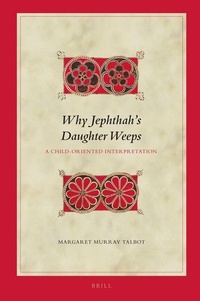
Why Jephthah's Daughter Weeps
A Child-Oriented Interpretation
Published on 18. March 2022
Book
Hardback
240 pages
978-90-04-50816-3 (ISBN)
Description
Why does Jephthah's daughter weep? Readers have creatively imagined the causes of her tears as she weeps upon her betulim-usually translated virginity or maidenhood. But her menstrual cycle's relation to these terms is rarely mentioned. A child-oriented theoretical and methodological foundation and research with post-menarcheal girls provide new answers to oft-raised questions about Bat-Yiphtach's weeping and her agency. Through an in-depth philological review and a focus on the "excluded middle" of the child-adult binary, this translation and interpretation of the story contribute to the field of childhood studies and shows that menarche and menstruation play a larger role in the narrative than readers have realized.
More details
Series
Language
English
Place of publication
Leiden
Netherlands
Target group
Professional and scholarly
Product notice
sewn/stitched
Cloth over boards
Dimensions
Height: 235 mm
Width: 155 mm
Thickness: 20 mm
Weight
528 gr
ISBN-13
978-90-04-50816-3 (9789004508163)
Copyright in bibliographic data and cover images is held by Nielsen Book Services Limited or by the publishers or by their respective licensors: all rights reserved.
Schweitzer Classification
Person
Margaret Murray Talbot, Ph.D. (2020), as principal and founder of CPQeditorial, provides freelance editing support to academic writers in a variety of disciplines and is adjunct instructor in the Certificate in Jewish-Christian Relationship program at Austin Presbyterian Theological Seminary.
Content
Acknowledgements
Abbreviations
1 Introduction
?1?Bat-Yiphtach's Story
?2?How the Book Proceeds
2 Characterizations of Bat-Yiphtach as Woman, Young Woman, Child
?1?Seeing Women in Judges: The Dominance of the Gender Binary
?2?Focus on Bat-Yiphtach Scholarship: Woman and Child Characterizations
?3?Conclusion
3 Theories and Methods for Transitioning Children
?1?Childhood Studies: An Overview
?2?Childhood Studies and Biblical Studies
?3?Conclusion
4 Menarche, Menstruation, and Moons: Bat-Yiphtach as Transitioning Child
?1?????? and ?????? in the Hebrew Bible and in Childist Scholarship
?2?Menstruation in Biblical Scholarship
?3?Adolescence and Menarche in Childhood Studies
?4?A Tower, Two Moons, and Bat-Yiptach's Lament: Judges 11:29-40
?5?Conclusion: Child-Oriented Exegesis of Judges 11:29-40
5 Relational Assemblages and Bat-Yiphtach's Agency
?1?Agency in Childhood Studies
?2?Agency as Relational: Assemblages and Extensions
?3?Previous Assessments of Bat-Yiphtach's Agency
?4?What Agency? Bat-Yiphtach's Bleeding Body Assemblage
?5?Conclusion
6 Conclusion ... and More Questions
?1?The Trajectory of My Research, Exegetical Observations, and Arguments
?2?Limitations of My Research and Future Research Opportunities
Bibliography
Index
Abbreviations
1 Introduction
?1?Bat-Yiphtach's Story
?2?How the Book Proceeds
2 Characterizations of Bat-Yiphtach as Woman, Young Woman, Child
?1?Seeing Women in Judges: The Dominance of the Gender Binary
?2?Focus on Bat-Yiphtach Scholarship: Woman and Child Characterizations
?3?Conclusion
3 Theories and Methods for Transitioning Children
?1?Childhood Studies: An Overview
?2?Childhood Studies and Biblical Studies
?3?Conclusion
4 Menarche, Menstruation, and Moons: Bat-Yiphtach as Transitioning Child
?1?????? and ?????? in the Hebrew Bible and in Childist Scholarship
?2?Menstruation in Biblical Scholarship
?3?Adolescence and Menarche in Childhood Studies
?4?A Tower, Two Moons, and Bat-Yiptach's Lament: Judges 11:29-40
?5?Conclusion: Child-Oriented Exegesis of Judges 11:29-40
5 Relational Assemblages and Bat-Yiphtach's Agency
?1?Agency in Childhood Studies
?2?Agency as Relational: Assemblages and Extensions
?3?Previous Assessments of Bat-Yiphtach's Agency
?4?What Agency? Bat-Yiphtach's Bleeding Body Assemblage
?5?Conclusion
6 Conclusion ... and More Questions
?1?The Trajectory of My Research, Exegetical Observations, and Arguments
?2?Limitations of My Research and Future Research Opportunities
Bibliography
Index