

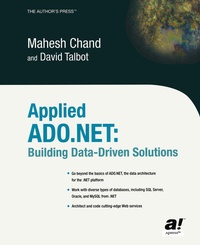
Applied ADO.NET
Building Data-Driven Solutions
Published on 1. April 2003
Book
Paperback/Softback
XXXIV, 928 pages
978-1-59059-073-7 (ISBN)
Description
In this book, readers will learn to:
* Understand the basics of ADO.NET, the data architecture for the .NET
platform.
* Work with both connected and disconnected data.
* Build a custom data provider and leverage XML in applications.
* Code custom stored procedures and call them from .NET.
* Work with diverse types of databases including SQL Server, Oracle,
and MySQL from .NET.
* Use databinding on both Windows desktop and ASP.NET Web applications
for easy and seamless data manipulation.
* Architect and code cutting-edge Web services.
More details
Edition
First Edition
Language
English
Place of publication
Berkeley
United States
Publishing group
Springer-Verlag Berlin and Heidelberg GmbH & Co. KG
Target group
Professional and scholarly
Professional/practitioner
Product notice
Paperback (trade)
Unsewn / adhesive bound
Illustrations
XXXIV, 928 p.
Dimensions
Height: 235 mm
Width: 191 mm
Thickness: 49 mm
Weight
1687 gr
ISBN-13
978-1-59059-073-7 (9781590590737)
DOI
10.1007/978-1-4302-0759-7
Schweitzer Classification
Persons
David Talbot's background is diverse, ranging from developing license-plate recognition technology to television-set boxes to scalable web applications. Currently, David works in the new business technologies group at FreeMarkets, applying cutting-edge .NET technologies to solve business problems. He has been working with .NET since the early betas, developing a number of solutions for a number of start-ups and established companies while working on several .NET books and articles. Prior to the development of .NET, David worked primarily on Java, SCO UNIX, Linux, DB2, SQL Server, and Perl.
Content
1 ADO.NET Basics.- 2 Data Components in Visual Studio .NET.- 3 ADO.NET in Disconnected Environments.- 4 ADO.NET in Connected Environments.- 5 Handling ADO.NET Events.- 6 Integrating XML with ADO.NET.- 7 Data Binding and Windows Forms Data-Bound Controls.- 8 Constraints and Data Relations.- 9 ADO.NET Exception Handling.- 10 Working with the ODBC .NET Data Provider.- 11 Stored Procedures and Views.- 12 Oracle, SQLXML, and Other .NET Data Providers.- 13 Developing a Custom Data Provider.- 14 Developing Database Web Applications Using ASP.NET.- 15 Using ADO.NET in XML Web Services.- 16 ASP.NET Server Controls and Data Binding.- 17 Building Real-World Web Applications.- 18 Object-Relational Mapping in .NET.- 19 Mapped Objects: Performance Considerations and Data Binding.- 20 COM Interoperability and ADO.NET.- 21 Messaging.- 22 SQL Server and ADO.NET: Notes on Performance.- Appendix A Relational Databases: Some Basic Concepts.- Understanding Normalization.- First Normal Form (1NF).- Second Normal Form (2NF).- Third Normal Form (3NF).- Boyce-Codd Normal Form (BCNF).- Fourth Normal Form (4NF).- Fifth Normal Form (5NF or PJ/NF).- Introducing Sets, Cursors, and ADO.NET.- Using Locking.- Isolation Levels.- Locking Modes.- Summary.- Appendix B Commonly Used SQL Statements.- Understanding SQL References.- Using the SELECT Statement.- Using the UPDATE Statement.- Using the DELETE Statement.- Using the CREATE TABLE Statement.- Using the DROP TABLE Statement.- Using the TRUNCATE TABLE Statement.- Using the INSERT Statement.- Using Joins and Aliases.- Understanding Views.- Using SQL Server's SELECT...FOR XML Clause.- Summary.- Appendix C ADO.NET Frequently Asked Questions.- Summary.