

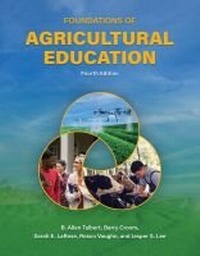
Foundations of Agricultural Education
4th Edition
Will be published approx. on 15. July 2022
Book
Hardback
480 pages
978-1-61249-752-5 (ISBN)
Description
Foundations of Agricultural Education, Fourth Edition is designed for college students in agricultural education and others interested in agricultural education as fundamental preparation for the profession. Teachers of agricultural education and those in support roles will find this book to be a helpful resource. This fourth edition is updated to reflect current educational theory and practices, and includes changed laws and initiatives since the third edition.
This updated textbook is appropriate for both introductory and advanced courses. Each chapter begins with a scenario designed to engage the learner in thinking about the content of that chapter and draws from relevant research and literature. Photos, illustrations, and tables provide greater context to key concepts, and every chapter concludes with questions for review and discussion, as well as additional activities designed to guide the learner into further exploration. Foundations of Agricultural Education, Fourth Edition is an engaging, immersive guide that will help prepare the next generation of agricultural educators.
This updated textbook is appropriate for both introductory and advanced courses. Each chapter begins with a scenario designed to engage the learner in thinking about the content of that chapter and draws from relevant research and literature. Photos, illustrations, and tables provide greater context to key concepts, and every chapter concludes with questions for review and discussion, as well as additional activities designed to guide the learner into further exploration. Foundations of Agricultural Education, Fourth Edition is an engaging, immersive guide that will help prepare the next generation of agricultural educators.
More details
Edition
Fourth Edition
Language
English
Place of publication
West Lafayette
United States
Target group
Professional and scholarly
Edition type
New edition
Illustrations
200 illustrations
Dimensions
Height: 279 mm
Width: 216 mm
Thickness: 35 mm
Weight
679 gr
ISBN-13
978-1-61249-752-5 (9781612497525)
Copyright in bibliographic data and cover images is held by Nielsen Book Services Limited or by the publishers or by their respective licensors: all rights reserved.
Schweitzer Classification
Other editions
Additional editions
B. Allen Talbert | Barry Croom | Sarah E. Larose
Foundations of Agricultural Education, Fourth Edition
E-Book
05/2022
4th Edition
Purdue University Press
€64.49
Available for download
Persons
Dr. B. Allen Talbert is a professor of agricultural education at Purdue University. He currently teaches courses in School-Based Agricultural Education program planning, SAE/FFA, and student teaching. His research focuses on recruitment and retention of students from underrepresented minority groups. His engagement work is focused on professional development of agriculture teachers and service to FFA on all levels.
Dr. Barry Croom has more than thirty-five years of experience in agricultural education. Croom began his professional career as a high school agricultural education teacher. While a high school teacher, Croom was selected by the National FFA Organization to develop and present in-service workshops to teachers across the United States. Croom maintains a research program that focuses on effective teaching, career and technical education policy, and diversity in agricultural and extension education. He is the author of three textbooks, fifty peer-reviewed publications, and more than twenty popular publications.
Dr. Sarah E. LaRose is an assistant professor of agricultural education at Purdue University. She began her career in agricultural education as a high school agricultural education teacher and FFA advisor in Woodbury, Connecticut, where she developed curriculum on local food production and extensively used agricultural teaching laboratory spaces to deliver instruction. Her research seeks to cultivate the development of agricultural educators who actively create student-centered, inclusive programs so that all students can experience the transformative benefits of agricultural education.
Dr. Rosco Vaughn is professor and agricultural teacher educator at California State University, Fresno. He was a coauthor of previous editions of this title.
Dr. Jasper S. Lee is a retired agricultural educator. He served as faculty member at Virginia Tech and Mississippi State University, after which he worked full-time as an author and publisher. He was a coauthor of previous editions of this title.
Dr. Barry Croom has more than thirty-five years of experience in agricultural education. Croom began his professional career as a high school agricultural education teacher. While a high school teacher, Croom was selected by the National FFA Organization to develop and present in-service workshops to teachers across the United States. Croom maintains a research program that focuses on effective teaching, career and technical education policy, and diversity in agricultural and extension education. He is the author of three textbooks, fifty peer-reviewed publications, and more than twenty popular publications.
Dr. Sarah E. LaRose is an assistant professor of agricultural education at Purdue University. She began her career in agricultural education as a high school agricultural education teacher and FFA advisor in Woodbury, Connecticut, where she developed curriculum on local food production and extensively used agricultural teaching laboratory spaces to deliver instruction. Her research seeks to cultivate the development of agricultural educators who actively create student-centered, inclusive programs so that all students can experience the transformative benefits of agricultural education.
Dr. Rosco Vaughn is professor and agricultural teacher educator at California State University, Fresno. He was a coauthor of previous editions of this title.
Dr. Jasper S. Lee is a retired agricultural educator. He served as faculty member at Virginia Tech and Mississippi State University, after which he worked full-time as an author and publisher. He was a coauthor of previous editions of this title.
Content
PART 1
Introduction to the Agricultural Education Professions
1. A Career in Agricultural Education
2. Philosophical Foundations of Agricultural Education
3. History and Development of Agricultural Education
4 Organization and Structure of Agricultural Education
5. Program Planning
6. Advisory and Citizen Groups
7. Curriculum Development
8. Student Enrollment and Advisement
9. Classroom and Laboratory Facilities
10. Instructional Resources
PART 2: Program Development and Management
11. The Psychology of Learning
12. The Teaching Process
13. Digital Learning
14. Classroom Management
15. Agricultural Literacy
16. Middle School Agricultural Education
17. High School Agricultural Education
PART 3: Instruction in Agricultural Education
18. Adult and Postsecondary Education
19. Evaluating Learning
20. Meeting the Needs of Diverse Students
21. Using Laboratories
PART 4: Supervised Agricultural Experience, FFA, and Community Resources
23. FFA
24. Community Resources
PART 5: Career Stages in Agricultural Education
25. Progressing Through the Profession
Glossary
Index
Introduction to the Agricultural Education Professions
1. A Career in Agricultural Education
2. Philosophical Foundations of Agricultural Education
3. History and Development of Agricultural Education
4 Organization and Structure of Agricultural Education
5. Program Planning
6. Advisory and Citizen Groups
7. Curriculum Development
8. Student Enrollment and Advisement
9. Classroom and Laboratory Facilities
10. Instructional Resources
PART 2: Program Development and Management
11. The Psychology of Learning
12. The Teaching Process
13. Digital Learning
14. Classroom Management
15. Agricultural Literacy
16. Middle School Agricultural Education
17. High School Agricultural Education
PART 3: Instruction in Agricultural Education
18. Adult and Postsecondary Education
19. Evaluating Learning
20. Meeting the Needs of Diverse Students
21. Using Laboratories
PART 4: Supervised Agricultural Experience, FFA, and Community Resources
23. FFA
24. Community Resources
PART 5: Career Stages in Agricultural Education
25. Progressing Through the Profession
Glossary
Index