

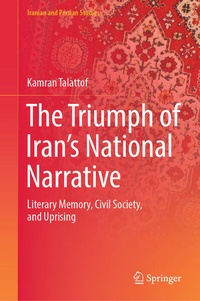
The Triumph of Iran's National Narrative
Description
This book traces the long struggle between Iran's national narrative and the competing ideological metanarratives, Islamic and Marxist, that sought to displace it, culminating in the 1979 Revolution, when the national narrative appeared defeated. Yet through social and literary resistance, it gradually regained hegemony, sustained by Persian literature, pre-Islamic civilizational heritage, and civic values that persisted beneath ideological domination. Through their novels, women writers exposed the mechanisms of female subjugation while reclaiming Iran's literary legacy, civic values, and cultural pride- helping forge what this book defines as civil society nationalism: a coherent, affirmative, and organic nationalist movement. This book situates these novels within a broader constellation of cultural resistance: suppressed arts, protest slogans, diaspora media, and the transformative energy of successive uprisings, from the reform era of 1997-2005 to the Women, Life, Freedom movement of 2022 and the Lion and Sun uprising of 2025. Together, these developments reveal how cultural memory does not merely sustain identity- it reorganizes political imagination, transforming historical continuity into collective aspiration. Theoretically, the book makes a case for narrative studies over discourse analysis as the sharper framework for understanding both the 1979 Revolution and Iran's ongoing political transformation. A national narrative is, at its core, a story: layered, dynamic, and enduring- and Iran's, though periodically interrupted, has never been extinguished. Drawing on literary studies, narrative theory, and political history, this book provides new perspectives.
"A triumph for a distinguished literary historian and critic of Persian literature. a
must read for modern literary critics of Persian literature."
Homa Katouzian (University of Oxford)
"This splendid study is a must for anyone who is interested in Iran, her politics, her
rich modern literary tradition, and the complexities of everyday life. It is rich in its
selection of topics, innovative in analysis, and perceptive in contextualizing social
dynamics within pivotal historical events."
Asghar Seyed-Gohrab (Utrecht University)
More details
Person
Kamran Talattof received his Ph.D from The University of Michigan in 1996, and he has been teaching at the University of Arizona since 1999 after teaching at Princeton University for three years. He is currently a full professor for the Department of Near Eastern Studies while holding an affiliation with the Department of Gender & Women's Studies and the Graduate Program in Second Language Acquisition and Teaching. He has taught courses on classical and modern Persian literature, Iranian cinema, Iranian history, the Persian language, and Middle Eastern Women's writings. Kamran Talattof has received a few awards for his teaching and services to the field of Persian and Iranian Studies. He has served on several national and international committees within academic associations and on the editorial committees of academic journals, as well as on several ad-hoc international committees. He's authored, co-edited, and co-translated books focusing on issues of gender, sexuality, ideology, culture, and Persian language pedagogy. His articles also focus on gender, ideology, culture, and fundamentalism. Kamran Talattof is the Founding Chair of the Roshan Graduate Interdisciplinary Program in Persian and Iranian Studies.
Content
Chapter 01. Introduction: From Bestsellers and Civil Society Activism to National Narrative.- Chapter 02. The Battles of Narratives and Nationalism.- Chapter 03. Sexuality, Space, and the Power of Imagination.- Chapter 04. Politics and Sexuality in Bamdad-e Khomar [The Morning After].- Chapter 05. Self and Nation in Parandeh-ye Man (My Bird).- Chapter 06. Self and Life in Adat Mikonim (We Adapt) and Beyond.- Chapter 07. My Lot: Narratives of Identity in Parinoush Saniee's Sahm-e Man.- Chapter 08. Family and Love in Chehel Salegi (Being Forty).- Chapter 09. Women's Literature and the Echoes of Emancipation.- Chapter 10. From Page to Protest: Identity and the Triumph of National Narrative.- Chapter 11. From Page to Nation: Narrative, Discourse, and Discipline.