

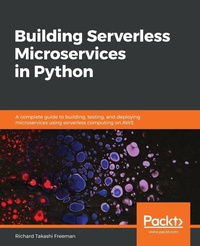
Building Serverless Microservices in Python
A complete guide to building, testing, and deploying microservices using serverless computing on AWS
Published on 29. March 2019
Book
Paperback/Softback
168 pages
978-1-78953-529-7 (ISBN)
Description
A practical guide for developing end-to-end serverless microservices in Python for developers, DevOps, and architects.
Key Features
Create a secure, cost-effective, and scalable serverless data API
Use identity management and authentication for a user-specific and secure web application
Go beyond traditional web hosting to explore the full range of cloud hosting options
Book DescriptionOver the last few years, there has been a massive shift from monolithic architecture to microservices, thanks to their small and independent deployments that allow increased flexibility and agile delivery. Traditionally, virtual machines and containers were the principal mediums for deploying microservices, but they involved a lot of operational effort, configuration, and maintenance. More recently, serverless computing has gained popularity due to its built-in autoscaling abilities, reduced operational costs, and increased productivity.
Building Serverless Microservices in Python begins by introducing you to serverless microservice structures. You will then learn how to create your first serverless data API and test your microservice. Moving on, you'll delve into data management and work with serverless patterns. Finally, the book introduces you to the importance of securing microservices.
By the end of the book, you will have gained the skills you need to combine microservices with serverless computing, making their deployment much easier thanks to the cloud provider managing the servers and capacity planning.What you will learn
Discover what microservices offer above and beyond other architectures
Create a serverless application with AWS
Gain secure access to data and resources
Run tests on your configuration and code
Create a highly available serverless microservice data API
Build, deploy, and run your serverless configuration and code
Who this book is forIf you are a developer with basic knowledge of Python and want to learn how to build, test, deploy, and secure microservices, then this book is for you. No prior knowledge of building microservices is required.
Key Features
Create a secure, cost-effective, and scalable serverless data API
Use identity management and authentication for a user-specific and secure web application
Go beyond traditional web hosting to explore the full range of cloud hosting options
Book DescriptionOver the last few years, there has been a massive shift from monolithic architecture to microservices, thanks to their small and independent deployments that allow increased flexibility and agile delivery. Traditionally, virtual machines and containers were the principal mediums for deploying microservices, but they involved a lot of operational effort, configuration, and maintenance. More recently, serverless computing has gained popularity due to its built-in autoscaling abilities, reduced operational costs, and increased productivity.
Building Serverless Microservices in Python begins by introducing you to serverless microservice structures. You will then learn how to create your first serverless data API and test your microservice. Moving on, you'll delve into data management and work with serverless patterns. Finally, the book introduces you to the importance of securing microservices.
By the end of the book, you will have gained the skills you need to combine microservices with serverless computing, making their deployment much easier thanks to the cloud provider managing the servers and capacity planning.What you will learn
Discover what microservices offer above and beyond other architectures
Create a serverless application with AWS
Gain secure access to data and resources
Run tests on your configuration and code
Create a highly available serverless microservice data API
Build, deploy, and run your serverless configuration and code
Who this book is forIf you are a developer with basic knowledge of Python and want to learn how to build, test, deploy, and secure microservices, then this book is for you. No prior knowledge of building microservices is required.
More details
Language
English
Place of publication
Birmingham
United Kingdom
Target group
Professional and scholarly
US School Grade: College Graduate Student
Dimensions
Height: 235 mm
Width: 191 mm
Thickness: 9 mm
Weight
327 gr
ISBN-13
978-1-78953-529-7 (9781789535297)
Copyright in bibliographic data and cover images is held by Nielsen Book Services Limited or by the publishers or by their respective licensors: all rights reserved.
Schweitzer Classification
Other editions
Additional editions
Richard Takashi Freeman
Building Serverless Microservices in Python
A complete guide to building, testing, and deploying microservices using serverless computing on AWS
E-Book
09/2024
Packt Publishing
€22.49
Available for download
Person
Richard Takashi Freeman has an M.Eng. in computer systems engineering and a Ph.D. in machine learning and natural language processing from the University of Manchester, UK. He is currently a lead big data and machine learning engineer at JustGiving; and a cloud architect, serverless computing, and machine learning freelance SME and consultant at Starwolf. He previously worked at PageGroup and Capgemini, and has been delivering cloud-based, big data, machine learning, serverless, and scalable solutions for over 14 years across different sectors.
He is a blogger; a speaker, presenting at various events; and the author of two video courses. You can visit his website, titled Richard Freeman, PhD, for his blog posts, presentations, and courses.
He is a blogger; a speaker, presenting at various events; and the author of two video courses. You can visit his website, titled Richard Freeman, PhD, for his blog posts, presentations, and courses.
Content
Table of Contents
Serverless Microservices Architectures and Patterns
Creating Your First Serverless Data API
Deploying Your Serverless Stack
Testing Your Serverless Microservice
Securing Your Microservice
Serverless Microservices Architectures and Patterns
Creating Your First Serverless Data API
Deploying Your Serverless Stack
Testing Your Serverless Microservice
Securing Your Microservice