

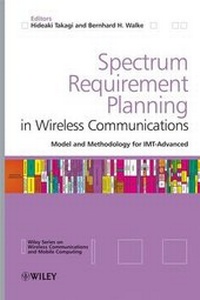
Spectrum Requirement Planning in Wireless Communications
Model and Methodology for IMT - Advanced
Will be published approx. on 11. April 2008
Book
Hardback
266 pages
978-0-470-98647-9 (ISBN)
Description
Presents the model and methodology, applied by ITU-R WRC'07, to calculate the spectrum requirement for IMT-Advanced Systems, i.e. the next generation wireless communication systems.
Spectrum requirement Planning in Wireless Communications: Model and Methodology for IMT-Advanced is a self-contained 'handbook'" of the models and methodologies used for the spectrum requirement calculating for IMT-Advanced systems, as well as for the predecessor IMT-2000 systems. the reader will learn how the spectrum requirement is calculated for real systems that prevail worldwide. The book also provides the basis on which to develop advanced methodologies for forthcoming systems, as the spectrum regulation will continue in the future.
Key Features:
* Provides the reader with information on how the spectrum requirement is calculated for real systems that prevail worldwide
* Contains useful tables and examples, such as a flowchart of the methodology
* Introduces definitions of service category and radio environment, the process of distributing traffic to radio environments, and the method to calculate the required spectrum
* Applies queueing and loss models for the calculation of required system capacity
* Explains how to use the calculation tool package
* Provides a link to a website with the downloadable tool applied by ITU-R WRC'07 for making decisions on spectrum regulation for mobile systems.
This book serves as an invaluable guide to engineers in mobile phone companies, system design engineers, operator system engineers and other specialists dealing with mobile system planning and development. It is also of great interest to researchers and graduate students in the fields of applied probability theory, operations research, telecommunications, and mobile networks engineering.
More details
Product info
gebunden
Series
Edition
1. Auflage
Language
English
Place of publication
New York
United States
Target group
Professional and scholarly
Product notice
Unsewn / adhesive bound
Paper over boards
Dimensions
Height: 249 mm
Width: 174 mm
Thickness: 22 mm
Weight
640 gr
ISBN-13
978-0-470-98647-9 (9780470986479)
Schweitzer Classification
Other editions
Additional editions
Hideaki Takagi | Bernhard H. Walke
Spectrum Requirement Planning in Wireless Communications
Model and Methodology for IMT - Advanced
E-Book
08/2008
Wiley
€118.99
Available for download
Persons
Hideaki Takagi, Tsukuba, Japan is a Professor in the School of Systems and Information Engineering and Chair of the Master's Program in Business Administration and Public Policy at the University of Tsukuba. He is the author of research monographs Analysis of Polling Systems (The MIT Press, 1986), and Queueing Analysis: A Foundation of Performance Evaluation, Volumes 1-3 (Elsevier, 1991-1993). He has published over 70 papers in refereed journals. He is IEEE Fellow (1996) and IFIP Silver Core Holder (2001).
Bernhard H Walke, Aachen, Germany is the Chair for Communication Networks at Aachen University (RWTH), Germany since 13 years. He has published more than 110 reviewed conference papers, 25 journal papers and seven textbooks on the architecture, traffic performance evaluation, and design of future communication systems. He has been a board member of ITG/VDE and is Senior Member of IEEE.
Bernhard H Walke, Aachen, Germany is the Chair for Communication Networks at Aachen University (RWTH), Germany since 13 years. He has published more than 110 reviewed conference papers, 25 journal papers and seven textbooks on the architecture, traffic performance evaluation, and design of future communication systems. He has been a board member of ITG/VDE and is Senior Member of IEEE.
Content
About the Series Editors.
Preface.
1 Introduction (Bernhard H. Walke and Hitoshi Yoshino).
1.1 Trends inMobileCommunication.
1.1.1 Mobileapplicationsandservices.
1.1.2 Radio interface technologies.
1.1.3 Standardization.
1.2 Trends inSpectrumUsage.
1.2.1 Physicalpropertiesof radiospectra.
1.2.2 Spectrumallocationandidentification.
1.3 SpectrumAllocation:Why and How.
2 Utilization of Radio Frequencies (Hitoshi Yoshino, Naoto Matoba, Pekka Ojanen and Bernhard H. Walke).
2.1 SpectrumUsageOverview.
2.2 Spectrum Management by ITU.
2.3 Radio Communication Services.
2.4 Radio Communication Systems.
3 Spectrum Requirement Calculation for IMT-2000 (Hideaki Takagi).
3.1 Model.
3.2 Input Parameters.
3.3 Methodology.
3.4 Sequel to the Story.
4 Spectrum Requirement Calculation for IMT-Advanced (Marja Matinmikko, J¨org Huschke, Tim Irnich, Naoto Matoba, Jussi Ojala, Pekka Ojanen, Hideaki Takagi, Bernhard H. Walke and Hitoshi Yoshino).
4.1 Overview.
4.2 Models and Input Parameters.
4.3 Methodology.
4.4 Summary of Methodology for IMT-Advanced.
5 Calculation Tool Package (Marja Matinmikko, Jörg Huschke and Jussi Ojala).
5.1 Description and Use of Software Tool.
5.2 Front Sheet of Software Tool.
5.3 Inputs to Software Tool.
5.4 IntermediateCalculationSteps.
5.5 Outputs from Software Tool.
6 Market Data (Marja Matinmikko and Mitsuhiro Azuma).
6.1 Collection of Market Data.
6.2 Use of Market Parameters in the Methodology.
6.3 AnalysisofCollectedMarketData.
6.4 Example Input Market Parameter Value Set.
7 Radio-Related Input Parameters (Marja Matinmikko, Pekka Ojanen and Jussi Ojala).
7.1 RAT Group Approach.
7.2 Use of Radio Parameters in the Methodology.
7.3 Example Input Radio Parameter Value Set.
8 Numerical Examples (Tim Irnich, Marja Matinmikko, Jussi Ojala and Bernhard H. Walke).
8.1 Packet Size Statistics and QoS Requirements.
8.2 Traffic Demand Derived from Market Data.
8.3 TrafficDistribution Ratios .
8.4 Offered Traffic per RAT Group and Radio Environment.
8.5 Required System Capacity.
8.6 Required Spectrum.
9 Capacity Dimensioning to Meet Delay Percentile Requirements (Tim Irnich and Bernhard H. Walke).
9.1 Delay Percentile Evaluation.
9.2 ServiceTimeDistributionin IP-BasedCommunicationSystems.
9.3 Waiting Time Distribution in M/G/1 Queues.
9.4 Delay DF Approximation.
9.5 Accuracy of Gamma and H2 Approximations.
9.6 Impact of Percentile Requirements on System Capacity.
9.7 Conclusion.
10 Epilog: Result ofWRC-07 (Hitoshi Yoshino).
Appendices.
Appendix A Derivation of Formulas by Queueing Theory (Hideaki Takagi).
A.1 Erlang-B Formula for a Loss System.
A.2 Erlang-C Formula for a Delay System.
A.3 Multidimensional Erlang-B Formula.
A.3.1 Two classes of calls with single server occupation.
A.3.2 Several classes of calls with multiple server occupation.
A.4 M/G/1 Nonpreemptive Priority Queue.
Appendix B Example Market Study Parameter Values.
Appendix C List of Acronyms and Symbols.
C.1 Acronyms.
C.2 Symbols.
Appendix D ITU-R Documents and Web Sites.
D.1 ITU-R Recommendations.
D.2 ITU-R Reports.
D.3 Other ITU-RDocuments.
D.4 WebSites.
Bibliography.
Index.