

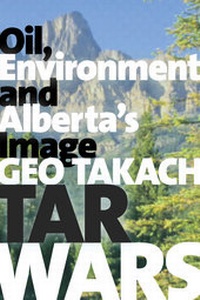
Tar Wars
Oil, Environment and Alberta's Image
Published on 31. January 2017
Book
Paperback/Softback
256 pages
978-1-77212-140-7 (ISBN)
Description
Tar Wars offers a critical inside look at how leading image-makers negotiate escalating tensions between continuous economic growth mandated by a globalized economic system and its unsustainable environmental costs. As place branding assumes paramount importance in an increasingly global, visual, and ecologically conscious society, an international battle unfolds over Alberta's bituminous sands. This battle pits independent documentary filmmakers against professional communicators employed by government and the oil industry. Tar Wars engages scholars and students in communications, film, environmental studies, social psychology, PR, media and cultural studies, and petrocultures. This book also speaks to decision makers, activists, and citizens exploring intersections of energy, environment, culture, politics, economy, media and power.
Reviews / Votes
"Alberta for generations was famous for mountains, rodeos, Mormonism, football, Ukrainian culture, meatpacking and Social Credit. Say 'Alberta' today and any focus group replies, 'oil'. That's no accident, writes Prof. Geo Takach of Royal Roads University. From the 1947 oil strike at Leduc Number One, 'resource extraction became heroic'. Alberta's very identity was intertwined with oil sands production, for better and worse. Tar Wars documents this modern cultural phenomenon... [and] ... covers all angles. ... The search is compelling and clever." -- Holly Doan * Blacklock's Reporter * "In his extensively researched and politically provocative new book, Tar Wars, award-winning author Geo Takach...offers attentive citizens, policy wonks and communications pros a solid 'case study in environmental communication.'" -- Rob Norris * Alberta Views * "... [Takach's] purpose: to depolarize and ultimately enable debate of the bit-sands and their role in defining Alberta... Tar Wars highlights two points that are seldom part of the discussion. The first is that while the antagonistic 'Alberta is energy' approach originated with industry and political leaders, the polarizing rhetoric does not represent the views of all or even the majority of Alberta residents. The second is that polarized debate limits meaningful dialogue and political engagement... Underlying is Takach's message that we must refuse to fall into easy stereotypes of any region, including the one we live in." [Full review at https://bcbooklook.com/2017/09/29/174-lights-camera-action-debate/] -- Nichole Dusyk * BC BookLook * "This book is relevant to scholars in communication studies, specifically those with a focus on environmental communication and activism, as well as those in strategic communication, specifically PR, marketing, and branding, and obviously those in the fields of journalism and film." [Full review at https://cjc-online.ca/index.php/journal/article/view/3673/3885] -- Gordon Alley-Young * Canadian Journal of Communication Vol 44 *More details
Language
English
Place of publication
Edmonton
Canada
Product notice
Paperback (trade)
Dimensions
Height: 229 mm
Width: 152 mm
Thickness: 15 mm
Weight
370 gr
ISBN-13
978-1-77212-140-7 (9781772121407)
Copyright in bibliographic data and cover images is held by Nielsen Book Services Limited or by the publishers or by their respective licensors: all rights reserved.
Schweitzer Classification
Person
Geo Takach is a writer, speaker, instructor, filmmaker, and scholar. He is a member of the faculty of Royal Roads University.
Content
Acknowledgements xi
1 | The Problem of the Sands 1
2 | Four Foundational Principles 17
3 | Images and Frames of Alberta 29
4 | Positioning and Contesting Alberta 43
5 | Visually Redefining Alberta 127
6 | Implications 149
Notes 167
References 193
Index 225
1 | The Problem of the Sands 1
2 | Four Foundational Principles 17
3 | Images and Frames of Alberta 29
4 | Positioning and Contesting Alberta 43
5 | Visually Redefining Alberta 127
6 | Implications 149
Notes 167
References 193
Index 225