

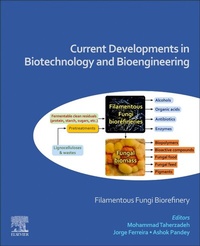
Current Developments in Biotechnology and Bioengineering
Filamentous Fungi Biorefinery
Published on 18. November 2022
Book
Paperback/Softback
614 pages
978-0-323-91872-5 (ISBN)
Description
Filamentous Fungi Biorefinery, the latest release in the Current Developments in Biotechnology and Bioengineering series, builds on knowledge on the classification of filamentous fungi and presence and roles played in ecosystems. The importance of filamentous fungi is then further corroborated through a description of their present applications in biotechnological processes. Knowledge on fungal biology is extended through discussion on structure and composition together with a description of growth potentialities of filamentous fungi in/on a wide range of substrates. In addition, the morphology of filamentous fungi is then described and its implications during integration in industrial processes is discussed.
The book then provides an overview on the use of filamentous fungi for the production of a wide range of value-added products, including feed and food products, alcohols, organic acids, pigments, enzymes, antibiotics and biopolymers. All provided state-of-arts are extended to a description of the present degree of application of filamentous fungi towards the production of those products using low-value substrates, identification of research gaps, and proposes future research avenues.
The book then provides an overview on the use of filamentous fungi for the production of a wide range of value-added products, including feed and food products, alcohols, organic acids, pigments, enzymes, antibiotics and biopolymers. All provided state-of-arts are extended to a description of the present degree of application of filamentous fungi towards the production of those products using low-value substrates, identification of research gaps, and proposes future research avenues.
More details
Language
English
Place of publication
Philadelphia
United States
Target group
Professional and scholarly
Professionals, researchers, and graduate students working in the biotechnology, biochemical and environmental engineering, applied microbiology, food technology, etc.; A guide for Biotechnologists, Microbiologists and Food Technologists who desire knowledge in Industrial Biotechnology, Environmental Biotechnology, Environmental Science & Technology, and Biochemical Engineering
Product notice
Paperback (trade)
Illustrations
Approx. 100 illustrations; Illustrations
Dimensions
Height: 235 mm
Width: 191 mm
Thickness: 31 mm
Weight
1041 gr
ISBN-13
978-0-323-91872-5 (9780323918725)
Copyright in bibliographic data and cover images is held by Nielsen Book Services Limited or by the publishers or by their respective licensors: all rights reserved.
Schweitzer Classification
Other editions
Additional editions
Mohammad Taherzadeh | Jorge Ferreira | Ashok Pandey
Current Developments in Biotechnology and Bioengineering
Filamentous Fungi Biorefinery
E-Book
11/2022
Elsevier
€200.00
Available for download
Persons
Mohammad J. Taherzadeh is professor in Biotechnology since 2004 at University of Boras in Sweden. He is also director of Resource Recovery, a research profile with about 50 researchers to convert wastes to energy and value-added products. Prof. Taherzadeh has PhD in Bioscience and MSc and Bsc in Chemical Engineering. He is working on converting wastes and residuals to ethanol, biogas, fish feed and superabsorbents, in which fermentation development using bacteria, yeast and filamentous fungi has a heavy weight. Prof. Taherzadeh has more than 120 publications in scientific peer-reviewed journals, 10 book chapters and two patents about filamentous fungi. Mohammad is the panel chairman of "biotechnology, chemical technology and environmental technology? of Swedish Research Council, and also in the editorial board of Bioresource Technology and BioResources. Jorge A. Ferreira is Assistant Professor at the Swedish Centre for Resource Recovery, University of Boras in Sweden. Prof. Ashok Pandey is currently Executive Director, Centre for Energy and Environmental Sustainability-India, Lucknow. His major research and technological development interests are industrial and environmental biotechnology and energy biosciences, focusing on biomass to biofuels and chemicals, waste to wealth and energy, etc.
Content
1. Introduction (world of fungi and fungi ecosystem)
2. Fungal biotechnology
3. Fungal biology
4. Mycotoxins
5. Sampling, preservation, and growth monitoring of filamentous fungi
6. Wastes, residuals, and wastewaters as feedstocks for filamentous fungi growth
7. Filamentous fungi morphology in industrial aspects
8. Bioreactors and engineering of filamentous fungi cultivation
9. Filamentous fungi processing by solid-state fermentation
10. Production of enzymes by filamentous fungi
11. Production of bioactive compounds by filamentous fungi
12. Filamentous fungi for food
13. Filamentous fungi for feed
14. Production of alcohols by filamentous fungi
15. Production of organic acids by filamentous fungi
16. Production of antibiotics by filamentous fungi
17. Biopolymers from filamentous fungi
18. Versatility of filamentous fungi in novel processes
2. Fungal biotechnology
3. Fungal biology
4. Mycotoxins
5. Sampling, preservation, and growth monitoring of filamentous fungi
6. Wastes, residuals, and wastewaters as feedstocks for filamentous fungi growth
7. Filamentous fungi morphology in industrial aspects
8. Bioreactors and engineering of filamentous fungi cultivation
9. Filamentous fungi processing by solid-state fermentation
10. Production of enzymes by filamentous fungi
11. Production of bioactive compounds by filamentous fungi
12. Filamentous fungi for food
13. Filamentous fungi for feed
14. Production of alcohols by filamentous fungi
15. Production of organic acids by filamentous fungi
16. Production of antibiotics by filamentous fungi
17. Biopolymers from filamentous fungi
18. Versatility of filamentous fungi in novel processes