

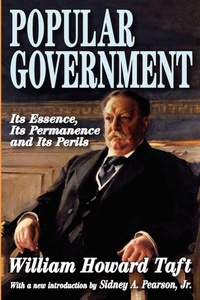
Popular Government
Its Essence, Its Permanence and Its Perils
1st Edition
Published on 15. April 2009
Book
Paperback/Softback
366 pages
978-1-4128-1044-9 (ISBN)
Description
The modern presidency is increasingly seen as in trouble by all sides of the political spectrum and by people of the most diverse political views. Understanding why this is the case requires examining the basic principles of the presidency itself, and there is no better place to start than William Howard Taft's Popular Government. His views on executive power and constitutional interpretation of this power are not rooted in nostalgia. Instead, Taft describes how and why the Progressive Movement marked one of the major turning points in American political thought.
Taft wrote out of concern over the nature of the American system itself. He sought to describe the founding principles of the country, arguing that grasping these is essential for Americans' understanding of themselves as a people and for their daily exercise of citizenship. The concerns he addressed remain central today. Th at is because Taft's quarrels with the liberal-progressive tradition in politics have not yet completely played themselves out, either in academic life, or in the political arena.
In a brilliant new introduction, Sidney Pearson argues that neither Roosevelt nor Wilson should be viewed as enemies of free government by any serious student of American political thought, nor should Taft be so regarded either. The concerns Taft engages remain important for any understanding of the problems that confront the American experiment in popular government. Popular Government is a basic introduction to debate about the nature of the presidency and the larger constitutional context in which such arguments take place. Th ere is no better way to gain perspective on the debate than reading this volume.
Taft wrote out of concern over the nature of the American system itself. He sought to describe the founding principles of the country, arguing that grasping these is essential for Americans' understanding of themselves as a people and for their daily exercise of citizenship. The concerns he addressed remain central today. Th at is because Taft's quarrels with the liberal-progressive tradition in politics have not yet completely played themselves out, either in academic life, or in the political arena.
In a brilliant new introduction, Sidney Pearson argues that neither Roosevelt nor Wilson should be viewed as enemies of free government by any serious student of American political thought, nor should Taft be so regarded either. The concerns Taft engages remain important for any understanding of the problems that confront the American experiment in popular government. Popular Government is a basic introduction to debate about the nature of the presidency and the larger constitutional context in which such arguments take place. Th ere is no better way to gain perspective on the debate than reading this volume.
More details
Language
English
Place of publication
New York
United States
Publishing group
Taylor & Francis Inc
Target group
College/higher education
Professional and scholarly
Dimensions
Height: 229 mm
Width: 152 mm
Thickness: 20 mm
Weight
533 gr
ISBN-13
978-1-4128-1044-9 (9781412810449)
Copyright in bibliographic data and cover images is held by Nielsen Book Services Limited or by the publishers or by their respective licensors: all rights reserved.
Schweitzer Classification
Other editions
Additional editions
Book
09/2017
1st Edition
Routledge
€207.20
Shipment within 10-20 days
E-Book
07/2017
Routledge
€64.49
Available for download
E-Book
07/2017
Routledge
€64.49
Available for download
Person
William Howard Taft served as the twenty-third president of the United States from 1909-1913 and as Chief Justice of the Supreme Court from 1921-1930. He is the only person to have held the highest office in two of the three branches of American government. He wrote numerous books including Our Chief Magistrate and His Powers, The Anti-Trust Act and the Supreme Court, and The Covenanter: An American Exposition of the Covenant of the League of Nations. Sidney A. Pearson, Jr. is professor emeritus of political science at Radford University. He is also the series editor of Library of Liberal Thought at Transaction Publishers.
Content
Introduction I. The Meaning of ''We, the People of the United States, in the Preamble of the Constitution II. The Representative System III. The Initiative and the Referendum IV. The Initiative, the Referendum, the Recall (Continued) V. The Direct Primary VI. In Order to Form a More Perfect Union VII. To Establish Justice VIII. To Establish Justice (Continued) The Selection and Tenure of Judges IX. To Establish Justice (Continued) Public Need of Educated Lawyers and Judges-The Necessity and Advantage of Judge-Made Laws X. To Insure Domestic Tranquillity, Provide for the Common Defense