

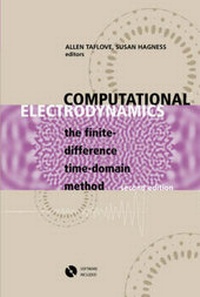
Computational Electrodynamics
The Finite-difference Time-domain Method
2nd Edition
Published on 1. June 2000
Book
Mixed media product
878 pages
978-1-58053-076-7 (ISBN)
Description
This reference text is designed as an aid for professional engineers using the Finite-Difference Time-Domain (FDTD) method for Maxwell's equations. It explains the method and presents developments in FDTD techniques.
More details
Series
Edition
2nd Revised edition
Language
English
Place of publication
Norwood
United States
Target group
Professional and scholarly
Edition type
Revised edition
Illustrations
index
Dimensions
Height: 230 mm
ISBN-13
978-1-58053-076-7 (9781580530767)
Copyright in bibliographic data and cover images is held by Nielsen Book Services Limited or by the publishers or by their respective licensors: all rights reserved.
Schweitzer Classification
Other editions
New editions
Allen Taflove | Susan Hagness
Computational Electrodynamics: The Finite-Difference Time-Domain Method, Third Edition
The Finite-Difference Time-Domain Method
Book
06/2005
3rd Edition
Artech House Publishers
€146.50
Shipment within 10-20 days
Previous edition
Book
05/1995
Artech House Publishers
€185.50
Shipment within 10-20 days
Persons
Content
Preface. Reinventing Electromagnetics. The One-Dimensional Scalar Wave Equation. Introduction to Maxwell's Equations and the Yee Algorithm. Numerical Stability. Numerical Dispersion. Enhanced FDTD Algorithms. Incident Wave Source Conditions for Free Space and Waveguides. Absorbing Boundary Conditions for Free Space and Waveguides. Near-to-Far-Field Transformation. Dispersive, Nonlinear, and Gain Materials. Local Subcell Models of Fine Geometrical Features. Explicit Time-Domain Solution of Maxwell's Equations Using Nonorthogonal and Unstructured Grids. The Body of Revolution FD-TD Algorithm. FDTD Modeling of Periodic Structures. Modeling of Electromagnetic Fields in High-Speed Electronic Circuits. FD-TD and Antenna Analysis. Emerging Application Areas. Efficient FD-TD Algorithms for Vector and Multiprocessor Computers. Appendix. Index.