

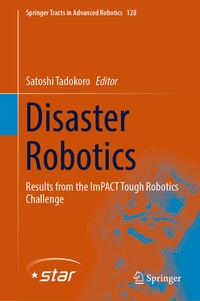
Disaster Robotics
Results from the ImPACT Tough Robotics Challenge
Published on 13. February 2019
Book
Hardback
XI, 534 pages
978-3-030-05320-8 (ISBN)
Description
This book introduces readers to the latest findings on disaster robotics. It is based on the ImPACT Tough Robotics Challenge, a national project spearheaded by the Japan Cabinet Office that focuses on developing robotics technologies to aid in disaster response, recovery and preparedness. It presents six subprojects that involve robot platforms and several component technologies used in conjunction with robots:
The book offers a valuablesource of information for researchers, engineers and practitioners in safety, security and rescue robotics, disaster robotics, and plant and infrastructure maintenance. It will also appeal to a wider demographic, including students and academics, as it highlights application scenarios and the total concept for each robot in various scientific and technical contexts.
In addition to a wealth of figures and photos that explain these robots and systems, as well as experimental data, the book includes a comprehensive list of published papers from this project for readers to refer to. Lastly, an external website offers video footage and updated information from the International Rescue System Institute.
-
cyber rescue canines, which are digitally empowered rescue dogs;
-
serpent-like robots for searching debris;
-
serpent-like robots for plant/infrastructure inspection;
-
UAVs for gathering information on large areas struck by disaster;
-
legged robots for plant/infrastructure inspection in risky places; and
-
construction robots for recovery tasks that require both power and precision.
The book offers a valuablesource of information for researchers, engineers and practitioners in safety, security and rescue robotics, disaster robotics, and plant and infrastructure maintenance. It will also appeal to a wider demographic, including students and academics, as it highlights application scenarios and the total concept for each robot in various scientific and technical contexts.
In addition to a wealth of figures and photos that explain these robots and systems, as well as experimental data, the book includes a comprehensive list of published papers from this project for readers to refer to. Lastly, an external website offers video footage and updated information from the International Rescue System Institute.
More details
Series
Edition
2019 ed.
Language
English
Place of publication
Cham
Switzerland
Publishing group
Springer International Publishing
Target group
Professional and scholarly
Illustrations
399 farbige Abbildungen, 44 s/w Abbildungen
XI, 534 p. 443 illus., 399 illus. in color.
Dimensions
Height: 241 mm
Width: 160 mm
Thickness: 33 mm
Weight
1080 gr
ISBN-13
978-3-030-05320-8 (9783030053208)
DOI
10.1007/978-3-030-05321-5
Schweitzer Classification
Other editions
Additional editions
E-Book
01/2019
Springer
€139.09
Available for download
Person
Satoshi Tadokoro
graduated from the University of Tokyo in 1984. He served as an Associate Professor at Kobe University from 1993 to 2005, and has been a Professor at Tohoku University since 2005. He has been president of the International Rescue System Institute since 2002 and was the IEEE RAS President from 2016 to 2017. He served as project manager for the MEXT DDT Project on rescue robotics, which involved more than 100 professors nationwide, from 2002 to 2007, and served as a PI of numerous NEDO projects related to disaster robotics. His team has developed various rescue robots, two of which, Quince and Active Scope Camera, are well-known because they were used in the nuclear reactor buildings following the Fukushima-Daiichi Nuclear Power Plant Accident. The project manager for Japan Cabinet Office's ImPACT Project (2014 to 2018), he is an IEEE Fellow, RSJ Fellow, JSME Fellow, and SICE Fellow.
Content
Introduction and Overview.- Disaster Response and Recovery.- Preparedness for Disaster.- Component Technologies.- Evaluation and Human Factors.- Conclusions and Future.