

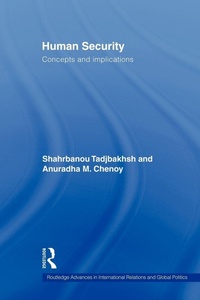
Human Security
Concepts and implications
1st Edition
Published on 27. October 2008
Book
Paperback/Softback
292 pages
978-0-415-47338-5 (ISBN)
Description
This book, now available in paperback, traces the key evolutions in the development of the concept of human security, the various definitions and critiques, how it relates to other concepts, and what it implies for polities, politics, and policy.
Human security is an important subject for the whole world, in particular Asia, as it deals with interactions among fields of social change, such as development, conflict resolution, human rights, and humanitarian assistance. In a globalizing world, in which threats become trans-national and states lose power, security can no longer be studied in a one-dimensional fashion.
Written by authors who are experts in this field and with case studies from different regions (Afghanistan, Central Asia and South Asia) presented throughout, this book - now available in paperback - contributes to this new multidimensional conception of security, analyzes its strengths and weaknesses, and focuses on its implications for analysis and action.
Human security is an important subject for the whole world, in particular Asia, as it deals with interactions among fields of social change, such as development, conflict resolution, human rights, and humanitarian assistance. In a globalizing world, in which threats become trans-national and states lose power, security can no longer be studied in a one-dimensional fashion.
Written by authors who are experts in this field and with case studies from different regions (Afghanistan, Central Asia and South Asia) presented throughout, this book - now available in paperback - contributes to this new multidimensional conception of security, analyzes its strengths and weaknesses, and focuses on its implications for analysis and action.
Reviews / Votes
"Human Security is a new buzz word - but what exactly does it mean, who uses it, who disagrees and what are the catches? This important book clarifies these points and much more, drawing on experience in Afghanistan and other countries in conflict of Asia and Africa and presenting perspectives tried out in the US, France and India. The book, clear and readable, is excellent for students, a quick catch up for policy makers who may not be quite sure how and when to use the concept and a challenge for all who doubt its relevance for the world today."Sir Richard Jolly (Institute of Development Studies, University of Sussex, UK)
"This critically informed study is the most intellectually balanced, grounded, and action-oriented attempt to theorise and conceptualise human security so far published."
Professor Oliver Richmond (School of International Relations, Director, Centre for Peace and Conflict Studies, University of St Andrews, UK)
More details
Series
Language
English
Place of publication
London
United Kingdom
Publishing group
Taylor & Francis Ltd
Target group
College/higher education
Professional and scholarly
Illustrations
16 s/w Abbildungen, 16 s/w Zeichnungen, 13 s/w Tabellen
13 Tables, black and white; 16 Line drawings, black and white; 16 Illustrations, black and white
Dimensions
Height: 234 mm
Width: 156 mm
Thickness: 16 mm
Weight
447 gr
ISBN-13
978-0-415-47338-5 (9780415473385)
Copyright in bibliographic data and cover images is held by Nielsen Book Services Limited or by the publishers or by their respective licensors: all rights reserved.
Schweitzer Classification
Other editions
Additional editions
E-Book
02/2007
1st Edition
Routledge
€65.99
Available for download
E-Book
02/2007
1st Edition
Routledge
€65.99
Available for download
Book
12/2006
1st Edition
Routledge
€206.70
Shipment within 15-20 days
Persons
Shahrbanou Tadjbakhsh is the Director of the Center for Peace and Human Security at L'Institut d' Etudes Politiques (Sciences Po) in Paris, where she teaches courses on human security and on international organizations and is editor of the Human Security Journal, an online publication. She has also taught on human security as an Adjunct Professor at Columbia University in New York. Between 1995 and 2002, she was a staff member of the United Nations Development Programme, and currently continues to work as a consultant with teams preparing national Human Development Reports. She has written numerous articles on human development, human security and gender issues as well as on the application of these discourses in Central Asia and in Afghanistan.
Anuradha M. Chenoy is Professor in the School of International Studies, Jawaharlal Nehru University New Delhi, where she has been the Chairperson and Director of the Area Studies Program for Russia and Central Asia. She has also been on the governing bodies of several institutions in India and internationally, and has served as a specialist for various Meetings of the United Nations. She writes extensively in Journals and newspapers on international relations, gender and social issues.
Anuradha M. Chenoy is Professor in the School of International Studies, Jawaharlal Nehru University New Delhi, where she has been the Chairperson and Director of the Area Studies Program for Russia and Central Asia. She has also been on the governing bodies of several institutions in India and internationally, and has served as a specialist for various Meetings of the United Nations. She writes extensively in Journals and newspapers on international relations, gender and social issues.
Content
Introduction Part 1: Concepts 1. Rationale and Political Usage 2. Definitions, Critiques and Counter-Critiques 3. A Paradigm Shift in Security Studies? 4. Human Security and Human Development: Shadow or Threshold? 5. Debating Dignity: Human Security and Human Rights Part 2: Implications 6. Underdevelopment and Conflict: A Vicious Cycle? 7. The State and its Domestic Responsibilities 8. Intervention, Engagement and the Responsibilities of the International Community 9. Externalities of Human Security: The Role of International Aid 10. Concluding Thoughts: Whither Human Security?