

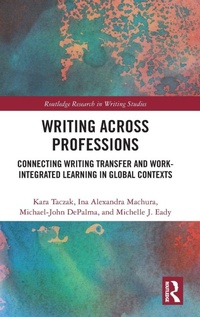
Writing Across Professions
Connecting Writing Transfer and Work-Integrated Learning in Global Contexts
1st Edition
Published on 9. February 2026
Book
Hardback
226 pages
978-1-032-97175-9 (ISBN)
Description
Writing Across Professions (WAP) unites research on writing transfer and work-integrated learning (WIL) to explore how writers adapt and apply knowledge across academic and professional contexts.
Drawing on multi-institutional research from the United States, Australia, Germany, and Singapore, the authors introduce Writing Across Professions (WAP), a model designed to prepare students for the diverse writing demands of global workplaces. This book explores the intersection of two key areas of scholarship: writing transfer research and WIL research. The research analyzed in these chapters examines how students develop writing expertise in professional contexts, the barriers they face as writers in the workplace, and the role of writing in shaping pre-professional writing identities.
This book equips educators, students, and industry partners with strategies for facilitating writing transfer, fostering professional identity, and navigating the evolving role of artificial intelligence (AI) in writing and effective communication. It is a vital resource for anyone committed to helping students become adaptable and flexible with writing (and communication) in workplace contexts.
Drawing on multi-institutional research from the United States, Australia, Germany, and Singapore, the authors introduce Writing Across Professions (WAP), a model designed to prepare students for the diverse writing demands of global workplaces. This book explores the intersection of two key areas of scholarship: writing transfer research and WIL research. The research analyzed in these chapters examines how students develop writing expertise in professional contexts, the barriers they face as writers in the workplace, and the role of writing in shaping pre-professional writing identities.
This book equips educators, students, and industry partners with strategies for facilitating writing transfer, fostering professional identity, and navigating the evolving role of artificial intelligence (AI) in writing and effective communication. It is a vital resource for anyone committed to helping students become adaptable and flexible with writing (and communication) in workplace contexts.
More details
Series
Language
English
Place of publication
London
United Kingdom
Publishing group
Taylor & Francis Ltd
Target group
Professional and scholarly
College/higher education
Academic, Postgraduate, and Undergraduate Advanced
Illustrations
4 s/w Zeichnungen, 5 s/w Tabellen, 11 s/w Abbildungen, 7 s/w Photographien bzw. Rasterbilder
5 Tables, black and white; 4 Line drawings, black and white; 7 Halftones, black and white; 11 Illustrations, black and white
Dimensions
Height: 240 mm
Width: 161 mm
Thickness: 18 mm
Weight
549 gr
ISBN-13
978-1-032-97175-9 (9781032971759)
Copyright in bibliographic data and cover images is held by Nielsen Book Services Limited or by the publishers or by their respective licensors: all rights reserved.
Schweitzer Classification
Other editions
Additional editions
Kara Taczak | Ina Alexandra Machura | Michael-John DePalma
Writing Across Professions
Connecting Writing Transfer and Work-Integrated Learning in Global Contexts
E-Book
02/2026
Routledge
€60.49
Available for download
Kara Taczak | Ina Alexandra Machura | Michael-John DePalma
Writing Across Professions
Connecting Writing Transfer and Work-Integrated Learning in Global Contexts
E-Book
02/2026
Routledge
€60.49
Available for download
Persons
Kara Taczak is an assistant professor at the University of Central Florida, USA, and the coeditor of College Composition and Communication (CCC). Her award-winning research centers on composition theory and pedagogy, specifically focusing on Teaching for Transfer (TFT) and reflection. Her work has appeared in numerous edited collections as well as in CCC, Writing & Pedagogy, Writing Spaces, the International Journal of Work-Integrated Learning (IJWIL), The WAC Journal, Composition Forum, Teaching English in a Two-Year College, and Across the Disciplines.
Ina Alexandra Machura is a postdoctoral researcher in teaching and learning. She teaches both discipline-specific courses in educational psychology and interdisciplinary writing courses for graduate and doctoral students in the social and life sciences, as well as academic development courses. She is also creating digital open educational resources (OER) for students and faculty in postsecondary education, particularly in teacher training programs. Her research focuses on developing pedagogies that support students in engaging in adaptive, recursive transfer-repurposing their knowledge and strategies across different contexts of work and study. She is especially interested in intercultural pedagogies, service learning, and the impact of AI on teaching and learning.
Michael-John DePalma is a professor and department chair of English at Baylor University, USA. He teaches undergraduate and graduate courses in rhetoric, spiritual writing, creative nonfiction, persuasive writing, professional writing, and writing theory and pedagogy. His research centers on religious rhetorics, transfer, and rhetorical education. His work has appeared in numerous journals and edited collections. With Jeffrey M. Ringer, he edited Mapping Christian Rhetorics: Connecting Conversations, Charting New Territories (Routledge, 2015). He is the author of Sacred Rhetorical Education in 19th Century America: Austin Phelps at Andover Theological Seminary (Routledge, 2020). With Paul Lynch and Jeffrey M. Ringer, he edited Rhetoric and Religion in the Twenty-First Century: Pluralism in a Postsecular Age (2023).
Michelle J. Eady is a professor of education at the University of Wollongong, Australia, a Fulbright Scholar, SFHEA, and Fellow of HERDSA and ISSOTL. A national teaching citation recipient and past president of ISSOTL, her research spans the Scholarship of Teaching and Learning (SoTL), WIL, Indigenous studies, and teacher preparation. She serves on national and international boards and enjoys connecting with others passionate about teaching and learning.
Ina Alexandra Machura is a postdoctoral researcher in teaching and learning. She teaches both discipline-specific courses in educational psychology and interdisciplinary writing courses for graduate and doctoral students in the social and life sciences, as well as academic development courses. She is also creating digital open educational resources (OER) for students and faculty in postsecondary education, particularly in teacher training programs. Her research focuses on developing pedagogies that support students in engaging in adaptive, recursive transfer-repurposing their knowledge and strategies across different contexts of work and study. She is especially interested in intercultural pedagogies, service learning, and the impact of AI on teaching and learning.
Michael-John DePalma is a professor and department chair of English at Baylor University, USA. He teaches undergraduate and graduate courses in rhetoric, spiritual writing, creative nonfiction, persuasive writing, professional writing, and writing theory and pedagogy. His research centers on religious rhetorics, transfer, and rhetorical education. His work has appeared in numerous journals and edited collections. With Jeffrey M. Ringer, he edited Mapping Christian Rhetorics: Connecting Conversations, Charting New Territories (Routledge, 2015). He is the author of Sacred Rhetorical Education in 19th Century America: Austin Phelps at Andover Theological Seminary (Routledge, 2020). With Paul Lynch and Jeffrey M. Ringer, he edited Rhetoric and Religion in the Twenty-First Century: Pluralism in a Postsecular Age (2023).
Michelle J. Eady is a professor of education at the University of Wollongong, Australia, a Fulbright Scholar, SFHEA, and Fellow of HERDSA and ISSOTL. A national teaching citation recipient and past president of ISSOTL, her research spans the Scholarship of Teaching and Learning (SoTL), WIL, Indigenous studies, and teacher preparation. She serves on national and international boards and enjoys connecting with others passionate about teaching and learning.
Content
Foreword
Preface
Prologue: WIL from a European perspective
Part I: Forging Research And Teaching Connections Between Writing Transfer And Work-Integrated Learning
Introduction
1. Mapping Conceptual and Methodological Foundations at the Intersections of WIL and Writing Transfer
Part II: The Importance Of (Teaching) Writing In The Context Of Work-Integrated Learning (WIL)
2. The Nature of Writing as a Professional: Fostering Effective Workplace Writers through WIL
3. Designing Writing Across Professions (WAP) in Higher Education
Part III: Preparing Undergraduates For Professional Writing
4. Learning to Write for Professional Contexts: The Professionals' Experience
5. Learning to Write for Professional Contexts: The Students' Perspectives
6. The Formation of Pre-Professional Writing Identities
7. WAP-AI (Writing Across Professions Using AI)
Coda: Communication as cultural practice: Developing relationship and forging identity in written communication in WIL settings
Afterword: Advancing Writing Transfer and Work-Integrated Learning
Appendices A to D
Index
Preface
Prologue: WIL from a European perspective
Part I: Forging Research And Teaching Connections Between Writing Transfer And Work-Integrated Learning
Introduction
1. Mapping Conceptual and Methodological Foundations at the Intersections of WIL and Writing Transfer
Part II: The Importance Of (Teaching) Writing In The Context Of Work-Integrated Learning (WIL)
2. The Nature of Writing as a Professional: Fostering Effective Workplace Writers through WIL
3. Designing Writing Across Professions (WAP) in Higher Education
Part III: Preparing Undergraduates For Professional Writing
4. Learning to Write for Professional Contexts: The Professionals' Experience
5. Learning to Write for Professional Contexts: The Students' Perspectives
6. The Formation of Pre-Professional Writing Identities
7. WAP-AI (Writing Across Professions Using AI)
Coda: Communication as cultural practice: Developing relationship and forging identity in written communication in WIL settings
Afterword: Advancing Writing Transfer and Work-Integrated Learning
Appendices A to D
Index