

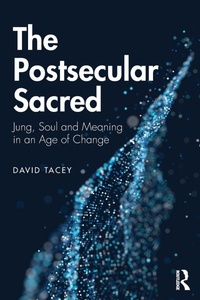
The Postsecular Sacred
Jung, Soul and Meaning in an Age of Change
1st Edition
Published on 11. July 2019
Book
Paperback/Softback
198 pages
978-0-367-20322-1 (ISBN)
Description
In The Postsecular Sacred: Jung, Soul and Meaning in an Age of Change, David Tacey presents a unique psychological study of the postsecular, adding a Jungian perspective to a debate shaped by sociology, philosophy and religious studies. In this interdisciplinary exploration, Tacey looks at the unexpected return of the sacred in Western societies, and how the sacred is changing our understanding of humanity and culture.
Beginning with Jung's belief that the psyche has never been secular, Tacey examines the new desire for spiritual experience and presents a logic of the unconscious to explain it. Tacey argues that what has fuelled the postsecular momentum is the awareness that something is missing, and the idea that this could be buried in the unconscious is dawning on sociologists and philosophers. While the instinct to connect to something greater is returning, Tacey shows that this need not imply that we are regressing to superstitions that science has rejected. The book explores indigenous spirituality in the context of the need to reanimate the world, not by going back to the past but by being inspired by it. There are chapters on ecopsychology and quantum physics, and, using Australia as a case study, the book also examines the resistance of secular societies to becoming postsecular. Approaching postsecularism through a Jungian perspective, Tacey argues that we should understand God in a manner that accords with the time, not go back to archaic, rejected images of divinity. The sacred is returning in an age of terrorism, and this is not without significance in terms of the 'explosive' impact of spirituality in our time.
Innovative and relevant to the world we live in, this will be of great interest to academics and scholars of Jungian studies, anthropology, indigenous studies, philosophy, religious studies and sociology due to its transdisciplinary scope. It would also be a useful resource for analytical psychologists, Jungian analysts and psychotherapists.
Beginning with Jung's belief that the psyche has never been secular, Tacey examines the new desire for spiritual experience and presents a logic of the unconscious to explain it. Tacey argues that what has fuelled the postsecular momentum is the awareness that something is missing, and the idea that this could be buried in the unconscious is dawning on sociologists and philosophers. While the instinct to connect to something greater is returning, Tacey shows that this need not imply that we are regressing to superstitions that science has rejected. The book explores indigenous spirituality in the context of the need to reanimate the world, not by going back to the past but by being inspired by it. There are chapters on ecopsychology and quantum physics, and, using Australia as a case study, the book also examines the resistance of secular societies to becoming postsecular. Approaching postsecularism through a Jungian perspective, Tacey argues that we should understand God in a manner that accords with the time, not go back to archaic, rejected images of divinity. The sacred is returning in an age of terrorism, and this is not without significance in terms of the 'explosive' impact of spirituality in our time.
Innovative and relevant to the world we live in, this will be of great interest to academics and scholars of Jungian studies, anthropology, indigenous studies, philosophy, religious studies and sociology due to its transdisciplinary scope. It would also be a useful resource for analytical psychologists, Jungian analysts and psychotherapists.
Reviews / Votes
"The issues with which this book deals have been attracting increased interest for several decades, and this seems set to continue for the foreseeable future. The question of the place of the sacred in predominantly secular cultures is unlikely to be resolved one way or the other anytime soon." - Roderick Main, University of Essex, UK; author, The Rupture of TimeMore details
Language
English
Place of publication
London
United Kingdom
Publishing group
Taylor & Francis Ltd
Target group
College/higher education
Professional and scholarly
Postgraduate and Professional
Dimensions
Height: 234 mm
Width: 156 mm
Thickness: 11 mm
Weight
324 gr
ISBN-13
978-0-367-20322-1 (9780367203221)
Copyright in bibliographic data and cover images is held by Nielsen Book Services Limited or by the publishers or by their respective licensors: all rights reserved.
Schweitzer Classification
Other editions
Additional editions
E-Book
07/2019
1st Edition
Routledge
€52.49
Available for download
E-Book
07/2019
1st Edition
Routledge
€52.49
Available for download
Book
07/2019
1st Edition
Routledge
€196.00
Shipment within 15-20 days
Person
David Tacey is Emeritus Professor of Humanities, La Trobe University, Australia. He is the author of many books, including The Darkening Spirit: Jung, Spirituality, Religion (Routledge).
Content
Introduction; The Postsecular Condition; Chapter 1: The Postsecular Landscape; Chapter 2: The Mystical Turn; Secularism Under Pressure; Chapter 3: A Secular Country; Chapter 4: The Aboriginal Gift We Will Not Accept; Reanimation of the World; Chapter 5: Ecopsychology and Indigenous Cosmology; Chapter 6: Physics and Reanimation; Postsecular Religion and Atheism; Chapter 7: God After God; Chapter 8: Derrida: Emissary of the Postsecular; Violence and the Sacred; Chapter 8: Return of the Sacred in an Age of Terror; Chapter 10: Epilogue: Sacrifice and the Future; Index